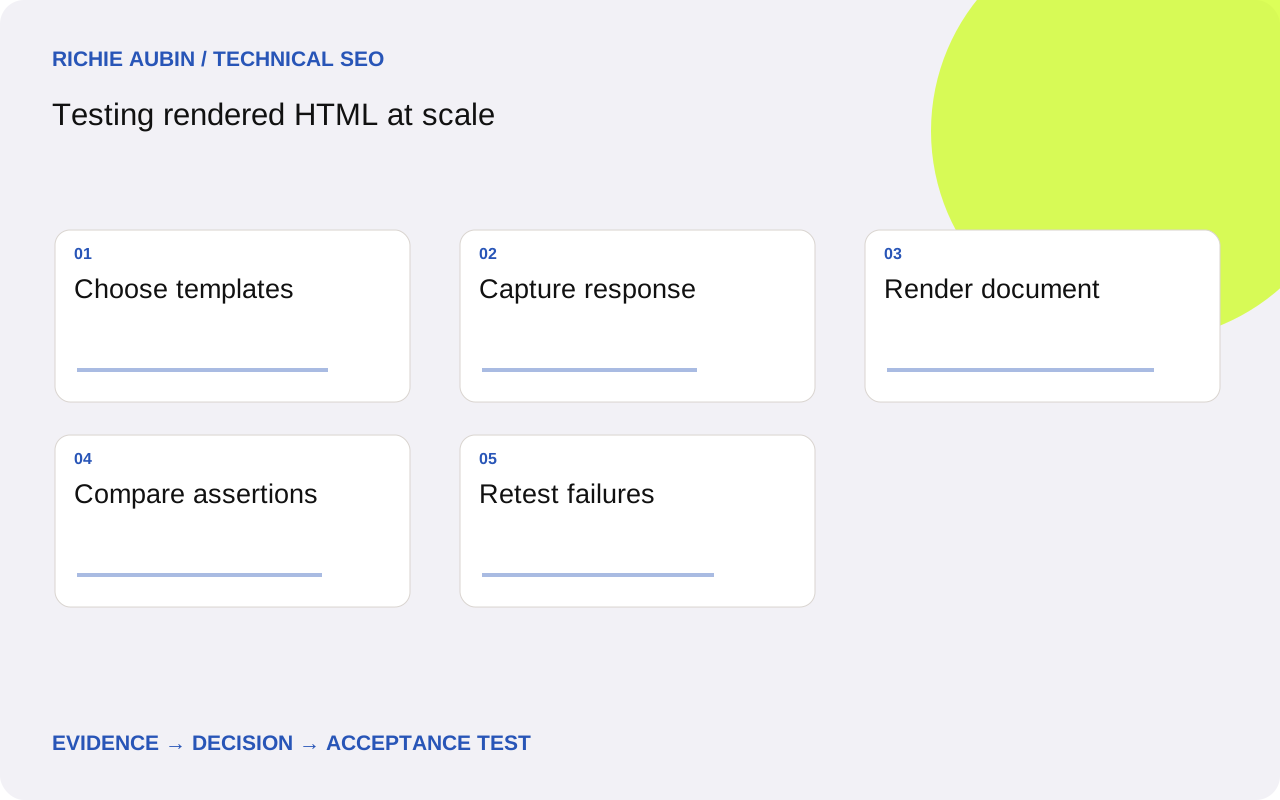
Define the contract before collecting rendered pages
Rendered HTML testing asks whether the document produced after browser processing contains the information a public page is meant to expose. It is a comparison between an expected page contract and observed output. A screenshot is useful evidence, but it cannot establish link destinations, robots directives or the ownership of structured data. Start with assertions that another reviewer can reproduce.
For an editorial template, specify the headline, a distinctive passage from the main body, the canonical URL, expected indexability and important navigation destinations. For a listing, include representative item links and access to subsequent results. Record which elements are essential and which can legitimately vary. Avoid asserting the exact wording of a rotating banner when its presence has no bearing on the investigation.
The JavaScript SEO audit workflow helps select the components worth examining. A successful local render demonstrates that particular execution, under recorded conditions. It does not prove that Google rendered the same version, indexed the page or selected it for a query.
Build a sample that exposes template boundaries
Group URLs by rendering behaviour rather than selecting only the busiest pages. Include direct-entry routes, deeply nested articles, empty listings, pagination, unusually long records and pages recently changed by the release. Add cases with missing optional fields because these often exercise branches that a populated demonstration record conceals.
Keep two populations: a stable regression set and a rotating discovery sample. The stable set makes comparisons across builds meaningful; the rotating set finds new content combinations. Document the sampling rule and its exclusions. Ten passing pages from one template cannot establish coverage of a different application shell or a regional data source.
Set a request budget before running at scale. Limit concurrent browser contexts and avoid creating a load test against production by accident. Cache the URL inventory, but label captured output with its actual collection time. Where a URL redirects, retain both the submitted address and final destination so a successful render does not hide an unexpected routing change.
Capture a reproducible evidence checklist
For every attempted URL, retain the requested URL, final URL, HTTP status, response headers relevant to indexing, raw document body, rendered HTML, capture time and release identifier. Record the browser version, viewport, locale, cookie state and readiness rule. Store a screenshot and console or request failures for exceptions, with personal information removed.
Extract comparable fields from both the original response and the final DOM. Save the title, canonical, robots metadata, primary text markers, ordinary anchor destinations and structured data blocks. Preserve multiple values when duplicates occur rather than silently selecting the first match. A duplicate canonical is evidence, even if a crawler interface displays only one.
Separate collection failures from assertion failures. A browser process that crashes has not established that page content is missing. Likewise, a navigation timeout does not necessarily mean the document was unusable. Record which assertions could run and which remained untested. This distinction makes incident totals credible and prevents infrastructure noise from overwhelming the pages requiring engineering attention.
Choose explicit readiness rules and preserve timeouts
A browser load event, a quiet network and a complete article are different observations. Persistent analytics requests can prevent a network-idle condition; a quiet network can coexist with an empty component. Prefer a bounded readiness rule tied to the template, such as the presence of a published record marker and the removal of its loading placeholder.
Capture an early state and a settled state when startup changes matter. Test fresh direct navigation separately from client-side transitions. Do not add scrolling or clicks to the baseline just to make the body appear. Google generally does not interact with pages in that way, so an interaction-assisted capture should be labelled as a separate diagnostic.
Set a maximum waiting period and report timeouts explicitly. Increasing that period until every page passes erases an important failure mode. If output is inconsistent, save repeated attempts with their conditions. The missing rendered content guide provides a deeper route through resource failures and conditional loading once the sample identifies a reproducible discrepancy.
Test competing hypotheses with controlled comparisons
A missing paragraph may reflect an API failure, a consent dependency, a hydration replacement or an incorrect assertion. Compare the raw response with the final DOM first. If the paragraph exists initially and disappears, investigate client takeover and later state updates. If it is absent throughout, inspect the source record, route resolution and required data requests.
Compare a working sibling on the same build. Repeat with a fresh cache and then a warm cache, changing one condition at a time. A stale asset mismatch needs a different repair from a regionally blocked endpoint. Save request status and response identity rather than assuming every failed request caused the content failure.
Check whether the content is actually inside a frame, a shadow tree or a collapsed component that the extraction method handles differently. A plain text extractor can create false negatives. Use DOM inspection to verify the element and its visibility before assigning the defect. For takeover-specific evidence, consult hydration diagnosis and trace the operation that changed the expected region.
Compare meaning without hiding meaningful differences
Normalise whitespace and known volatile tokens before comparing text, but preserve numbers, destinations and directives that carry meaning. A full-page hash changes when a footer date changes; an over-normalised comparison can miss the wrong product or an outdated price. Prefer a small set of explicit assertions alongside a reviewable content diff.
Resolve relative link destinations against the final document URL. Verify that essential links use anchors with usable href values, and examine targets directly where routing could disguise a broken destination. Treat canonical and robots checks as independent assertions. Finding the headline does not establish that the page identifies itself correctly.
Parse JSON-LD blocks separately so a content pass cannot conceal invalid serialisation. If the response contains noindex, do not rely on JavaScript removing it: Google may skip rendering after encountering that directive. Keep the original response in the report. Where a browser modifies invalid HTML during parsing, distinguish that repair from a later JavaScript mutation before changing application code.
Illustrative worked example: one shared shell, two outcomes
This is an illustrative scenario, not a client result. A guide template serves its headline and body in the original HTML. A proposed regression sample contains twelve records, including two without an optional summary. Direct navigation to those two records leaves a loading panel in the final DOM, although the response contains the expected article text.
Three hypotheses remain plausible: the extractor selects the loading panel incorrectly, hydration removes valid content, or a later data refresh replaces the article. A mutation trace shows the body being replaced after the summary request returns an empty value. The same record renders correctly when that optional field is populated. This narrows the investigation to component state handling rather than crawler access.
The repair keeps the published body independent of optional summary state. Acceptance requires both empty-summary records to retain their text after startup and navigation, while missing required records still show the intended error response. A repeat capture checks fresh and warm caches. These observations demonstrate the repaired contract; they provide no measured search-performance outcome.
Set release acceptance criteria that engineers can verify
Require all essential assertions to pass across the agreed template matrix, with no unexplained removal of primary text, identity metadata or important links. Every exception should carry a captured URL, build, failed condition and accountable owner. Define whether a collection failure blocks release or requires a manual rerun, rather than allowing unknown results to count as success.
Use Google's URL Inspection tools on representative public URLs to examine the output Google can currently fetch and render. Compare that with your own captures without treating the tools as interchangeable. A live test is evidence of a test execution; indexed information may reflect an earlier crawl. Neither is a promise of subsequent indexing.
Track execution duration and failure rate for the test system itself. A growing timeout population can indicate either application deterioration or exhausted test capacity. Keep performance acceptance separate: Core Web Vitals good thresholds are LCP at most 2.5 seconds, INP at most 200 milliseconds and CLS at most 0.1, assessed at the 75th percentile of field visits.
Plan rollback and recognise the limits of the sample
Archive the previous passing assertions and representative captures with the release reference. If deployment removes essential content, restore the responsible application change or disable the faulty component through an established release mechanism. Recheck the public response afterwards. A rollback that restores HTML while leaving incompatible cached assets can retain the original failure or introduce another one.
Avoid reverting unrelated improvements merely because a browser capture failed. First establish whether the fault belongs to the release, the data service or the collector. Where an emergency workaround changes content delivery, document its expiry and test equivalent information for users and crawlers. The regression testing guide explains how to preserve the discovered case in subsequent checks.
Sampling leaves uncertainty around untested routes, devices and data combinations. State that limitation in the handover and expand coverage when a new template or dependency appears. Rendered HTML checks complement accessibility, performance and crawl diagnostics; they do not measure relevance, guarantee rankings or establish which sources an AI system will cite.
Frequently asked questions
Is rendered HTML the same as page source?
No. Page source normally shows the document delivered by the server. Rendered HTML reflects the browser’s parsed document and subsequent changes. Save both when investigating content loss, because the difference helps identify whether delivery, parsing or application execution introduced the defect.
Can a screenshot replace DOM assertions?
A screenshot can confirm visible layout and expose empty regions, but it cannot reliably verify canonical values, robots directives or anchor destinations. Use it alongside structured extractions. If text extraction disagrees with the image, inspect the relevant DOM region before declaring the page broken.
Should every test wait for network idle?
No universal readiness event proves that meaningful content is complete. Choose a bounded condition appropriate to the template and retain timeout evidence. Run interaction-dependent checks separately, so a click or scroll does not conceal a failure in the initial public document.
How many URLs should a release sample contain?
Choose enough to cover materially different templates, data states and entry paths. A small deliberate matrix is more informative than many identical records. Add every confirmed regression as a stable fixture, then rotate additional URLs to discover combinations the permanent set does not contain.
Does a passing render establish indexability?
It establishes only the assertions tested under the captured conditions. Inspect status codes, access restrictions, canonical signals and indexing directives separately. Google’s live rendering tools add useful evidence, but a technically accessible page can still remain unindexed for reasons outside the rendered HTML test.