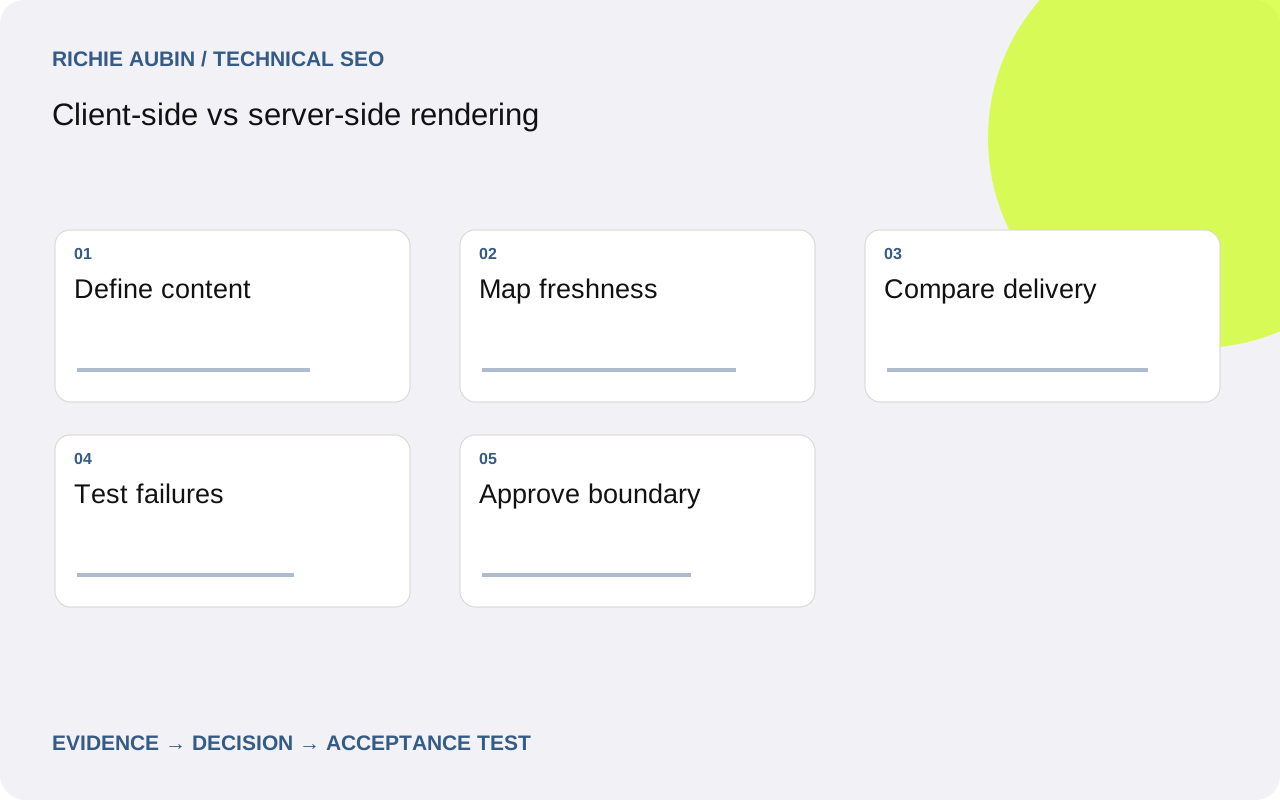
Compare delivery paths rather than framework labels
Client-side rendering builds page content in the browser. Server-side rendering produces HTML on the server for a request. Static generation prepares output before the visit, usually during a build or publishing process. Hydration adds application behaviour to delivered HTML. These terms describe stages and locations of work, not automatic quality ratings.
A route may use several approaches. An editorial introduction can be static, a public availability summary can come from a server response and an account-specific panel can initialise in the browser. Write down those boundaries before comparing frameworks. Otherwise two proposals called server rendering may deliver very different amounts of useful content.
The first decision concerns essential information: what must be present for an anonymous visitor arriving directly from a search result? Separate that from optional enhancements. The JavaScript SEO overview explains the discovery and content requirements that should survive whichever architecture you choose.
Make freshness and failure behaviour explicit
List content fields and their permitted update delay. A service description may tolerate a publishing cycle, while a booking status may need a fresher source. Do not assume every field must share the most demanding freshness requirement. That assumption can move a whole page onto an expensive request-time path unnecessarily.
For each field, define an acceptable failure state. Should the page show a previously published description, omit an optional widget or return a temporary error when essential data is unavailable? Decide this with product and engineering before implementation. A silent success response containing only skeleton components is rarely a useful operational contract.
Add preview, localisation and access requirements. Editorial previews may need authentication even when published content is public. Regional content must have a defined default and consistent URL behaviour. These requirements can outweigh small laboratory differences between prototypes. Record their owners so later optimisation does not accidentally weaken privacy or publish draft material.
Gather evidence for the architecture decision
The evidence checklist should include current response content, API dependencies, bundle execution, document latency, cache hit behaviour and publishing delay. Sample a representative long article, a frequently updated listing and an error route. A single homepage prototype cannot represent every content lifecycle on a large application.
Inspect warm and cold delivery conditions. A cached server response can hide slow origin generation, while a warmed browser can hide the cost of downloading route code. Keep both observations, label their conditions and avoid presenting the better run as a universal benchmark. Any numerical comparison should come from your actual controlled measurements.
Check direct entry and client navigation separately. Browser navigation may reuse data and scripts that a first visit lacks. This distinction is central to hydration diagnosis, where a useful response can still be damaged during start-up. Keep a copy of the initial and final article text before choosing a replacement architecture.
Assess the work each approach moves elsewhere
Browser rendering can keep servers simple but makes public content depend on script delivery, execution and data retrieval. Server rendering can put important information in the response but makes origin work and upstream services part of the delivery path. Static output can simplify serving while moving complexity into publishing, invalidation and rebuild orchestration.
Ask which team owns each new failure surface. A server-rendered route needs timeouts, sensible caching and capacity planning. Static pages need a reliable method for reflecting edits and removals. Interactive pages need robust initial state and clear separation between public content and personalised data. Architecture is incomplete until those responsibilities are assigned.
Avoid treating server-rendered HTML as the end of performance work. Shipping the same large application afterwards can still delay interaction. Use JavaScript performance analysis to examine execution separately. The rendering decision should reduce the dependency chain where justified, while preserving useful behaviour and giving the team observable operational controls.
Test whether rendering location is actually the problem
An empty public response may suggest moving content to the server, but several narrower explanations compete. A route resolver may fail only on refresh. A consent manager may gate a public API. A failed content request may be swallowed. A deployment may serve old HTML with a removed bundle. Those defects can survive an architecture migration if their contracts remain unclear.
Build a small experiment around the suspected dependency. Deliver the essential introduction through an existing server path, or make the direct route initialise correctly without stored state. Compare expected content and failure behaviour. The aim is to test the proposed mechanism, not to win a framework comparison using a polished demonstration page.
If the current implementation can satisfy the requirement with a small repair, document why a broader change is still justified before committing to it. Conversely, repeated failures across independent templates may support a shared delivery change. Keep that conclusion proportional to the evidence and explicitly distinguish confirmed defects from future maintainability concerns.
Illustrative example: split a guide from live availability
Consider an illustrative training website with long course guides and a live availability widget. The current page waits for both editorial and availability APIs before showing anything. When the availability service is slow, the guide remains a loading shell even though its editorial content has not changed. No real performance improvement is implied by this example.
A proposed design publishes the guide as static HTML and treats availability as an independent enhancement. The public page retains its title, description, syllabus and course links when the widget fails. The widget shows a clear unavailable state rather than a misleading offer. Editorial updates trigger publication and cache invalidation through a defined workflow.
A request-time server design could also work, but it would need to prevent the optional availability call from holding the entire response hostage. The comparison therefore turns on dependency boundaries and publishing needs. The team tests a newly published edit, a cancelled course, an unavailable service and an old deep link before deciding which design it can operate safely.
Write acceptance criteria for content and operations
Require meaningful page-specific content on direct entry, correct status handling for missing records and consistent metadata before and after client start-up. If output is generated ahead of time, specify how publication, correction and deletion reach the served page. If output is request-time, specify timeout handling and the intended cache behaviour for public versus private information.
Include failure simulations in acceptance. Disable the optional endpoint, serve an unexpected payload and load a stale cached document. Confirm that the result follows the agreed content contract. Test browser navigation and a hard refresh of the destination. For public routes, copied URLs must not rely on state established by another screen.
Document the prototype’s limits. A successful test on three routes does not prove every locale or template behaves correctly. Expand coverage where delivery rules differ, and use rendered HTML comparisons to verify substantive outputs. Require an engineering owner for invalidation and rollback rather than leaving those tasks as assumptions in an SEO recommendation.
Plan migration and rollback around cached artefacts
A rendering migration can change URLs, metadata ownership, caching and data exposure as well as HTML. Keep the scope narrow enough to review those changes. If different templates move at different times, document which system supplies each route. Otherwise a shared fallback may serve the wrong template while returning a plausible success response.
False positives arise when test environments have different data, weaker traffic or unusually warm caches. An apparent improvement may disappear under normal publishing conditions. Retain comparable baselines and distinguish content availability from visual timing. Neither a better screenshot nor more response text guarantees indexing or improved rankings.
Roll back using a compatible set of HTML, code and cache rules. Keep previous versioned assets available while old documents can still circulate. Check for private data in public cache keys before and after reversal. If considering bot-specific output as a shortcut, review dynamic rendering’s limitations; another delivery branch adds operational obligations rather than removing them.
Frequently asked questions
Is server rendering always faster for visitors?
No. It can deliver useful HTML earlier, but a slow origin or upstream dependency can delay the response. Hydration may still add substantial browser work. Measure the full journey under representative cache and device conditions. A rendering label does not substitute for observations of content delivery and interaction.
When is static generation a sensible choice?
It suits content whose freshness can be managed through a defined publishing process. Check build duration, invalidation, deletions and regional variants before choosing it. The key question is whether a correction reaches users reliably within the agreed window, including when only part of a build or purge succeeds.
Can a public site mix rendering strategies?
Yes. Assign strategies to routes or components according to their content and operational requirements. Keep public information independent from optional personalised widgets where possible. Document ownership so shared metadata, caching and navigation behave consistently across the boundaries. Verify direct entry on both sides of any split.
What evidence would justify a full rendering migration?
Look for a repeated delivery problem that a shared architectural change directly addresses, alongside a workable operational plan. Compare that proposal with smaller fixes. Include engineering cost, failure handling and release risk. Do not justify a migration solely through a general claim that search engines prefer one named approach.