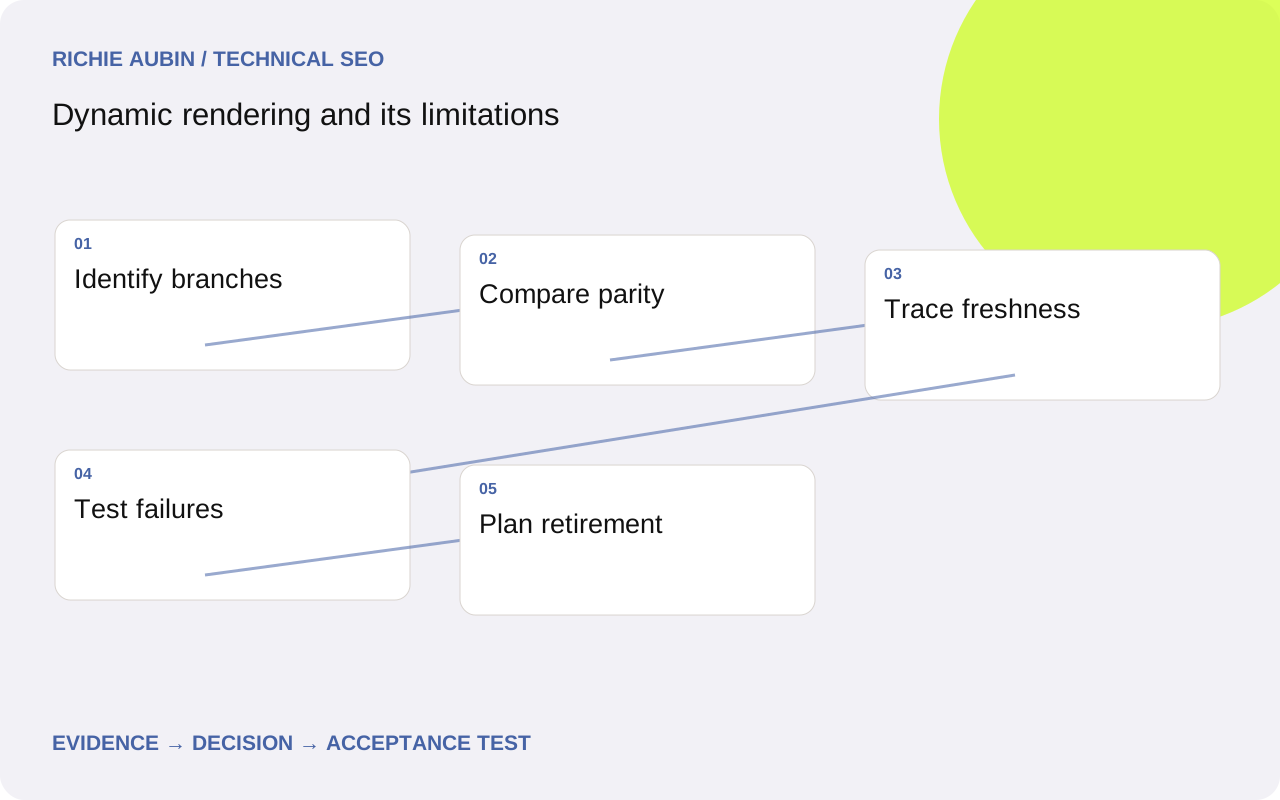
Distinguish dynamic rendering from shared server rendering
Dynamic rendering detects selected crawlers and sends them a rendered representation while ordinary visitors follow a different delivery path. Shared server rendering instead delivers useful HTML through the normal public route. The distinction matters because a separate branch needs its own freshness, failure handling, access policy and deployment verification.
Google’s guidance treats dynamic rendering as a workaround and recommends other rendering approaches for durable solutions. That does not justify switching off an inherited service without investigation. It may currently supply essential information that the visitor application cannot reliably expose to a renderer. First establish what depends on it and why it was introduced.
Use client-side versus server-side rendering to evaluate alternatives. The goal is a reliable public content contract with manageable operational cost. Removing a service is not progress if the same URLs then return incomplete content, incorrect statuses or metadata belonging to a generic application shell.
Inventory routing, ownership and supported URLs
Find the routing layer that chooses a representation. It may live in an edge rule, reverse proxy, application middleware or third-party rendering service. Record the matching logic, the route scope, exclusions, cache keys and service owner. Do not assume a crawler user-agent string is the only relevant input.
List which templates use the branch and what the rendering service can access. A renderer with private network access may produce content unavailable through the public visitor path. That requires a deliberate review of public information boundaries. Keep authentication secrets out of saved traces and establish whether the rendered artefact contains anything that should remain restricted.
Check redirects and missing routes as well as successful pages. A bot branch may bypass a normal redirect or turn every unknown address into a cached success document. Include those cases in the inventory because they can persist unnoticed when monitoring checks only whether the rendering endpoint returns a nonempty HTML body.
Build a parity evidence checklist
For matched URLs, collect the visitor response, visitor rendered document and crawler-branch response. Save statuses, final URLs, titles, canonical targets, directives, main content, essential links and structured data. Record timestamps, deployment identifiers and cache age where available. These three views reveal differences that a two-response comparison can miss.
Compare meaning rather than byte equality. Different wrappers or script tags can be expected, while a changed offer, missing warning or different article body is substantive. Define which fields must agree and how fresh they must be. Use page-specific identifiers to avoid accidentally comparing two different records with similar headings.
Inspect a deliberately revised record and a removed record. Verify how quickly each representation reflects the approved change through the actual invalidation process. A fresh service test may bypass a stale edge cache, so retain observations from the served route too. The evidence should explain what visitors and selected crawlers receive, not merely what the renderer can generate.
Separate parity defects from detection and cache defects
If a crawler branch looks wrong, possible causes include failed detection, an old snapshot, renderer navigation to the wrong URL, blocked dependencies or a visitor application defect inherited by the snapshot. Test the branch selection first, then inspect the generated artefact and its served cache entry. That ordering avoids debugging code that was never executed.
Do not treat a spoofed user agent as proof of Google’s exact experience. It is useful for testing your own routing rule, but real requests may traverse different security or caching conditions. Use relevant Google testing output where available and explain what the local branch test establishes. The rendering pipeline guide covers that evidence boundary.
Keep infrastructure failures distinct from content differences. A renderer timeout, an exhausted queue and a stale snapshot need different fixes. Increasing the generation timeout may worsen service pressure without addressing a blocked content request. Record whether failure produces a controlled error, an old page or an empty success response before choosing the operational response.
Review content parity without turning it into a loophole
Google distinguishes rendering workarounds from deceptive content differences when representations are substantially similar. Treat that as a requirement for honest delivery, not permission to manufacture a more persuasive crawler-only page. The public article, identity, offers and restrictions should remain consistent with what ordinary visitors can access.
Compare essential claims and destinations across the branches. A stale price or withdrawn service is meaningful even if both pages share a title. Structured data must also describe the served content. The renderer should not add unsupported reviews, identities or hidden explanations that the normal page lacks simply to make a test show more extracted information.
Document intentional differences narrowly, such as omitted interactive controls that do not change the underlying information. If an omission affects what a visitor can understand or do, assess it explicitly. A parity review needs human judgement as well as extraction. Automated text overlap can miss a small but decisive difference in eligibility, availability or a legal restriction.
Illustrative example: a stale bot snapshot survives a withdrawal
Consider an illustrative course directory. A course is withdrawn in the CMS, and the visitor application shows a replacement notice. The crawler branch still serves the old course description and enrolment link. Possible causes include failed rendering, incorrect route selection, a missed purge and an outdated source feed. These conditions are illustrative, not reported client results.
The renderer generates the correct replacement when invoked directly, and route selection reaches the intended service. The edge cache retains the earlier snapshot because the withdrawal event purges only the visitor response. This evidence supports an invalidation gap rather than a need for longer rendering waits or a different bot-detection expression.
The repair connects withdrawal handling to every served representation and tests stale-cache recovery. Acceptance includes both public branches, the destination status and any structured data describing the course. A longer-term proposal moves the stable course explanation into shared public delivery, but that migration is reviewed separately so it does not delay correcting the confirmed stale information.
Set acceptance for operation and eventual retirement
For an inherited service that must remain temporarily, require equivalent essential content, correct statuses, intended directives and controlled cache separation. Define freshness and invalidation behaviour for edits, withdrawals and redirects. Include service failure and dependency failure in acceptance, with explicit rules for whether an older public snapshot is acceptable.
Set ownership and a review condition for retiring the branch. A useful retirement criterion is that the normal delivery path consistently provides the required content and links across representative routes without the workaround. Avoid an arbitrary removal date disconnected from that dependency. Compare the replacement using rendered HTML tests with the same content assertions.
Roll out the replacement to a bounded route group and preserve evidence from both paths. Keep a clear configuration map so engineers know which system owns a failing URL during the transition. Use release QA to verify cache rules, direct entry and failure states in production before extending the migration.
Plan reversal without mixing representations
Rollback can restore the detection rule while leaving the wrong cache contents behind. Preserve configuration versions and know how to purge or version each representation. Keep the previous renderer and its compatible application assets available while the transition is reversible. Test a cached old document as well as a freshly generated one.
False positives include harmless wrapper differences and tests that bypass the production routing layer. False negatives include small content changes hidden by broad text similarity and cached successes that conceal generation failures. Pair automated assertions with a focused human review of the fields that matter to the page’s purpose.
Do not promise that replacing dynamic rendering will improve rankings, force indexing or eliminate every rendering problem. The concrete benefit should be a simpler, verified delivery contract and fewer independently maintained branches where the evidence supports that conclusion. Continue checking public content after retirement; removing a workaround changes dependencies rather than making them disappear.
Frequently asked questions
Is dynamic rendering the same as server-side rendering?
No. Dynamic rendering selects a separate representation for certain crawlers, while shared server rendering supplies useful HTML through the ordinary public route. Both may involve server execution, but the separate branch creates additional routing, parity and freshness obligations. Inspect the actual delivery configuration rather than relying on how a service is marketed.
Should an existing dynamic rendering service be removed immediately?
First establish what it currently supplies and whether the normal route meets the same content contract. Remove it through a tested migration with rollback and cache controls. An inherited workaround may be undesirable long term while still covering a real dependency that must be repaired before retirement.
Can a crawler-only version contain extra explanatory text?
Do not use the branch to present materially different information. Review whether the normal public page exposes the same essential content, claims and destinations. Differences in interactive controls may be reasonable, but added crawler-only claims require scrutiny. A parity test should compare meaning and access rather than simply count matching words.
How can I tell whether the snapshot cache is stale?
Trace a known content revision through generation, storage and served delivery. Compare record version, cache age and visible text in both branches. Invoking the renderer directly may show a correct new page while the public route still serves an old snapshot. Test the actual invalidation event, including withdrawals and redirects.