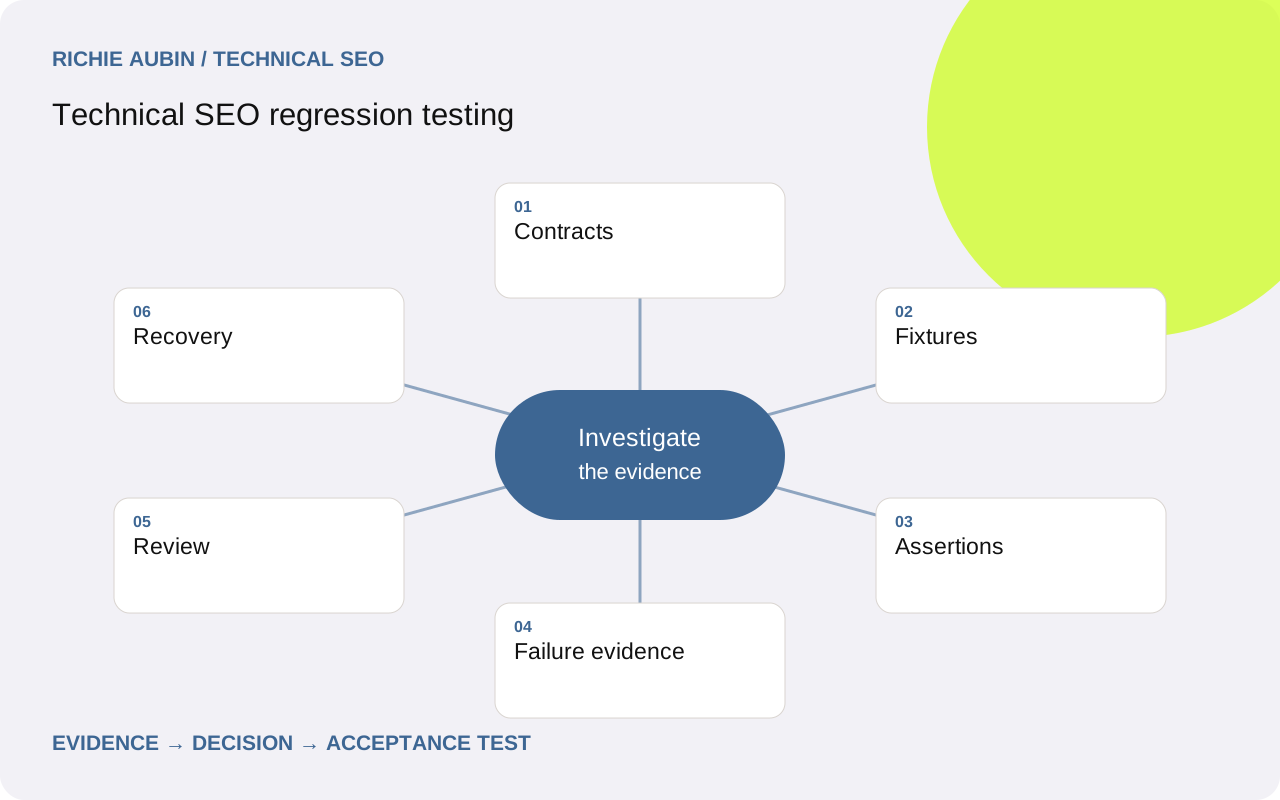
Turn important behaviours into testable contracts
A regression is an unintended loss of previously required behaviour. Start with requirements that engineering and content owners recognise: a public article resolves directly, a retired route redirects to its replacement, a preview stays protected, and a section exposes links to its published children. Each contract needs an expected state and a test capable of observing it.
Do not simply preserve every attribute in yesterday’s crawl. Yesterday’s output may contain an existing defect, while tomorrow’s release may intentionally alter the title or navigation. Write assertions against the intended publishing and routing model. Historical observations provide comparison evidence, but they are not automatically the specification.
Separate permanent contracts from checks for one deployment. SEO release QA evaluates the risks of a particular change; the regression suite repeatedly protects established rules. A confirmed release defect should become a targeted assertion when its mechanism can be represented reliably. This creates a growing record of meaningful requirements rather than a growing list of tool warnings.
Choose the cheapest layer that can observe the failure
Test deterministic output generation close to the code where practical. For a PHP site, a template check can verify that a supplied public record produces the intended canonical and title. It cannot establish that the web server serves the correct status or that a deployed edge layer preserves headers, so add integration checks for those responsibilities.
Use HTTP checks for status codes, redirect chains, headers and original document content. Use browser checks when behaviour depends on script execution, interaction or layout. Reserve broader crawls for discovery paths and inventory relationships. Running every assertion in a browser adds cost without improving questions that a direct response can answer.
Keep a small production smoke suite because build tests cannot represent every deployed configuration. Treat synthetic requests as observations under specified conditions, not an imitation of every Google processing step. A spoofed crawler user-agent does not prove how Google rendered or indexed a page. Record the distinction between your test environment and the search evidence you may inspect later.
Maintain fixtures that represent awkward states
Create a fixture register linking each sample to a failure mode. Include a normal article, a record with punctuation in its slug, a nested route, a long title, an optional field left empty, an old redirect and an unknown URL. If language variants or pagination exist, represent the rules controlling those outputs rather than merely adding more ordinary pages.
For generated sites, use controlled records for repeatable template tests and a separate rotating sample of real published URLs. Controlled fixtures stabilise expectations; rotating checks reveal content shapes the fixtures missed. Label which type produced a failure so an intentional editorial change is not mistaken for a rendering defect.
Keep preview and missing-page controls permanently. Otherwise a suite aimed only at public success can reward a change that makes every route return an article-shaped 200 response. Review fixture relevance after route, CMS or content-model changes. Record retired fixtures and their replacements so apparent improvements in pass rate cannot hide a reduction in difficult coverage.
Assert semantics instead of entire document snapshots
Prefer focused assertions: the expected canonical exists once, no unintended restrictive directive appears on a public record, the primary content marker is present, and required links point to valid destinations. Exact matching of an entire document is usually too sensitive to harmless whitespace, build identifiers and editorial updates.
Normalise only values whose differences are irrelevant to the requirement. Do not lowercase entire URLs or discard all query parameters by default; those transformations can hide real routing distinctions. Parse HTML with an HTML parser rather than relying on a regular expression to understand nested markup. Preserve the original response for diagnosis.
For a controlled fixture, an escaped expected fragment might be <link rel="canonical" href="https://example.com/guides/checks/">. The hostname is illustrative, and the assertion should compare the parsed target with configured expectations. Check annotations as emitted preferences, not as proof of Google’s selected canonical. Use the automated indexability checks guide when designing the wider rule model.
Cover discovery, structured data and experience selectively
Test discovery from known parent pages, not solely by requesting a list of children. A child can return correct content while losing every useful internal route. Verify required destinations are exposed through anchors with resolvable href attributes. Compare link sets against the publishing inventory, allowing intentional exclusions and documenting how those exclusions are decided.
If templates emit structured data, parse the output and check the properties needed by the chosen model. Compare factual values with visible content and review current Google feature requirements separately from vocabulary validity. FAQ rich results were retired in May 2026; retaining useful questions does not create eligibility for that retired appearance.
Add stable performance budgets for relevant templates, then use performance regression monitoring for production experience. Good field p75 thresholds are LCP at or below 2.5 seconds, INP at or below 200 milliseconds and CLS at or below 0.1, assessed for mobile and desktop separately. Laboratory tests support investigation; they cannot declare a field pass or guarantee ranking improvements.
Preserve evidence and test competing hypotheses
A failing test needs an actionable evidence packet. Capture the fixture identifier, expected state, assertion version, commit or release identifier, request timestamp, final URL, response chain and relevant output excerpt. For browser failures, add runtime errors and the state at which the assertion ran. Include the runner version and configuration when they affect reproducibility.
- Check whether the application output violates the contract.
- Check whether the fixture changed intentionally or lost required source fields.
- Check whether caching, authentication or security treatment changed the response.
- Check whether a parser, selector or runner upgrade changed the observation.
These are competing hypotheses, not interchangeable explanations. Compare an affected fixture with a stable control, inspect raw output and repeat under one changed condition. If a browser selector fails while the required text remains in valid markup, investigate the selector before changing the website. Keep unknown and failed states distinct: a runner timeout does not establish an absent canonical, and a skipped check does not pass.
Illustrative worked example: a broken canonical fallback
Illustrative worked example: a fictional PHP publishing site derives canonical URLs from a route table. Its fixture suite includes an ordinary guide, a nested guide, a legacy redirect and a private preview. A refactor changes the fallback used when a nested route lookup returns no value. All requests still return plausible pages.
The nested fixture fails because its canonical now targets the section root. Possible causes include incorrect source data, an overbroad normalisation rule and a stale response. The source record retains its full path, a fresh template render reproduces the target, and the ordinary control remains correct. These observations isolate the fallback branch rather than the edge cache.
The developer repairs that branch and adds an assertion for a second nested depth. Acceptance requires both nested fixtures to emit their intended targets, the ordinary guide to remain unchanged, and redirect and preview controls to preserve their expected states. This invented example demonstrates test design and diagnosis; it makes no claim about client results, indexation speed or traffic recovery.
Define implementation acceptance criteria and failure policy
A new suite is ready when another maintainer can run it, identify its coverage and reproduce an actionable failure. Specify environment setup, fixture source, time limits and ownership. Introduce a safe deliberate fault in an isolated test context to verify that the relevant assertion detects it. Then remove the fault and confirm the expected pass.
Gate deployment on deterministic high-consequence contracts such as unwanted public noindex, incorrect route destinations or missing primary content. Keep slower exploratory checks separate where they cannot produce reliable decisions within the release window. Publish counts for passed, failed, skipped and unknown checks, with sample membership, so aggregate success cannot conceal incomplete execution.
Use bounded retries for plausible transient failures and retain the initial result. Repeatedly rerunning until green hides intermittent defects. A quarantined test needs an owner, explanation and review date; quarantine is reduced coverage, not resolution. Connect pipeline rules with issue prioritisation so blocking decisions reflect consequence and confidence instead of the loudest tool warning.
Review baseline changes, rollback risk and limitations
Treat expected-output changes as reviewed changes to requirements. A baseline update should explain the intended new behaviour, affected fixtures and why the previous assertion no longer applies. Do not approve a bulk snapshot refresh merely because it removes failures. Preserve a readable difference so reviewers can see lost links, changed directives and altered destinations.
Prepare recovery for both site changes and testing changes. A parser upgrade can create misleading failures, but reverting the parser may also remove useful detection. An application rollback may conflict with newly published records or restore an older route defect. Identify compatible versions and verify the same protected contracts after any reversal rather than assuming the previous build is safe.
Keep limitations visible: fixtures cannot represent all content, laboratory conditions differ from field experience, and search systems make decisions beyond your assertions. Production technical SEO monitoring complements prevention by observing deployed behaviour. A passing suite supports confidence in the tested contracts; it does not guarantee crawling, indexing, rankings, rich results or AI citations.
Frequently asked questions
What should the first regression suite contain?
Start with a few high-consequence contracts: public response status, intended canonical, absence of accidental restrictive directives, primary content and a required discovery link. Add a missing route and a protected preview as negative controls. Choose fixtures for distinct rules, then expand after confirmed incidents or changes to the publishing model.
How is regression testing different from monitoring?
Regression tests compare expected behaviours with output during development or deployment, often using controlled inputs. Monitoring observes production over time, including changing content and infrastructure. They can share rules, but their evidence and response timing differ. A build can pass while a later edge change breaks production, so both layers have useful roles.
Should every metadata change fail the build?
No. A controlled fixture can justify an exact expectation, while live editorial metadata often changes legitimately. Check required properties and agreed uniqueness rules where relevant, then review meaningful differences. Do not enforce an arbitrary universal title length as if it were an indexing requirement. The contract should reflect the site’s actual publishing needs.
How should flaky browser tests be handled?
Capture the first failure, identify whether waiting conditions, unstable fixtures or real intermittent behaviour caused it, and use limited retries only when justified. Replace broad timing assumptions with an observable readiness condition. Quarantine unresolved checks with ownership and an expiry, and report the lost coverage rather than treating the suite as fully healthy.
Can a regression suite prove that Google will index a page?
No. It can verify selected technical conditions under recorded circumstances. Google may still choose another canonical or decide not to index an eligible page. Use live response checks to establish current behaviour and later search evidence to investigate search processing. Neither valid structured data nor a passing test promises a particular search appearance.
Technical references
- Google Search Central: Canonical URL signals and implementation
- Google Search Central: Crawlable links and anchor text
- Google Search Central: JavaScript SEO basics and rendering limits
- Google Search Central: Structured data quality guidelines
- Google Search Central: Documentation updates and FAQ retirement
- web.dev: Core Web Vitals and field assessment
- MDN: HTTP cache behaviour and validation