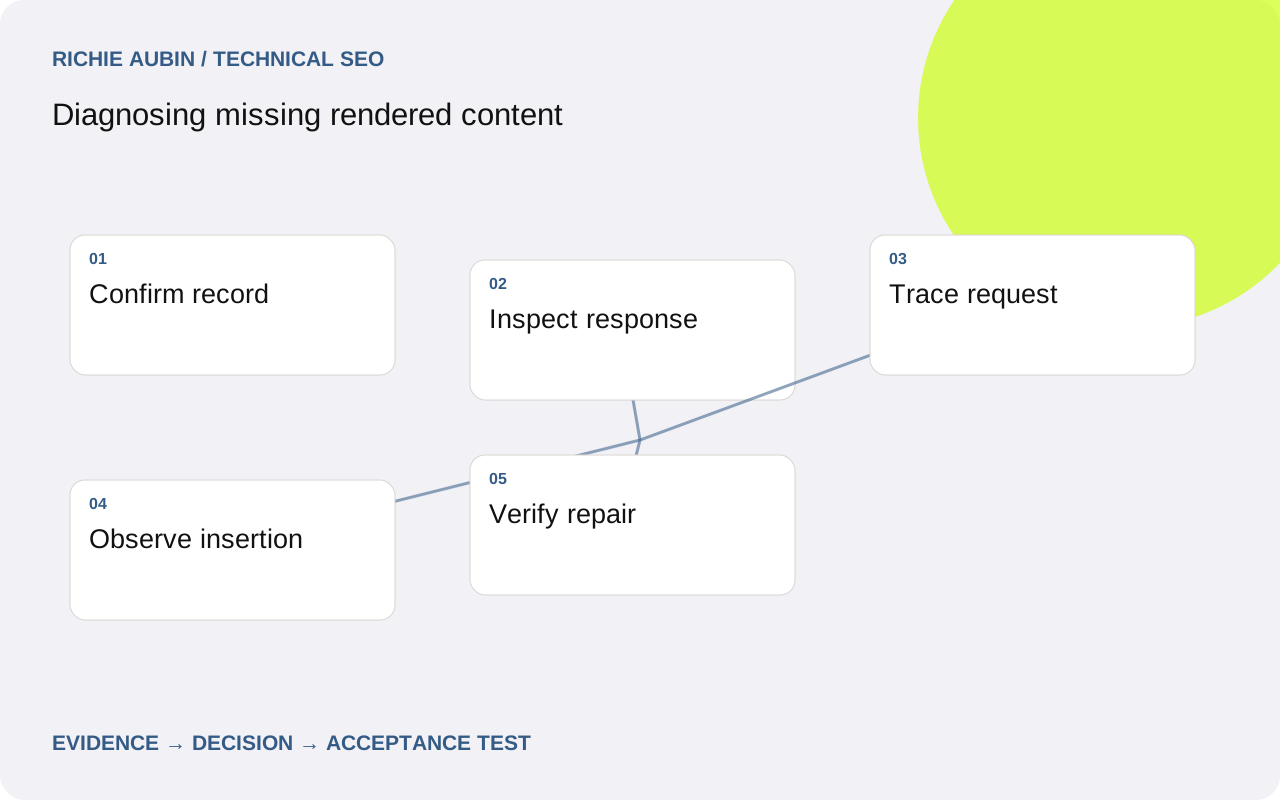
Define exactly which content is missing
Choose a distinctive sentence or field from the expected public record. Record the URL, locale, publication status and template. “The introduction beginning with this sentence is absent” gives the investigation a stable target. “The page looks thin” is harder to test and can mix a content-quality judgement with a delivery defect.
Confirm that the material should be available anonymously. An editorial preview, member-only field or unpublished translation may correctly be absent. Check the approved public record with the content owner before changing delivery rules. Exposing private content is not an acceptable way to make a crawler comparison pass.
Separate missing text from hidden presentation. Inspect whether the sentence exists in meaningful DOM text, an embedded data object or nowhere in the document. CSS visibility, an overlay and a failed insertion are different conditions. Use Google’s rendering model for context, but make the page-specific content requirement the basis of the investigation.
Save a compact but complete evidence checklist
Collect response status, final URL, response HTML, rendered HTML, screenshot, console output and the essential content request. Record the build version, timestamp, viewport, cookie state and whether entry was direct or through the application. Keep the expected sentence beside these artefacts so a second investigator can follow the same trace.
Use a fresh context and a known working sibling. If the sibling has the same delivery dependencies but different data, compare payload structure and publication fields. If both fail only in the automated environment, test whether rate limiting, security controls or test configuration explain the difference before declaring a template-wide production defect.
Capture the failure before clearing caches or repeatedly refreshing. Those actions can remove the evidence of stale assets or intermittent requests. You can then rerun deliberately under clean conditions. Record both outcomes rather than presenting a successful retry as proof that the original failure was imaginary or that the underlying fault has been repaired.
Follow the record through the data boundary
Start with the published source record. Does it contain the expected text in the intended locale? Then inspect the payload delivered to the browser. Check for an empty body, unexpected nesting, permission flags or a fallback record. A success status does not prove that the endpoint returned the correct content.
If the browser receives an error document disguised as data, preserve that body and identify the access boundary. If the correct data arrives, locate the component that selects and inserts it. A field rename can produce a clean request and no console exception while leaving the main content blank. The data contract is therefore part of the diagnostic evidence.
Do not copy a developer’s authenticated request and assume it represents public access. Repeat with a clean session through the same public path. Protect credentials and personal data when saving traces. The useful artefact is the minimum response needed to demonstrate the mismatch, not an indiscriminate export of account or request information.
Inspect gates, timing and replacement separately
A component may wait for consent, a click, viewport observation, geolocation or previous route state. Identify the exact condition that starts the content request. Waiting longer will not help if the condition is never satisfied. Test each gate deliberately and determine whether it belongs on essential public content or only on an optional feature.
Where the request starts automatically, inspect insertion and subsequent updates. Does the text appear briefly and then vanish? Does a late response overwrite a newer route? Does a shared loading flag clear the entire article? These transitions point to state management rather than a failure to retrieve content in the first place.
The hydration guide is especially relevant when the response already contains the correct body. For interaction-dependent loading, distinguish content already delivered inside a collapsed panel from content fetched only when someone opens it. The latter creates a dependency that a no-interaction rendering check will not exercise.
Use competing hypotheses to choose the next test
Keep a short hypothesis table in the investigation notes, even if the final ticket uses prose. For absent source data, inspect the CMS record. For blocked delivery, inspect the anonymous payload. For failed insertion, inspect the selector and component state. For later replacement, compare snapshots across startup. Every hypothesis should predict an observable difference.
Test timing only when the evidence supports it. Capture the same content marker at defined application states and record unresolved requests. Avoid choosing an arbitrary long delay and calling any eventual appearance a complete fix. A fragile dependency may still fail under normal network variation or after a different route sequence.
Check HTTP status handling when the missing body is actually an error state. A genuine unknown record should not masquerade as a useful public article. Conversely, a temporary dependency failure should not be cached indefinitely as if the record had been permanently removed. Agree those distinctions before implementing fallback behaviour.
Illustrative example: the body arrives under the wrong field
Consider an illustrative advisory site after a CMS change. Published guides retain headings and author details, but their explanatory text is absent. One browser still appears correct because it has cached data. Plausible causes include unpublished records, a blocked endpoint, a new payload shape and a component hidden by a stylesheet change.
The fresh response payload contains the expected introduction under content.body, while the component reads article.body. The DOM has an empty article container and no hidden copy. A working older cached payload uses the previous field. Together these observations support a data-contract mismatch rather than an indexing problem or a styling failure.
The repair updates the agreed data adapter and adds a controlled response for malformed records. Verification includes old and new content, multiple locales, an intentionally absent body and fresh browser entry. The example supplies no traffic or indexing claim. Its purpose is to show how a precise field-level observation can support a smaller, reviewable change than replacing the rendering system.
Require the correct body under representative conditions
Acceptance should identify the page-specific text, its semantic location and the conditions under which it must appear. Test a copied deep link, refresh and navigation from another route without stored preferences. Confirm that metadata and body belong to the same record. Include an unavailable-data case so empty success states do not return through the fallback path.
If response content is part of the repair, verify it survives startup. If the repair remains browser generated, verify the necessary requests work anonymously and do not require user interaction. Keep optional personalisation outside the essential-content requirement. This makes the contract explicit without prescribing a particular framework or implementation strategy.
For a shared component, run rendered HTML checks across representative templates and data variations. Store the expected content marker with each test rather than searching for a generic paragraph element. A paragraph container can exist while holding only a loading message, an error or text from the previous route.
Recognise false alarms and protect the rollback path
A crawler timeout can mimic a missing body, while a local cache can conceal it. CSS clipping may make a screenshot look incomplete even though the text is in the document. An embedded JSON copy can make a naïve text search appear successful without showing the article. Inspect the semantic location of the match before deciding whether the page passes.
Treat intermittent outcomes as evidence requiring narrower observation. Compare failing request identifiers, deployments and cache states. Do not average a missing article away because most retries work. Equally, avoid claiming all pages are affected from one failed resource call. Record the confirmed scope and explain where coverage remains uncertain.
Retain the previous adapter, application build and content-version compatibility information. Rolling back code after the CMS has changed can recreate the same mismatch. Agree whether rollback also needs a data transform or compatible payload version. After repair or reversal, verify fresh public delivery again; a return to the previous release number is not itself evidence that the article is readable.
Frequently asked questions
The API returns the text. Why is the page still incomplete?
The application may read the wrong field, reject the record, wait for another condition or overwrite the content later. Trace the expected sentence from payload to meaningful DOM text. Inspect both insertion and subsequent updates. Correct data delivery narrows the problem but does not prove that the public article presents it.
Does hidden accordion content count as missing?
Determine whether the content is already delivered in the document or fetched only after activation. A collapsed presentation is a different issue from absent content. Inspect the actual markup and the expected user behaviour. Do not infer availability solely from whether a screenshot shows every answer expanded.
Why does clearing cookies reproduce the failure?
Stored state may supply a locale, identifier, consent event or cached record that the direct-entry path fails to establish. Compare the relevant values one at a time. The correction should provide an appropriate public default or initialise from the URL, while preserving legitimate restrictions on private and personalised information.
Should missing content always be moved into the initial HTML?
That can reduce dependencies, but first identify the actual failure. A route or payload defect may require a targeted repair, and a server-rendered response can still be overwritten later. Choose the delivery boundary deliberately and verify both the response and final state. Avoid a migration that leaves the faulty data contract unchanged.