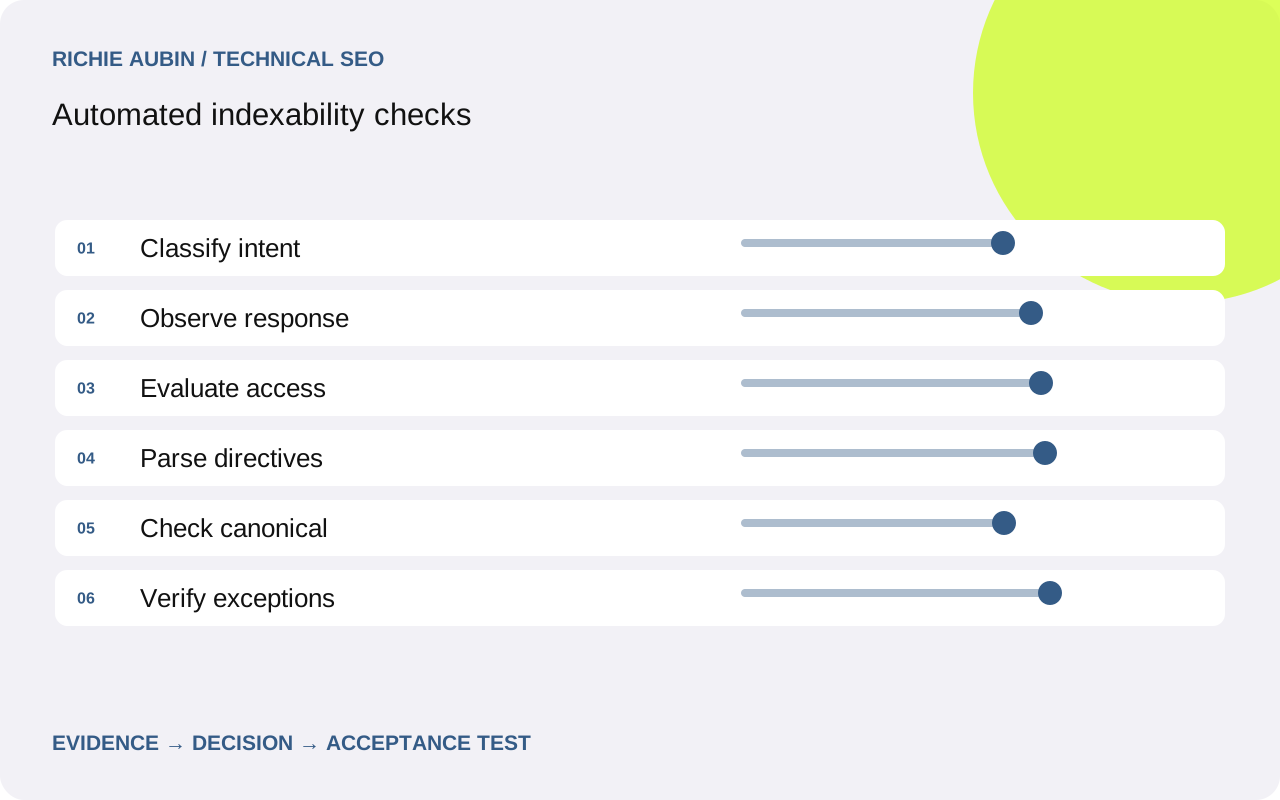
Define indexability as an explicit local expectation
An automated indexability check evaluates observable technical conditions against a declared publishing policy. It should identify whether a public URL meets the site’s expected retrieval, directive and canonical behaviour. It cannot reproduce every decision in Google’s indexing systems. Name the result technical compliance or a similarly precise label rather than presenting a green badge as proof of inclusion.
Create an inventory that distinguishes public content, intentional duplicates, excluded utility pages, previews and retired routes. Attach the intended state before collecting responses. The same noindex directive can be a serious public-template regression or a correct exclusion. Unknown intent should trigger review rather than defaulting every URL to public and indexable.
Record what is required for each class. A preferred public page might need successful content, permitted crawling, no applicable noindex and a canonical policy consistent with its identity. A duplicate variant may legitimately point elsewhere. Use robots.txt versus noindex to keep crawl permission separate from indexing instructions. The rules should preserve these distinctions rather than compressing them into one unexplained Boolean.
Observe the requested URL and every retrieval outcome
Save the requested URL, effective host, request time, response status and any redirect journey. A client that automatically follows redirects can show a final 200 while hiding that the original public page now moves somewhere unrelated. Evaluate the source’s expected behaviour and the final content independently. Keep timeouts, DNS failures and actual HTTP errors distinct.
Inspect representative response bodies, not only status codes. A successful response can contain an access challenge, an empty shell or an error message. Detect template-specific content markers and route mismatches where they can be defined reliably. Generic word-count cut-offs are weak substitutes for understanding what the page should contain.
Set collection limits and preserve incomplete observations. A timeout does not establish that the page is non-indexable. A crawler-facing block can also differ from an ordinary browser session. Record user agent, authentication state and rendering mode so equivalent requests can be repeated. If the collector hits protective infrastructure, investigate that condition before labelling the entire inventory as a website publishing failure.
Evaluate robots rules and page directives independently
Check the relevant robots.txt rules using a parser that models the intended crawler’s supported behaviour. Preserve the robots response, selected group and matched rule. A crawl restriction does not by itself guarantee that a URL stays out of search results. Do not treat a blocked request as evidence that the inaccessible page contains no noindex instruction.
For retrievable pages, collect applicable robots meta values and X-Robots-Tag headers. Preserve multiple declarations and crawler-specific targeting. Conflicting applicable rules must not be simplified by selecting whichever value looks most permissive. Record the raw declarations and the evaluated result so a reviewer can explain the classification from the evidence.
Support non-HTML resources through their headers rather than assuming every indexable resource has a document head. For public HTML, an escaped example of an unintended exclusion is <meta name="robots" content="noindex">. The checker should report where it found the instruction and which expectation it violates. It should not recommend deleting every exclusion rule across the site without checking publishing intent.
Check canonical relationships and rendering differences
Extract canonical declarations without overwriting the requested URL. Resolve relative references correctly, retain multiple values and inspect the declared target when required by the site’s policy. A self-referencing canonical is not a universal prerequisite for indexing. A different target can be intentional for duplicate content, but an unexpected target on a distinct public page needs investigation.
Compare server-delivered and rendered HTML when JavaScript can alter directives, canonicals or essential content. Preserve the two observations separately, with a defined rendering readiness condition. A late browser mutation does not prove that Google will observe the same final state. In particular, do not rely on JavaScript removing an initial noindex instruction from content intended for indexing.
The canonical guide explains preference signals and their limitations. Use rendered HTML testing for controlled comparisons across templates. A useful checker reports the exact inconsistency, such as a canonical changed during hydration, rather than announcing that the entire page is definitely excluded from Google.
Evidence checklist and competing hypotheses
Each finding should carry the URL’s intended class, inventory version, observation time, request settings, status journey, robots decision, raw directives, canonical values and a response reference. Include the rule version and collection completeness. Record whether a condition was observed, absent in an inspected response or unavailable because retrieval failed. These are different evidence states.
For unexpected noindex, test a preview-condition leak, a genuine editorial exclusion and an incorrect environment. Compare publication records, response host and template membership. For a canonical mismatch, test intentional duplication, a route-construction defect and a stale cache. Request an affected page and a suitable control under equivalent conditions before escalating.
For missing content, consider an empty API response, a render timeout and an actual deletion. Compare initial HTML, resource failures and the application’s publication inventory. A scanner should organise these hypotheses, not silently choose the most alarming one. Keep intentional exceptions with a reason, owner and review date, so a temporary workaround does not become an unexplained permanent suppression.
Illustrative worked example: detect a PDF header regression
Illustrative worked example: a fictional professional body publishes 200 public guidance PDFs and maintains 40 private draft documents behind authentication. The public PDFs should remain retrievable without an exclusion header. These invented counts demonstrate a checking method; they do not represent a client project or a prediction of search outcomes.
A new server rule adds X-Robots-Tag: noindex to 25 public PDFs. The collector saves successful responses and the exact headers. Investigators test three explanations: a deliberate archival policy, a broad file-extension rule and an inventory that accidentally includes drafts. Publication records confirm public intent, while unaffected HTML pages help narrow the likely configuration scope.
Suppose a directory-level header rule is confirmed. The repair limits that rule to its intended population, while draft access controls remain intact. Acceptance requires clean public PDF headers, expected content and continued authentication for private files. The automation verifies current responses after deployment. Google’s later recrawling and recorded indexing state are monitored separately, with no promise that all technically eligible PDFs will enter search results.
Specify implementation acceptance criteria
Define a reference set containing public HTML, public PDFs, intentional duplicates, excluded utility pages, redirects, unavailable URLs and request failures. Require the checker to explain each classification and preserve evidence for conflicting declarations. A run passes only when mandatory observations are complete and the agreed public-page expectations hold, with authorised exceptions recorded explicitly.
For the website repair, acceptance should describe the exact intended output. Removing an unintended header is different from removing a robots restriction or changing a canonical. Include unaffected templates and private content as controls. Verify the public route directly, after any relevant cache invalidation, rather than assuming a corrected source file proves the delivered response changed.
If Google’s recorded evidence is needed, use selective inspection with its own timestamp and property context. The API guide explains why the inspection endpoint is not a live test. Keep an unresolved inspection record separate from a failing current check; older recorded observations can remain unchanged after a technically verified repair.
Rollback risks and limits of the verdict
Store the previous header, template and robots configuration before deployment. A broad reversal can restore the public failure or remove valid restrictions elsewhere. Plan a bounded rollback that identifies the changed rule and its affected classes. Test controls after reversal, including access-restricted resources, rather than relying only on the original failing examples.
Do not use robots directives as security controls for confidential material. Authentication and appropriate access restrictions serve a different purpose from asking a search engine not to index a public response. An indexability checker should flag unclear policy rather than automatically making private content publicly retrievable so it can inspect a directive.
A passing check demonstrates observed compliance with local technical expectations. It does not establish content quality, Google’s selected canonical, index inclusion, rankings or AI citations. Report those limitations near the verdict and retain unknown states. Feed confirmed regressions and collection health into technical SEO monitoring, with a named owner who can investigate differences between current responses and later recorded search evidence.
Frequently asked questions
Does a 200 response mean a page is indexable?
It establishes only that the request received a successful response status. The body can still contain an error, access challenge or exclusion directive, and canonical relationships may need investigation. Even when local technical expectations pass, Google independently decides whether to index the content. Preserve the observed evidence instead of overextending the status code.
Should the check require every page to have a self-canonical?
No. Define canonical expectations from the page’s intended identity and duplication policy. Some variants legitimately prefer another URL, and a self-canonical is not a universal indexing requirement. Flag conflicting, malformed or unexpected relationships for investigation rather than forcing the same declaration onto every route.
Can robots.txt blocking hide a noindex problem?
It can prevent a crawler from retrieving the page and seeing the instruction. Report crawl permission and page-level evidence separately. A blocked observation should not become a clean directive result. Resolve the intended exclusion method before changing rules, and use access controls when the actual requirement is confidentiality.
How should JavaScript changes be tested?
Compare delivered and rendered observations under documented conditions, recording resource failures and the readiness rule. Preserve conflicting values rather than taking only the final browser state. For pages intended to be indexed, avoid initial noindex output that relies on JavaScript removal, because Google may skip the rendering needed to remove it.