Start with a decision that can be checked
Technical SEO automation turns repeatable observations into evidence for a defined decision. Useful examples include stopping a release that adds noindex to public articles, finding redirect destinations that no longer match an approved map, or detecting a failed data import before it creates a misleading report. The starting point is the expected behaviour and the consequence of missing a change.
Write a short contract for each candidate: which URLs belong in scope, what should be true, which source can demonstrate it, who investigates exceptions and how quickly they need to know. A public landing page and an authenticated account page need different expectations. Applying one universal indexability rule to both creates noise and may encourage harmful changes.
Prioritise tasks with stable inputs, frequent repetition and an observable answer. Keep editorial judgement and ambiguous consolidation decisions under review. The automation delivery guide explains how to turn a promising check into an operated service. Start with one useful decision rather than a large collection of disconnected scripts.
Keep observation sources separate
A crawler records responses under its own configuration. Server logs record requests received by the infrastructure that produced them. Search Console reports Google’s recorded search and indexing evidence. A publishing inventory describes intended content. Each answers a different question, and differences between them can be informative rather than erroneous.
For example, a fresh crawl may find a successful response while an inspection record describes an earlier server failure. Preserve both timestamps. Search Analytics supplies performance data, not a complete inventory of indexed URLs. Its returned rows are subject to coverage limitations; no returned row should remain distinct from an observed zero.
Use a source register containing property or host, owner, extraction method, observation period, permissions and known omissions. Include whether JavaScript was rendered and whether redirects were followed. Keep requested URLs alongside final destinations so a successful final response cannot conceal a broken journey. Use technical SEO APIs where they supply appropriate evidence, while maintaining a separate record of what each endpoint actually measures.
Build data contracts before combining exports
Define one row’s meaning before joining anything. A URL response table might contain one observation per requested URL and run. An internal link table contains source and destination pairs. A performance table can contain page, date, device and country combinations. Joining all three directly can multiply traffic metrics and link counts.
Retain immutable raw inputs and create derived tables with explicit keys. Preserve the original URL and document any comparison transformation. Lowercasing a path or removing every query parameter can merge distinct content. Canonical declarations and redirect destinations belong in relationship columns; neither should silently replace the original identifier.
Require unique keys at the declared grain, valid timestamps, recognised units and an explicit missing-data state. Record schema and rule versions with every output. The data quality guide covers these contracts in detail. An apparent website improvement is not credible if the underlying population shrank because a parser stopped recognising one template or an input file lost a column.
Evidence checklist and competing hypotheses
A reviewable automated finding needs more than a red count. Store the affected URL, expected state, observed value, request time, environment, source reference and rule version. Attach a representative response or a reproducible retrieval method. Group repeated failures by likely template or configuration owner without discarding the individual examples.
- Confirm the input inventory covers the intended publishing population.
- Record completed, failed, skipped and unknown observations separately.
- Check a known healthy URL and a known intentional exclusion.
- Compare request settings, rendering mode and release version.
- Retain evidence from before and after the suspected change.
Test competing explanations before escalating a site incident. A sudden rise in blocked URLs could reflect a production robots change, a staging hostname accidentally added to the inventory, or an authentication challenge affecting only the checker. A blank canonical column could indicate missing markup, a new extraction format or a failed render. One independent request and a configuration comparison often discriminate between these hypotheses more effectively than a larger crawl.
Separate collection, evaluation and action
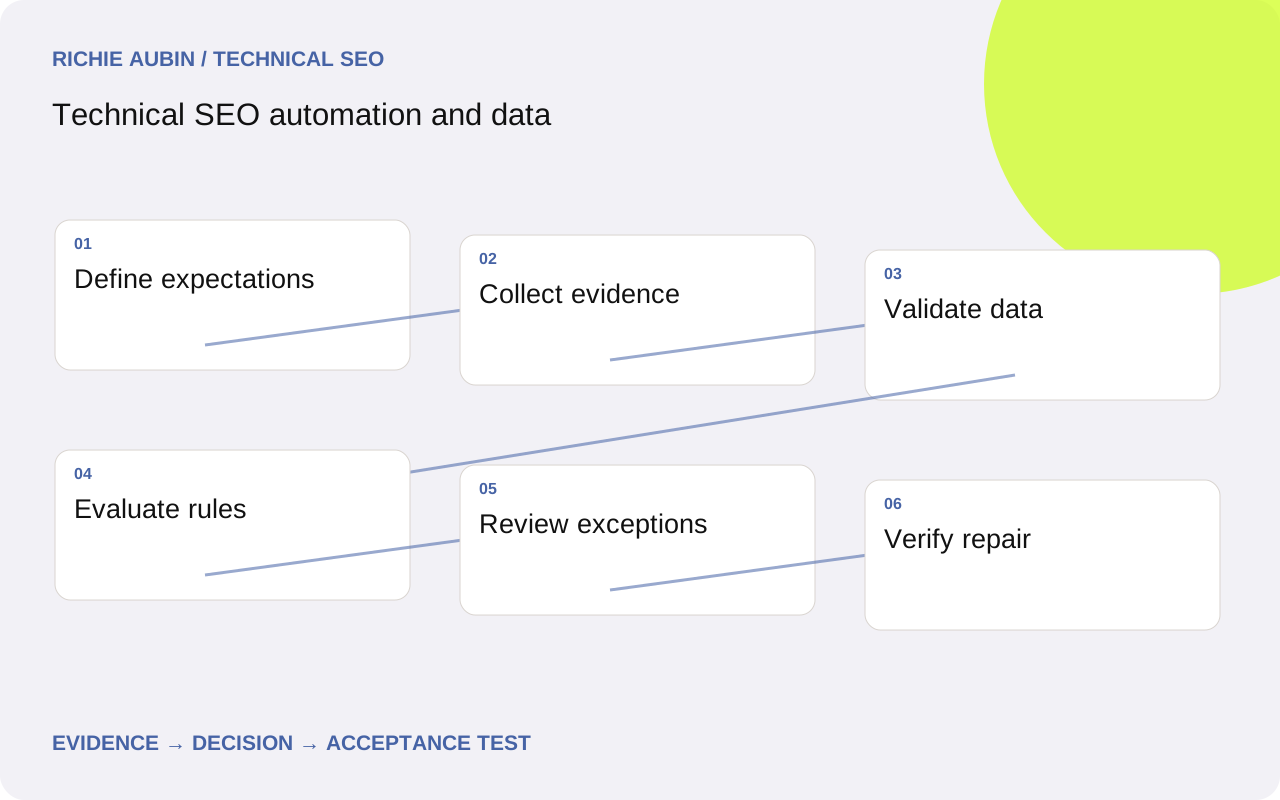
Use three distinct stages. Collection saves source observations. Evaluation applies versioned expectations and produces findings. Action routes a reviewed exception or applies an explicitly bounded change. This separation lets an analyst rerun improved rules against existing evidence without generating more site traffic, and keeps a reporting defect from immediately changing production.
Bound request concurrency, runtime, response size and retry attempts. Respect the permitted crawl scope and available service quotas. A timed-out request is unknown evidence, not a 404. Treat authentication failures as operational problems. Save checkpoints so a restart resumes incomplete work instead of duplicating every expensive request.
Publish a completed snapshot only after collection and validation finish. Keep the previous usable snapshot labelled with its age if the new run fails. A partial replacement can look like a reduction in defects while actually hiding untested URLs. For executable transformation examples, Python for technical SEO provides a focused route from small exports to reproducible analysis. Choose implementation complexity to match the decision’s cost.
Illustrative worked example: protect an article release
Illustrative worked example: a fictional publisher maintains 800 public article URLs and 60 preview URLs. These invented quantities explain a workflow, not a client outcome. The expectation is that public articles remain accessible without noindex, while previews remain protected by the publishing platform’s access controls. The automation begins with this classified inventory.
After a template deployment, 36 public URLs expose noindex in their response HTML. The same URLs were clear in the preceding completed run. Investigators consider three hypotheses: a shared template condition changed, the inventory incorrectly includes drafts, or the collection job fetched a preview environment. They check publication records, the effective hostname and response evidence from affected and unaffected templates.
Suppose the public category template is confirmed as the cause. The proposed repair narrows the preview condition rather than deleting all exclusion controls. Acceptance requires clean public responses across each affected template and continued protection for previews. A fresh collection verifies that output. Subsequent Google processing is monitored separately; passing this check does not prove that any URL is indexed or that search exposure has improved.
Define acceptance criteria for the automation itself
Approve a check when it correctly distinguishes expected public pages, intentional exclusions, genuine failures and missing observations on an agreed fixture set. Include malformed input, unavailable endpoints, redirect loops and changed response schemas where relevant. A green result must mean all required observations completed successfully, with no unresolved critical findings.
Require the output to identify the accountable team, provide exact examples and explain the next investigation. A notification without evidence transfers the work of rediscovering the problem to its recipient. Group duplicate alerts, but reopen a finding when its affected population changes materially or a confirmed repair regresses.
Measure operational value through detection time, false positives, unresolved unknowns and the effort required to investigate. Do not substitute the number of scripts or requests for useful coverage. For portfolio reporting, technical SEO dashboards should expose both website findings and collection health. Schedule checks according to the failure’s likely onset and the team’s ability to respond, rather than assuming every metric needs minute-by-minute refreshes.
Plan reversal and recognise the limits
For production changes informed by automation, retain the previous rule set, configuration and affected inventory. Test the reversal before a broad rollout. Disabling a faulty checker should not remove website safeguards or discard its evidence. Restoring a website configuration and restoring a reporting rule are different operations with different owners.
Automatic remediation carries particular risks around redirects, canonical rules and exclusions. A mistaken URL comparison can consolidate unrelated pages; a broad removal of noindex can expose content that was intentionally excluded. Prefer a reviewable diff and a bounded deployment for changes whose meaning depends on content intent. Stop the job if scope expands unexpectedly.
Automation can verify observed technical behaviour and make recurring work more dependable. It cannot guarantee crawling, indexing, rankings or inclusion in AI answers. Neither a successful API response nor a completed crawl proves those outcomes. Maintain a documented manual investigation route for uncertain cases and review the check when the website, source documentation or business policy changes. Retire rules whose original decision no longer exists.
Frequently asked questions
Which technical SEO task should be automated first?
Choose a recurring check with a clear expectation, reliable input and an owner who can act on failures. Release checks for public-page directives or approved redirect destinations are often easier to validate than broad quality scores. Establish a manual baseline and intentional exceptions before scheduling the job.
Can automation replace a technical SEO audit?
It can preserve and repeat parts of an audit, especially known regression checks. It does not establish publishing intent, evaluate every content relationship or explain every change in search performance. Use periodic investigation to discover new failure modes, then add stable checks where their expected behaviour can be specified.
Should every failing URL create a separate alert?
Usually a shared incident should contain a count, affected segment and representative examples, with the full evidence available for investigation. Separate alerts are useful when owners or consequences differ. Include incomplete collection as a distinct operational condition so untested URLs cannot quietly disappear from the report.
Does a passing automated check prove Google has indexed a page?
No. A live check describes the response observed by the checker. Google’s recorded indexing evidence has a separate observation time and interpretation. Even technically accessible pages are not guaranteed inclusion. Keep current technical compliance, recorded indexing state and search performance as separate measures with clear labels.