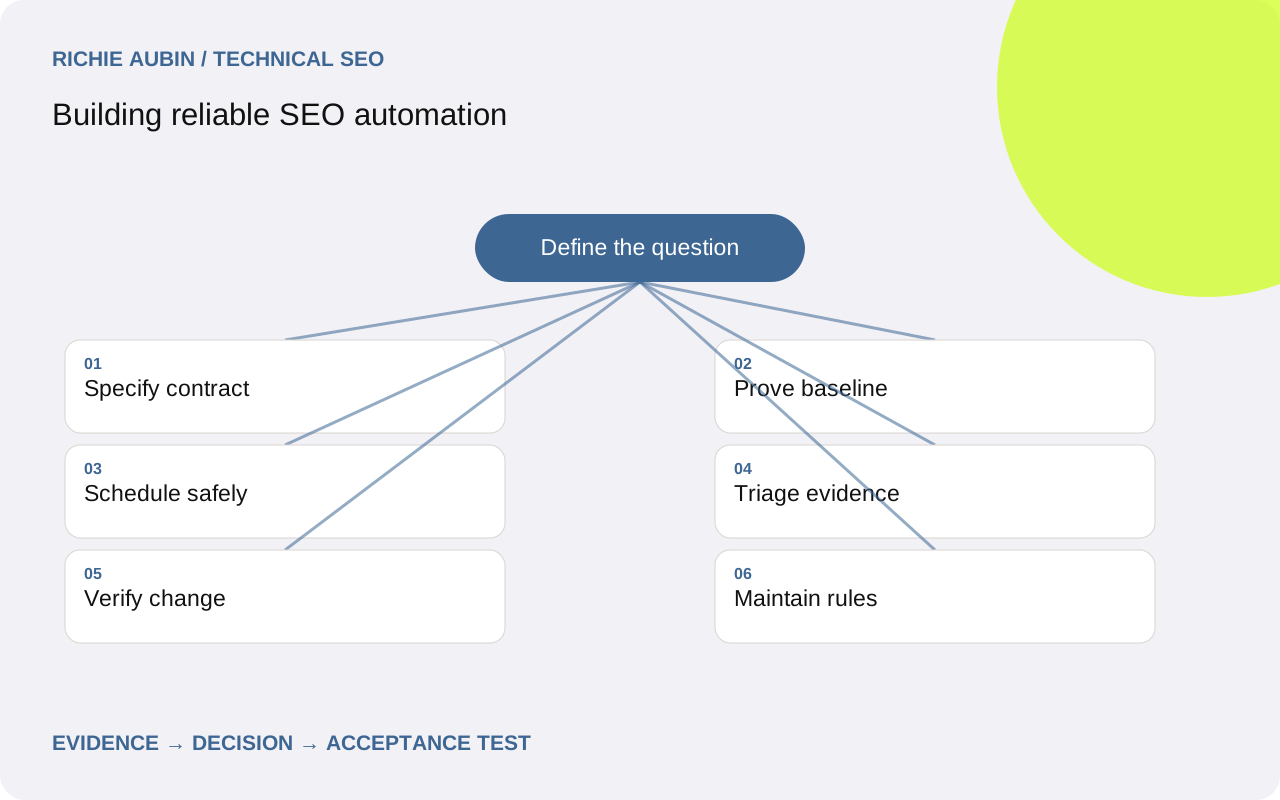
Choose work with a stable decision boundary
A reliable SEO automation starts with a task whose expected answer can be described without referring to one analyst’s intuition. Checking that an approved redirect reaches its mapped destination fits this model. Deciding whether two articles deserve consolidation usually requires more contextual judgement. Automate the evidence gathering for ambiguous work before attempting to automate the decision.
Score candidate tasks by repetition, impact of a missed defect, input reliability and cost of investigating an alert. A weekly report that nobody acts on is a weak candidate even if it takes hours to assemble. A small release check that prevents an accidental public-page exclusion can be valuable with only a few requests.
Write a one-sentence decision contract and a named response owner. Include what happens when evidence is incomplete. The broader technical SEO automation guide connects these choices to source selection and data design. Keep the first version narrow enough that a reviewer can inspect every rule and understand why each exception exists.
Specify the workflow as an operated service
Document the trigger, input population, source permissions, collection limits, evaluation rules and output audience. Triggers may be a release event, a scheduled inventory refresh or a manual investigation. They need different freshness expectations. A pre-release check cannot depend on search performance data that will only become available after launch.
Define service states such as collecting, complete, incomplete and failed. Store run identifiers and start and finish times. A completed process is not necessarily a complete dataset: a job can exit normally after skipping half its requests. Declare the required coverage and any permitted exceptions before reporting a pass.
Assign operational ownership separately from website ownership. The team maintaining API credentials may differ from the team repairing canonical output. Include runbooks for expired access, missing files and unexpected schema changes. If nobody can explain or restart the job, it is an unmanaged dependency regardless of how tidy its source code looks. Set a review date for its expectations and dependencies.
Establish a manual baseline and evidence checklist
Run the proposed check manually against a representative set before scheduling it. Include healthy public URLs, intentional exclusions, changed routes and known failures. Record which observations support each classification. This establishes a reference for the automation and exposes policy questions that code cannot resolve by itself.
The evidence checklist should include exact input identifiers, intended state, request settings, observation timestamps, raw response references, parsed values and rule version. Keep the expected population count alongside completed, failed and skipped observations. A missing result needs a reason, not a silent omission from the denominator.
Compare a sample of automated findings with independent requests under equivalent conditions. If a finding depends on rendered content, include the rendering environment and readiness condition. A clean response from a browser with an authenticated session does not disprove a problem encountered by an unauthenticated checker. These baseline differences should be resolved before the job begins sending incident notifications or blocking releases.
Control retries, state and publication
Make repeated execution safe. Give each scheduled interval or release a stable job key so overlapping triggers do not publish duplicate incidents. Checkpoint completed observations and distinguish a resumed run from a new one. A retry should not duplicate output rows, multiply API usage unnecessarily or overwrite a more recent accepted snapshot.
Limit concurrent requests per host and define total runtime and retry budgets. Use backoff for transient failures and respect valid server retry instructions. Separate expired credentials from rate limiting and from origin errors. A failed permission check should stop the relevant collector rather than becoming thousands of apparent website failures.
Validate all required tables before publishing. Write a new result to a separate snapshot, then make it current only after checks pass. If the run is incomplete, preserve the previous accepted result with a visible stale label. The data quality workflow explains how to prevent missing observations and schema changes from masquerading as improvements in website health.
Treat alerts as hypotheses with discriminating checks
Design each alert to narrow an investigation. A noindex regression should show the affected public template, the first observed change and a small set of exact response examples. The investigator can then test whether the site changed, publication intent changed or collection reached the wrong environment. A percentage alone cannot distinguish these explanations.
A sudden fall in crawl coverage could be caused by removed internal links, a crawler depth restriction or failed rendering. Compare configuration hashes, seed inventories and link evidence before claiming a site architecture regression. If only the pipeline changed, fix its measurement and rerun preserved inputs before asking developers to alter navigation.
Use confidence and consequence together. A clear header-level exclusion affecting public landing pages may require prompt action. An unconfirmed change from a partial render may justify a targeted recheck first. Link the operational alert to issue prioritisation so ownership and response reflect the affected population and plausible impact rather than the tool’s default severity colour.
Illustrative worked example: automate release checks
Illustrative worked example: a fictional documentation site deploys twice weekly and maintains a manifest of 120 critical public routes. The proposed job checks those routes against the release candidate, verifies status and directives, and compares them with declared expectations. The figures describe a teaching scenario and are not results from a real organisation.
The first scheduled test reports eight failures. Six responses are genuine successful pages carrying an unintended noindex directive; two requests timed out. The job reports six technical failures and two unknowns, rather than merging all eight into an indexing diagnosis. The release remains unaccepted because the required route set has not been fully verified.
Investigation considers a template condition, an outdated manifest and a collection timeout setting. Publishing records confirm the six URLs are public. A focused response check confirms their directives. After the template repair, all six meet expectations; the two unknowns complete on a controlled retry. Acceptance records the technical repair and complete coverage, while making no claim about when Google will crawl or index the pages.
Set implementation acceptance criteria and alert behaviour
Acceptance should cover both the detector and its operation. Require correct classifications for the reference fixtures, preservation of original evidence, bounded requests and an explicit failure when required coverage is missing. Test a missing input file and an unexpected API response so the job proves it can fail usefully rather than simply succeed on clean data.
For notifications, require a concise explanation, affected segment, timestamps, evidence references and the next diagnostic action. Group shared template incidents and suppress unchanged duplicates for a defined interval. Keep a clear resolved state and reopen incidents when a verified repair regresses. Ensure the operational owner can distinguish a disabled check from a healthy site.
For deployment integration, set critical checks deliberately and document the emergency override owner. A check should not block a release indefinitely because an unrelated reporting API is unavailable. Conversely, a required public-route test should not silently become optional. Use SEO release QA to align the gate with what can actually be observed in the release environment.
Rollback, maintenance and limits of automated action
Retain the previous detector version, configuration and accepted output. Deploy rule changes to a bounded sample and compare old and new classifications. When a rule becomes noisy, inspect the disagreement before adjusting its threshold. Raising a threshold to silence an incident can hide a real regression or change the meaning of the report without anybody noticing.
Define separate rollback procedures for the automation and any production repair. Restoring a website rule may require cache invalidation and coordination across edge and application layers. Restoring the checker may simply require reverting a parser. Keep these actions distinct so a reporting rollback does not accidentally remove a necessary website fix.
Review dormant jobs and remove checks that no longer support a live decision. Automation cannot guarantee indexing, rankings, rich results or AI citations. Its strongest claims concern observed behaviour under declared conditions. Feed meaningful operational measures into technical SEO dashboards: current coverage, unknown observations, actionable incidents and time to verification. A large number of green jobs is not evidence that every important failure mode is covered.
Frequently asked questions
How often should an SEO automation run?
Match the interval to when the failure can occur and how quickly somebody can respond. Release checks belong near deployment, while large inventory reconciliations may run less often. More frequent requests do not improve a slow-moving source’s freshness. Include a defined maximum evidence age and an explicit stale state.
Should automation fix technical SEO issues automatically?
Only tightly bounded actions with established intent and a tested reversal are good candidates. Changes to canonical rules, redirects and index exclusions can affect unrelated content if their scope is wrong. A reviewable proposed change is often a better first implementation than a system that edits production immediately.
What is the difference between an unknown result and a failure?
A failure means sufficient evidence demonstrates that an expectation was not met. Unknown means the required evidence could not be obtained or interpreted. Both may prevent acceptance, but they require different responses. Recheck collection problems before assigning a website repair to the team responsible for the affected template.
How can false positives be reduced without hiding defects?
Review representative false positives and fix their actual cause: incorrect intent, poor parsing, stale inventories or unsuitable request settings. Add explicit exceptions with an owner and reason. Avoid broad suppression rules based only on URL patterns unless those patterns reliably identify the intended population and are checked for drift.