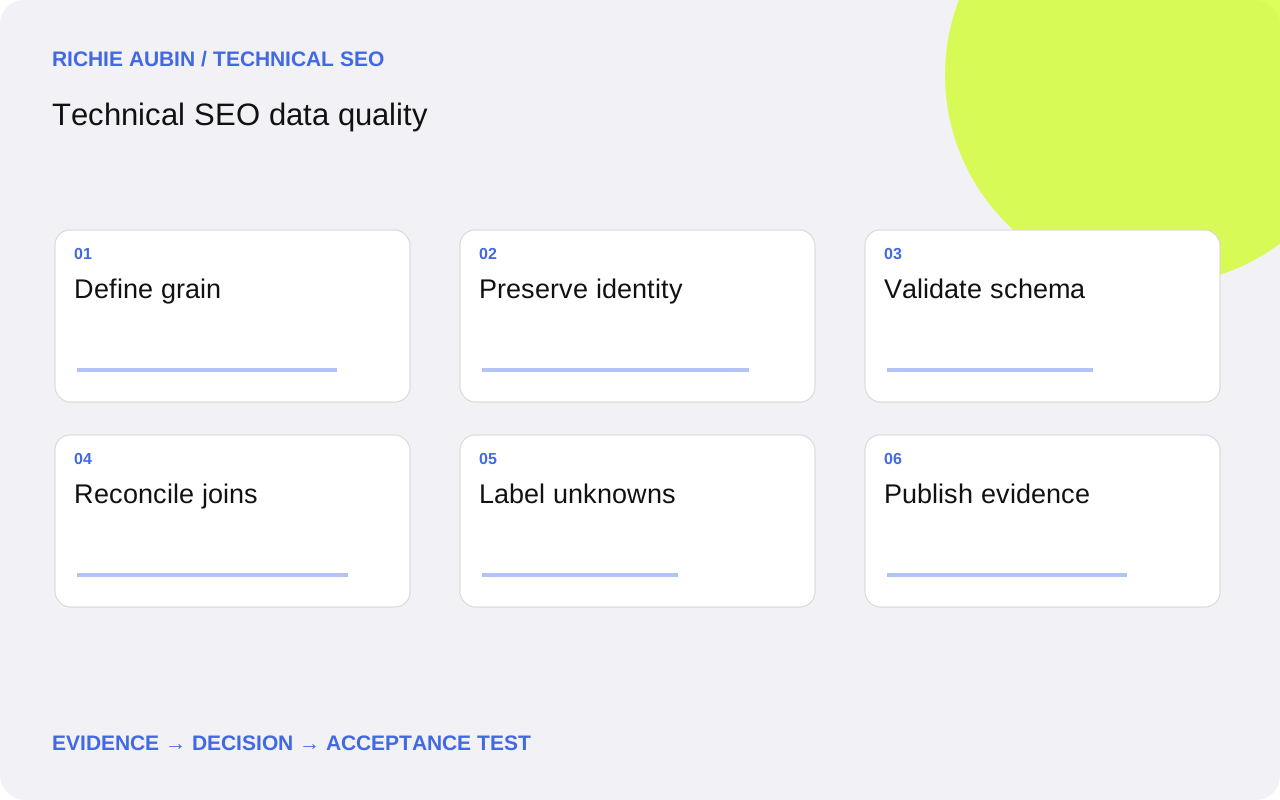
Define what a trustworthy SEO dataset must represent
Data quality in technical SEO means that observations retain enough identity, context and completeness to support the intended decision. A table can be syntactically valid while answering the wrong question. A crawl of one host cannot establish the current state of another, and an old inspection record cannot be presented as a live response merely because it was downloaded today.
Begin with the decision, source and intended population. State whether each record represents a requested URL, a content entity, a redirect hop, a link relationship or a performance measurement. Record the observation period and extraction time separately. These definitions establish the conditions under which a comparison or aggregate has meaning.
A practical quality contract specifies mandatory fields, valid values, unique keys, missing-data labels, coverage expectations and an accountable owner. The automation guide shows why these contracts matter before scheduling checks. Without them, a pipeline can run successfully every day while silently losing exactly the records that should have triggered investigation.
Preserve URL identity and document comparison keys
Keep original URL values immutable. Create comparison keys in separate fields, with named transformation rules and a version. Lowercasing a hostname may be appropriate, but lowercasing every path can merge distinct resources. Removing parameters or trailing slashes is a site-specific routing decision, not a universal cleaning operation that can be applied without evidence.
Store redirects, canonicals and content aliases as explicit relationships. If several URLs correspond to one preferred entity, retain their separate observations and the evidence for that mapping. A failed legacy route can matter even when its destination is healthy. Replacing the source identifier with the canonical before analysis can hide the broken journey entirely.
Inspect transformed groups containing more than one original identifier. Sample encoded characters, language parameters, pagination and case differences. Require a reason for every many-to-one mapping and measure how much of the population it affects. A comparison key should make equivalent observations easier to relate without erasing uncertainty about whether two resources are actually equivalent for the question under review.
Enforce grain and reconcile joins
Write the key for each table. A crawl observation may use run identifier and requested URL; a daily performance extract may add date, device and country; a link table needs both endpoints and possibly occurrence context. Assert uniqueness where it is required. A duplicated key should become a visible input or modelling failure rather than being silently deduplicated.
Aggregate metrics to the intended grain before joining. If clicks are attached to every inbound link occurrence, the result can multiply traffic totals while appearing detailed and useful. Validate join cardinality, source row counts, matched populations and unmatched populations. Compare metric totals before and after transformation under equivalent aggregation rules.
Use outer reconciliation when the missing population matters. An inner join retains only matches and can hide orphan candidates, new routes or historical URLs. Keep source membership flags and exact unmatched examples. The crawl and Search Console workflow explains how to preserve those differences without converting missing rows into claims about whether Google has indexed a page.
Separate missing, zero, stale and unavailable evidence
Define missing-data states explicitly. A successful extraction that found no canonical element differs from an unrequested page, a timed-out response and an extractor that could not parse the document. A numerical zero also differs from no returned performance row. Preserve those states in storage and reporting rather than replacing them all with a blank cell.
Track observation age and source collection windows. A dataset downloaded today can contain weeks of aggregated behaviour or an older crawl record. Comparing it with a current release requires chronology, not merely matching export dates. Store source time zones and define date-boundary conversions so daily comparisons do not drift across reporting periods.
Mark incomplete collections before they enter downstream calculations. If a collector fails on a particular template, the remaining records are not a representative complete sample by default. A shrinking denominator can make health percentages improve while evidence quality deteriorates. Keep the previous accepted snapshot available with a stale label and expose the reason a newer candidate was rejected or published with explicitly limited coverage.
Evidence checklist and competing hypotheses for data anomalies
The evidence checklist includes source provenance, permissions context, extraction parameters, input fingerprints, schema version, key rules, observation dates, row counts and transformation history. Keep representative raw records for every reported anomaly. Sensitive credentials should never be included in the evidence package; a secure reference to the collector configuration is sufficient.
When duplicate rows appear, test three explanations: genuine repeated observations, a source export containing duplicate keys, or a join that multiplied records. Compare counts before the first transformation, after each join and at final aggregation. Removing duplicates at the end can conceal the cause and discard legitimate detail. Fix the grain or join rather than forcing a desired total.
When a chart suddenly improves, consider a genuine website repair, an input population change and a parser failure that dropped defective pages. Check matched URL cohorts and rejected rows. A quality investigation should be able to demonstrate which explanation fits the preserved evidence. Otherwise the result remains uncertain, regardless of whether the dashboard colour changed from red to green.
Illustrative worked example: expose a false improvement
Illustrative worked example: a fictional technical report expects observations for 1,200 public URLs. Last week it contained 120 directive failures. A new export shows 40 failures across 800 records. The figures are invented to demonstrate reconciliation; the apparent reduction must not be reported as a measured client improvement without further investigation.
The initial hypotheses are a successful template repair, retirement of 400 pages or incomplete collection. Comparing exact inventory membership shows the 400 missing records still belong to the public population. Collector logs then reveal a rendering failure on one template. The headline count fell partly because evidence disappeared, rather than because every omitted defect was repaired.
Reject the incomplete snapshot for the complete-population headline and retain it for diagnostic use with clear coverage labels. Restore collection, rerun the missing population and reconcile matched results before assessing change. A verified reduction can then be described for the comparable cohort. The acceptance decision concerns evidence completeness first; it does not infer a search benefit from a lower error count.
Acceptance criteria for an analysis-ready dataset
Set mandatory invariants: recognised source and run identifiers, valid observation timestamps, preserved original URLs, unique declared keys and explicit result states. Require complete coverage of the agreed inventory or an approved, visible limitation. Define tolerances from the use case rather than adopting arbitrary percentages that allow important missing segments to pass.
Test transformations with fixtures that exercise encoding, duplicated keys, missing columns, incorrect units and unexpected response shapes. Reconcile row and metric totals. A semantic test might ensure that a timeout remains unknown or that an unmatched Search Console row is not labelled a confirmed indexing failure. These checks verify the interpretation needed by the analyst rather than merely checking file syntax.
Publish only validated derived tables and document their contract for consumers. The Python guide explains reproducible transformations, while API collection guidance covers endpoint-level limitations. Require a second analyst to trace a selected reported finding back through its transformations to the original observation before accepting a new pipeline into regular reporting.
Rollback, versioning and limits of clean data
Version schemas, comparison rules and metric definitions. When a correction changes historical results, regenerate the affected period from preserved evidence where feasible and annotate the discontinuity. Do not quietly mix values calculated under incompatible definitions. Keep the earlier accepted series so reviewers can understand why a previously published figure differs from the corrected one.
Rollback can restore a parser or key rule, but it cannot recover evidence that was never collected. Define source retention and checkpointing accordingly. Before replacing a pipeline, compare a fixed representative sample and a complete matched population. If totals diverge, inspect the changed records rather than assuming the new implementation is more accurate because it is newer.
Clean data still has source limitations. Search performance, crawl behaviour and user experience represent different populations and observation models. Quality controls cannot turn those observations into guarantees of causation, rankings or indexing. The dashboard guide explains how to keep coverage, freshness and definition changes visible so a concise report retains the qualifications necessary for a sound decision.
Frequently asked questions
Is an empty value the same as zero?
No. An empty value may mean no observation, a failed request, an absent field or a parsing error. Zero should represent an observed numerical result under a defined source contract. Preserve separate states and decide their reporting treatment deliberately, especially when calculating failure rates or joining performance data.
Can URL cleaning make analysis less accurate?
Yes. Unverified transformations can merge distinct paths, language variants or parameter-defined resources. Preserve original identifiers and use versioned comparison rules based on routing evidence. Review groups with several original URLs before aggregation. Convenience is not sufficient justification for changing the unit represented by a record.
Why do clicks increase after joining a crawl table?
A likely explanation is row multiplication caused by incompatible grain, such as several observations or link occurrences per page. Check key uniqueness and row counts before and after the join. Aggregate to the intended unit and reconcile totals against the original extract before interpreting any movement as real performance.
Should a partial dataset ever be published?
It can be useful for a clearly bounded investigation if coverage and missing populations are explicit. It should not silently replace a complete-population headline or mark unobserved URLs healthy. Preserve the previous accepted snapshot with its age, explain the collection failure and define what conclusions the partial evidence can actually support.