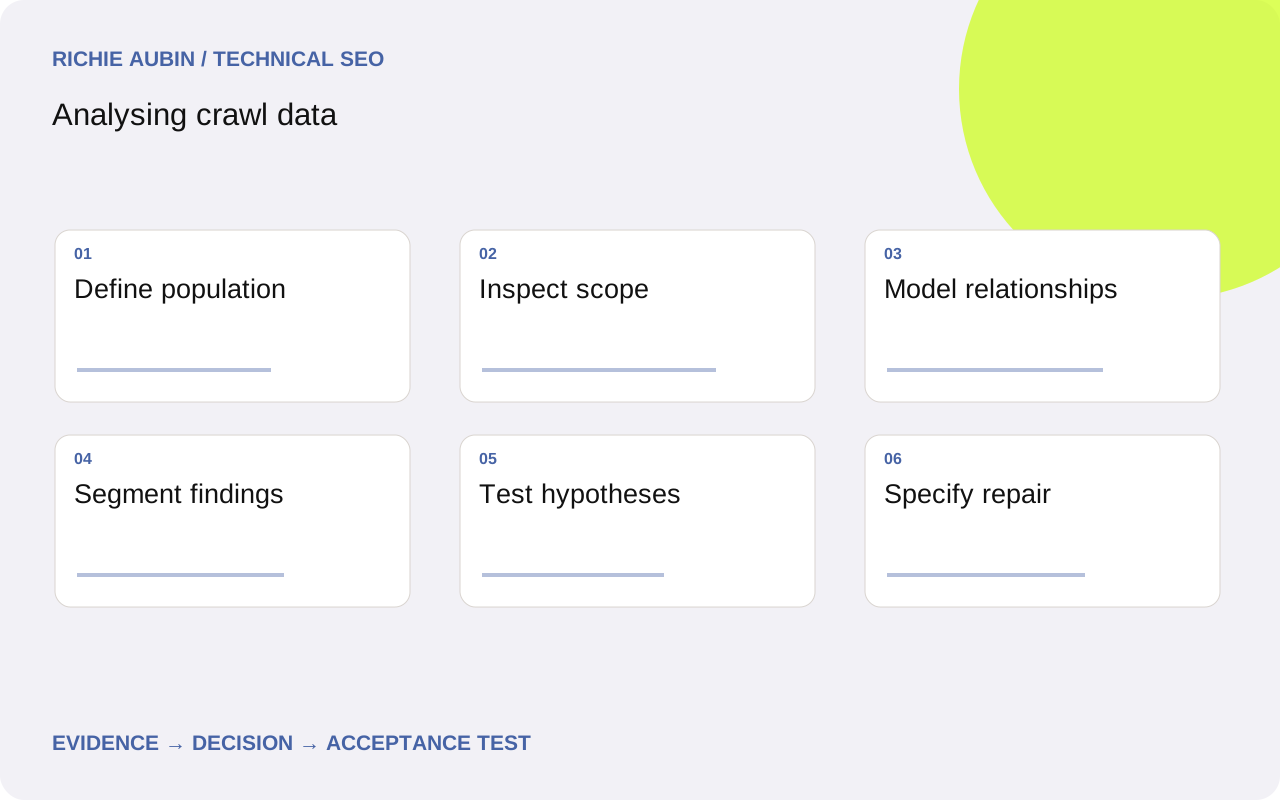
Choose a question before opening the export
A crawl export becomes useful when it helps decide what to investigate or change. Start with a question such as which public product pages have lost crawlable links, which legacy routes reach the wrong destinations, or which templates now emit conflicting directives. Counting every warning without a decision produces a long inventory of symptoms rather than a diagnosis.
Define the relevant population independently of the crawler wherever possible. A publishing manifest, product catalogue or approved route list can show pages the crawl never discovered. If analysis begins and ends with discovered URLs, a successful-looking crawl can conceal entire missing sections. Record both intended membership and discovery provenance.
Choose the unit of analysis. A requested URL, final destination, content entity and canonical group are different units. Keep those identities separate until the question requires aggregation. The automation overview explains how a recurring analysis can become a dependable check once the input population and expected output are clear.
Read crawl configuration as part of the evidence
Save the start URLs, allowed hosts, path restrictions, robots behaviour, rendering mode, user agent and request limits. Record crawl start and finish times, not just the export date. Large crawls may span releases, so two pages in one file may have been observed under different site configurations. Note any interruption or resumed collection.
Examine completeness before interpreting findings. Were crawl limits reached? Did resource failures prevent rendered links from appearing? Did authentication or a protective service return a challenge page? An export with thousands of successful status codes may still describe an interstitial rather than the intended content. Sample response bodies across each important template.
Keep excluded and failed URLs visible. A crawler configured to respect robots restrictions may not retrieve page-level directives from blocked URLs. That absence is not evidence that directives are absent. Likewise, a page omitted because of a path filter is outside that run’s observation scope, rather than necessarily unreachable through the actual website. These distinctions belong in the analysis notes and output labels.
Model URLs and relationships without flattening them
Create one observation table at the declared run-and-requested-URL grain. Use separate tables for links, redirect hops and declared canonical relationships. A single flattened sheet can repeat page metrics for every inbound link and inflate counts during aggregation. Retain the original identifiers and raw values before producing convenient comparison fields.
Resolve relative references with the correct base and preserve the source value. Do not build absolute destinations by simple string concatenation. A relative path can resolve differently depending on the source URL’s directory and any applicable document base. Treat protocol, host, path, query and fragment deliberately rather than stripping them all into one universal key.
Document any alias mapping supported by observed routing. A redirect from one address to another is evidence of a relationship, not permission to erase the source row. The data quality guide explains how key transformations and table grain affect later joins. Audit transformed groups with more than one original URL before relying on their aggregated counts.
Segment by intent, template and discovery route
Group pages by expected behaviour before counting defects. Public articles, search results, account routes, pagination and retired content need different expectations. A noindex directive on an intentionally excluded search page should not carry the same classification as the same directive on a core public landing page. Maintain an explicit unknown-intent category for unresolved records.
Add template, language, section, release version and discovery source where reliable. Compare rates within stable populations, showing both numerator and denominator. If a release introduces many valid pages, the percentage of existing failures can fall without a single repair. Conversely, a smaller crawl can make the absolute defect count look better while coverage has deteriorated.
For link analysis, distinguish unique referring pages from repeated link occurrences and sitewide navigation from contextual links. Crawl depth depends on the seed set and crawler configuration; it is not a fixed property of a URL. Inspect actual paths and source pages before interpreting a depth increase as a structural problem that requires new navigation.
Evidence checklist and competing hypotheses
A practical evidence checklist includes the independent inventory, crawl configuration, observation timestamps, requested and final URLs, relevant headers, extracted markup, link sources and a saved response sample. Retain counts of unrequested, blocked, failed and successfully observed URLs. Record the exact classification logic so the finding can be reproduced from the same export.
Consider alternative explanations for each pattern. A fall in discovered article URLs could result from removed hub links, a lower crawl-depth limit or JavaScript failing in the crawler. Compare previous configuration, source HTML and rendered link evidence. A large canonical change could reflect intentional consolidation, a template defect or a parser that now prefers a different declaration.
Use the next source to test the unresolved claim. Publishing records establish intent; current requests establish current responses; server logs can show recorded requests; Google inspection evidence describes Google’s recorded state. The crawl and Search Console workflow explains careful reconciliation. An impression count alone cannot establish whether a currently missing link caused an indexing or traffic change.
Illustrative worked example: investigate missing product pages
Illustrative worked example: a fictional retailer lists 1,000 active products in its publishing inventory. A navigation crawl discovers 920 of their expected URLs. These figures are invented to show the reasoning process. The initial question is why 80 expected products are absent, rather than how many pages the crawler regards as healthy.
An exact join finds that 30 absent products use newly renamed routes not yet reflected in the inventory, 20 sit beyond an accidental crawl restriction and 30 retain current public URLs. Keep those groups distinct. Correcting the inventory and scope explains 50 records but does not repair anything on the website. The remaining 30 require link-level investigation.
Suppose category membership records show those 30 should appear in a hub, but the hub’s delivered HTML contains no links to them. Competing hypotheses include a publication synchronisation delay and a broken category query. Compare update times and product membership before proposing a repair. The resulting ticket identifies the responsible hub query and exact missing links; it does not claim the products are absent from Google’s index.
Turn analysis into implementation acceptance criteria
Describe the expected user-facing behaviour, not merely the desired crawler score. For the product example, published products in the agreed category should appear as normal destination links on the appropriate hub. The links should resolve to the correct public product content. Draft, withdrawn and access-restricted products should remain outside the inclusion rule.
Validate a bounded set first, including previously affected products, unaffected products and intentional exclusions. Repeat the relevant crawl configuration after deployment and compare matched populations. Confirm that the repair has not introduced links to unavailable variants, broken pagination or duplicated category paths. A full recrawl is useful only if it resolves coverage questions left by the focused verification.
Data acceptance also matters: unique observation keys, preserved original URLs, a reconciled inventory join and visible unmatched groups. Use internal linking audit checks for deeper relationship analysis. Keep the website’s acceptance criteria separate from reporting criteria so a corrected export cannot be mistaken for a production fix. Save the evidence that demonstrates each completed requirement.
Rollback risks and analytical limitations
A crawl is a configured observation over time, not a complete replica of every user or search-engine interaction. Rendering, location, cookies, rate limits and edge behaviour can change the response. Google may have seen a different version earlier. Report what the crawl demonstrates and label the broader explanations that remain hypotheses.
Avoid causal claims based only on parallel movements in crawl warnings and traffic. Demand, publication changes, canonical attribution and search conditions can affect performance. Compare relevant dates and segments, but do not present an uncontrolled before-and-after chart as proof that one technical condition caused the change. Technical verification remains a separate, testable outcome.
Before changing navigation or consolidation rules, retain the previous configuration and affected URL inventory. A broad category repair can expose drafts or overload hubs; a mistaken canonical grouping can collapse distinct content. Roll out a bounded change and confirm the reversal path. Keep the original crawl and transformation rules so future analysts can reconstruct why the proposed change appeared necessary and assess whether that reasoning still applies.
Frequently asked questions
Is a crawl export a complete list of website URLs?
No. It contains the URLs discovered or supplied under that crawl’s scope and limits. Independent inventories, sitemaps, logs and other records may expose additional populations. Compare them with preserved source labels. Absence from a navigation crawl establishes only that this run did not observe the URL through its configured discovery process.
Should every duplicate title become an issue?
Treat it as a pattern to investigate. Several legitimate variants may share a title, while a template defect may also create unwanted duplication. Review intended content identity, canonical relationships and examples before proposing a change. The title count alone does not establish duplicate content, an indexing problem or a ranking penalty.
Why do two crawls report different depths?
Depth is measured relative to supplied seeds, followed links and crawl rules. Changed navigation can affect it, but so can different seed URLs, rendering settings or scope restrictions. Compare those conditions first and inspect actual link paths before describing the difference as a site architecture regression.
How should crawl findings be prioritised?
Combine confirmed intended behaviour, affected population, user consequence and strength of evidence. Give exact examples and a testable repair requirement. Keep unknown observations separate and resolve collection failures before treating them as website defects. Tool severity labels are inputs to judgement, rather than a sufficient implementation priority on their own.