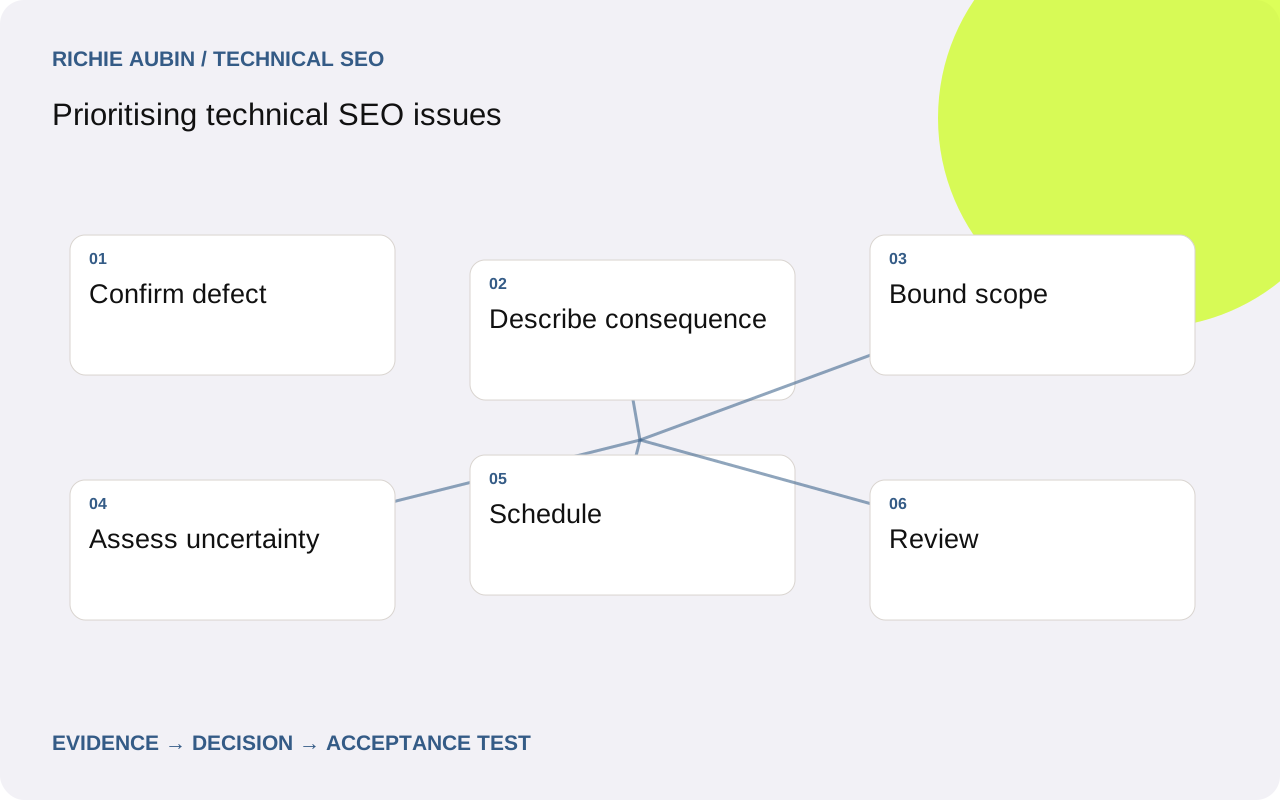
Separate defects, investigations and improvements
Before ranking findings, decide what kind of work each item represents. A confirmed public route returning an unintended noindex header is a defect. A fall in impressions with no established mechanism is an investigation. Rewriting acceptable descriptions may be an improvement. These work types need different completion rules and should not compete through an identical automated score.
A defect needs an agreed expected state and reproducible evidence of deviation. An investigation needs a bounded question, the next test and a stopping condition. An improvement needs a plausible user or maintenance benefit, with honest uncertainty about search effects. This first separation prevents uncertain theories acquiring artificial urgency because a spreadsheet requires a severity label.
Confirm that the affected URLs should serve the proposed purpose. Deliberately excluded account pages do not become urgent because a crawler marks them non-indexable. Use the audit methodology to establish causation and scope before estimating value. A queue of verified decisions is easier to schedule than a larger queue of unexplained warnings.
Describe consequence through a concrete journey
Write what a person or search system cannot do because of the defect. “Public product pages return a challenge instead of product content” describes a consequence. “There are 4,000 issues” describes an export. Link the condition to discovery, access, interpretation, navigation or the user’s ability to complete the page’s purpose.
Separate current harm from future exposure. An incorrect rule on an unused draft template differs from the same rule already serving an important public category. Both may deserve repair, but timing, owner and verification differ. Record whether the condition is persistent, intermittent, limited to one environment or tied to a publishing state.
Use business context carefully. Important journeys and valuable inventory can justify attention, but technical evidence does not establish a precise revenue loss. If an impact estimate depends on assumptions about demand or conversion, make those assumptions explicit. Never convert an illustrative calculation into a promised gain. The useful decision is whether the known consequence warrants action relative to competing work, not whether a speculative number looks impressive.
Estimate affected scope without inflating counts
Count unique meaningful pages and affected systems, not every URL variation independently. A filter defect may generate millions of combinations but originate in one route rule. Conversely, one broken navigation component can affect discovery across many valid pages. Keep URL volume, template reach and journey importance as separate descriptions.
Retain the evidence behind any scope estimate. A full deterministic inventory can support a stronger count than a small convenience sample. If you observed ten failures in a selected set, do not extrapolate to the entire site without understanding how that set was chosen. Record newly published, older and exceptional states separately when behaviour differs.
Watch for duplicates across audit findings. A single incorrect canonical rule may also produce sitemap conflicts, indexing exclusions and Search Console join mismatches. Those are useful supporting observations, but treating them as independent benefits overstates the value of the fix. Group shared causes and retain downstream checks as acceptance criteria. This makes the engineering estimate more realistic and reduces repeated work across separate tickets.
Use confidence to choose the next action
Assess confidence in three things: the observed defect, its mechanism and the proposed remedy. A header captured repeatedly gives strong evidence of the served directive. It does not alone prove which configuration created it. The next action may be a short investigation by an infrastructure owner, even when the consequence is serious.
Write competing hypotheses beside ambiguous findings. A crawler’s widespread 429 responses might indicate a real service limit, an aggressive audit configuration or security treatment specific to the crawler. Lower the rate and compare legitimate public requests before recommending capacity changes. That test may be more valuable than immediately implementing the highest-scored remedy.
Keep reversibility in the decision. A narrow template correction with direct acceptance tests is easier to validate than a broad URL consolidation with uncertain content equivalence. High uncertainty does not always mean low priority: a potentially widespread access failure can justify urgent diagnosis. The distinction is between prioritising the investigation and authorising an unproven production change. Avoid hiding that difference inside a single confidence multiplier.
Build a queue around urgency and dependencies
Use plain decision categories agreed with engineering. Immediate containment is appropriate for a confirmed broad access or exclusion incident. Scheduled repair suits a reproducible defect without an active emergency. Bounded investigation suits material uncertainty. Optional improvement fits work whose technical benefit is useful but not essential to current public behaviour.
Record effort as an estimate from the delivery owner, including testing, coordination, cache handling and deployment. A one-line code change can have a large verification burden if it alters every public response. Make dependencies visible: inventory classification may need to precede redirect design, and response logging may need to precede a request-based diagnosis.
Do not maintain a rigid score that silently becomes policy. If scoring helps discussion, show the inputs and allow a written override with a reason. Reassess the queue when evidence, inventory or release scope changes. The release QA guide helps identify work that must be completed before a risky deployment rather than waiting for its ordinary queue position.
Illustrative example: choose between three audit findings
Illustrative example: a fictional retailer has three findings: unintended noindex on a public seasonal category, many duplicate title warnings on intentional variants, and intermittent missing descriptions after rendering. None of these observations alone establishes a financial impact. The first has a clear intended-state failure; the second needs variant classification; the third needs reproduction under controlled conditions.
Prioritise containment and diagnosis of the public directive defect. Check the category’s route rule and affected siblings, with private preview pages as negative controls. Assign a bounded rendering investigation in parallel if capacity allows, focusing on API failures and extraction mistakes as competing explanations. Defer title rewriting until the team understands which variants are intended to stand alone.
This does not assert that a single category is universally more valuable than thousands of titles. The ordering follows the evidence in this invented scenario: a confirmed eligibility obstacle, an uncertain content failure and a warning that may describe deliberate duplication. If new evidence shows missing primary content across all products, reassess immediately. Prioritisation should change when the facts change.
Make priority usable in an engineering ticket
The ticket should state the observed condition, affected route group, consequence, confidence, owner and reason for its timing. Attach representative evidence and identify the system likely responsible. Include explicit exclusions so a broad interpretation does not create collateral changes. A developer should not need to reverse-engineer the business decision from an urgency label.
Acceptance criteria for the illustrative directive repair should cover public responses at origin and edge, relevant HTML and header directives, representative siblings and protected preview routes. Require the same checks after deployment with the release identifier attached. Keep subsequent search observation as a separate follow-up; a developer cannot guarantee when Google will recrawl or index a page.
Specify a rollback condition and mechanism before implementation. Restoring a previous global rule might reintroduce the defect or expose a different route class. Prefer a narrowly scoped reversal when possible. Use regression tests for durable expectations, and distinguish an approved exception from a test temporarily disabled to get a release through.
Review the queue against results and changing risk
At each review, ask whether the item still represents the same problem. A platform change may have removed it, expanded it or made the original evidence obsolete. Refresh high-consequence evidence before deployment if it was collected long ago. Close duplicated tickets under the confirmed root cause rather than leaving several teams to deliver overlapping repairs.
Evaluate the repair through the technical criteria first. If the intended state is restored but traffic does not recover, consider demand, content relevance, competing pages and reporting changes. Do not repeatedly alter the same technical control merely because a guaranteed commercial result never arrived. Technical correctness is necessary for some outcomes but not sufficient for all search performance.
Track the queue’s effectiveness through useful operational questions: can owners reproduce findings, are tests explicit, do reopened defects reveal missing controls, and are investigations producing decisions? The monitoring guide helps retain this history. A sustainable process reduces ambiguity and repeated incidents rather than rewarding the largest number of closed warnings.
Frequently asked questions
Should a tool’s high-severity issues always come first?
No. Tool severity is a prompt to inspect a condition, not a complete assessment of intent, consequence or scope. A blocked private page may be correct, while a small public template failure may matter immediately. Verify the expected behaviour and business journey before using the warning to support scheduling.
How can technical SEO compete with product development?
Give product and engineering teams a clear consequence, a reproducible example, an estimated affected scope and testable completion rules. Explain dependencies and implementation risks. Avoid speculative revenue claims. A well-defined access failure is easier to compare with other work than an abstract request to improve an audit score or eliminate every warning.
What should happen when two urgent issues share one owner?
Separate immediate containment from permanent repair, then compare confirmed consequence, reach and reversibility. Identify whether another owner can gather evidence or run independent tests while the responsible engineer handles the critical path. Record the trade-off and next review time. An urgency label cannot create capacity, but a precise task boundary can reduce wasted effort.
When should an issue be removed from the queue?
Remove or close it when evidence shows the behaviour is intended, the underlying cause is resolved and verified, or the affected feature is retired. Keep a short decision record. If uncertainty remains, reframe it as a specific investigation rather than silently closing it or preserving an implementation ticket with no defensible expected outcome.