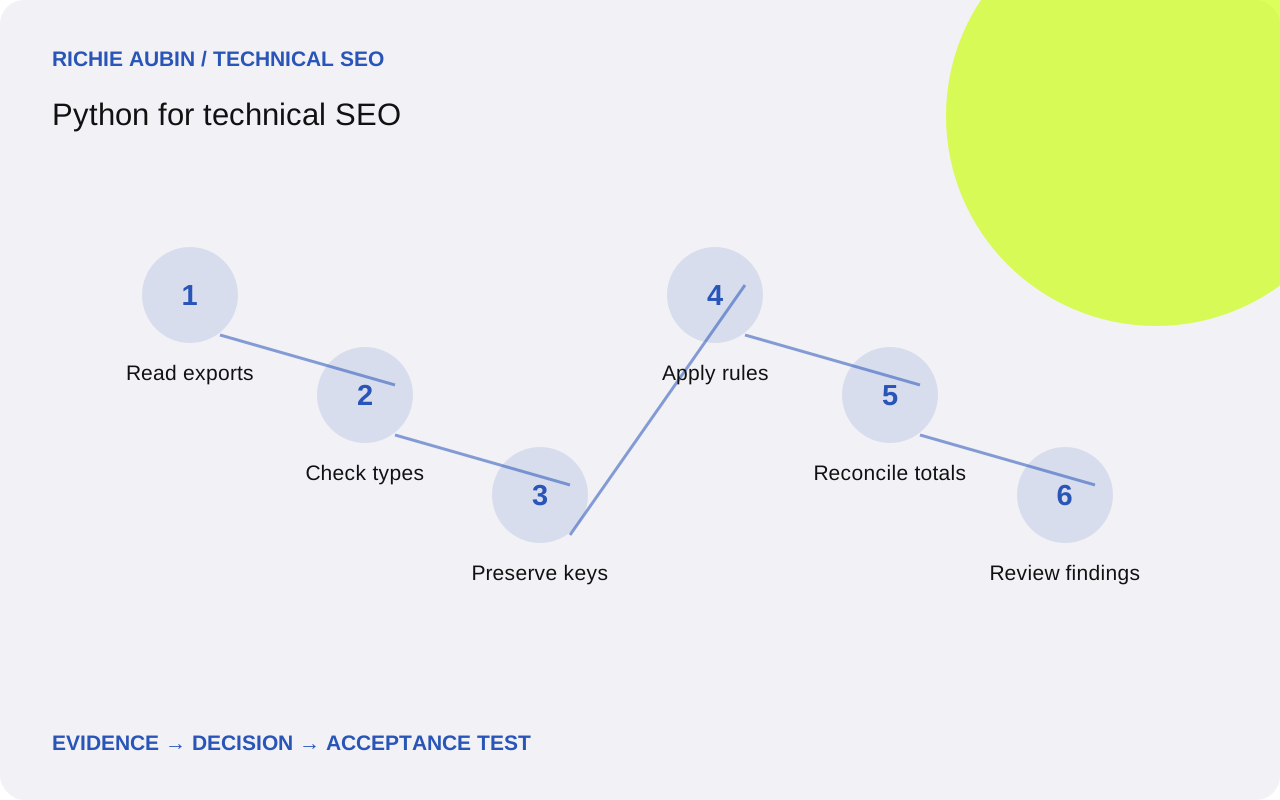
Use Python where the transformation needs to be reproducible
Python is useful when a technical SEO question requires the same transformation across several files or repeated observations. Typical tasks include comparing release snapshots, validating a redirect map, aggregating link relationships and reconciling crawl URLs with a publishing inventory. The value comes from an explicit procedure that another analyst can rerun, not from replacing every spreadsheet.
Begin with a narrow input and a defined output. For example: given a classified URL inventory and two crawl exports, identify public pages whose observed directives changed. Decide which columns are mandatory, whether multiple observations per URL are allowed and how incomplete requests should appear. Avoid starting with a large crawler when saved exports can answer the question.
Keep analysis and network collection separate. A script that reads local evidence is easier to reproduce and debug than one that silently fetches new responses during every calculation. The broader automation framework explains how these small analytical steps fit into a maintained workflow with ownership, scheduling and review.
Read files without changing the evidence
Preserve each original export and record its source, run time, encoding and configuration. CSV is a transport format, not a schema: a column containing a status code can arrive as text, while an empty field might represent an extraction failure rather than a missing tag. Declare required columns and parse types deliberately before any calculations.
Keep URL columns as strings. Retain the exact requested address alongside a comparison key. Never lowercase every path, strip all parameters or remove every trailing slash without establishing the site’s routing behaviour. Such transformations can merge distinct pages and make a script appear successful by reducing the population under investigation.
Validate delimiter and header handling with a few representative rows, including encoded characters, commas in titles and blank observations. Reject an unexpected column layout rather than guessing by position. Store parse errors with row references and stop publication when mandatory fields are unavailable. This preserves a clear distinction between a website defect and a broken export contract.
Design tables around their actual grain
Use separate tables for URL observations, link edges, redirect hops and performance measurements. A URL observation can be keyed by run identifier and requested URL. A link edge also needs its source and destination. If the export records repeated links or different contexts, decide whether the analysis counts occurrences or unique relationships.
Before a join, assert the expected uniqueness on each side. If a performance table contains several dates per page, aggregate to the intended grain before attaching it to a one-row-per-URL crawl table. Otherwise the join can multiply observations and produce plausible but incorrect totals. Preserve unmatched records so missing populations remain visible.
Add reconciliation checks: number of source rows, unique identifiers, duplicate keys, matched keys and unmatched keys. Compare metric totals before and after transformation at the same aggregation level. The data quality guide sets out the underlying contracts. In Python, these checks should fail visibly rather than merely print a warning that a scheduled job can ignore.
Make extraction rules readable and testable
Prefer an HTML parser for element and attribute extraction. A regular expression matching one exact spelling of a canonical element can miss equivalent markup with different attribute order or quotation style. Preserve all relevant declarations before evaluating conflicts; selecting the first occurrence conceals evidence when a template emits duplicates.
Represent expectations as named conditions with explanations. A record might contain intended publication state, observed response, robots evaluation, parsed directives and canonical destination. Evaluate each condition separately, then create an overall classification. This is more useful than a single Boolean that cannot explain whether retrieval failed or a real directive was found.
Keep missing values explicit. A missing header, an unrequested page, a timed-out response and an empty extraction are different states. Use indexability checks for the rule design rather than treating a successful HTTP response as sufficient evidence. Code should preserve the distinction between a local technical expectation and Google’s independent indexing decision.
Evidence checklist and competing explanations for script findings
For a reproducible Python investigation, retain the input fingerprints, interpreter and dependency versions, configuration, rule version and output timestamp. Record row counts at each stage and preserve a few exact source records that support the finding. Credentials and personal data should not be copied into debugging output.
A minimum review checklist covers required columns, unique keys, URL preservation, explicit unknowns, stable ordering and reconciliation of totals. Include a known healthy record, an intentional exception and a deliberately malformed record. Verify that each reaches the expected branch of the classifier. These fixtures test meaning rather than simply repeating the code’s own calculation.
When a script reports a sudden increase in missing canonicals, consider three hypotheses: the website removed the elements, the export renamed a column, or the parser stopped reading a new HTML representation. Compare raw response evidence with export rows and parser output. If only rendered observations changed, also inspect timing and resource failures before assigning a template defect to developers.
Illustrative worked example: compare directive snapshots
Illustrative worked example: a fictional site supplies two CSV files containing 500 public article observations each. Both include requested URL, HTTP status, raw robots values and observation time. The exercise is to identify newly observed noindex directives; these invented figures demonstrate a method and do not describe measured client results.
First check that each snapshot has one record per requested URL. Compare exact URL populations before applying any aliases. Suppose five URLs occur only in the newer file and three only in the older file. Report those changes separately instead of calling them directive regressions. For the matched population, compare parsed directives after preserving the original values.
Assume twelve matched articles now contain noindex. Inspect raw evidence for examples from each affected template, then check publishing intent. If all twelve are newly reclassified previews, the correct outcome may be an inventory correction. If public articles inherited a preview condition, produce a repair ticket containing URLs, previous and current values, timestamps and template membership. The script identifies a difference; investigation establishes its cause.
Add network requests only with bounded behaviour
If live collection is necessary, define the allowed hosts, permitted paths, request identity, concurrency and total runtime. Set connection and read timeouts, cap response size and keep a maximum redirect count. Revalidate scope after redirects so an approved source URL cannot send the job to an unintended host or private service.
Use bounded retries for transient conditions and save every attempt’s outcome. Respect a valid Retry-After instruction when the service supplies one. Do not repeatedly retry an authentication failure or assume that a rate-limited response demonstrates a page defect. Keep network errors distinct from actual HTTP responses received from the origin.
For APIs, validate response status, expected content type and required fields before parsing the payload as successful evidence. A JSON error object is still JSON. Store request parameters without secrets and checkpoint completed work. The SEO API guide explains property scope and endpoint semantics, which matter more than the particular Python HTTP library used to send requests.
Acceptance criteria, delivery and rollback
Accept the analysis when a second person can reproduce it from saved inputs, all declared invariants pass and representative findings agree with source evidence. Require deterministic sorting and documented comparison rules. For scheduled execution, include a non-success exit when mandatory inputs fail and publish only a fully validated output snapshot.
Keep the previous accepted output and the code version that generated it. A parser upgrade should be compared against a fixed sample before it replaces the scheduled process. If classifications change unexpectedly, restore the prior version and label any affected reports. Do not delete source rows to make a new result reconcile with an old chart.
Python analysis itself does not improve rankings or guarantee indexing. Its output can also become stale as site policies and source formats change. Route proposed production changes through reviewable configuration or content diffs, especially for redirects and exclusions. The crawl analysis workflow helps convert script output into scoped findings while retaining uncertainty and alternative explanations.
Frequently asked questions
Do I need Python for every technical SEO task?
No. A spreadsheet may be sufficient for a small, one-off review with simple transformations. Python becomes more useful when the procedure needs to run repeatedly, handle several related datasets or enforce explicit validation. Choose the simplest method that keeps the calculation understandable and the evidence reproducible.
Should I use regular expressions to parse HTML?
Use an HTML parser for structural extraction such as metadata elements and link attributes. Regular expressions remain useful for controlled text patterns after extraction. Preserve original values and multiple declarations so a convenience transformation does not conceal conflicting markup or introduce a false absence.
How should a Python script handle failed requests?
Record the failure class, requested URL, attempt time and any response received. A timeout must remain unknown rather than becoming a missing page or an empty canonical. Bound retries and stop or degrade the run explicitly when required coverage is unavailable. Keep completed observations available for a controlled restart.
What makes an SEO script safe to schedule?
It needs validated inputs, bounded resource usage, explicit errors, secure credentials and a named operational owner. It should publish complete snapshots and retain a usable previous version. Run it against representative fixtures before scheduling, then monitor extraction health as well as the website conditions it evaluates.