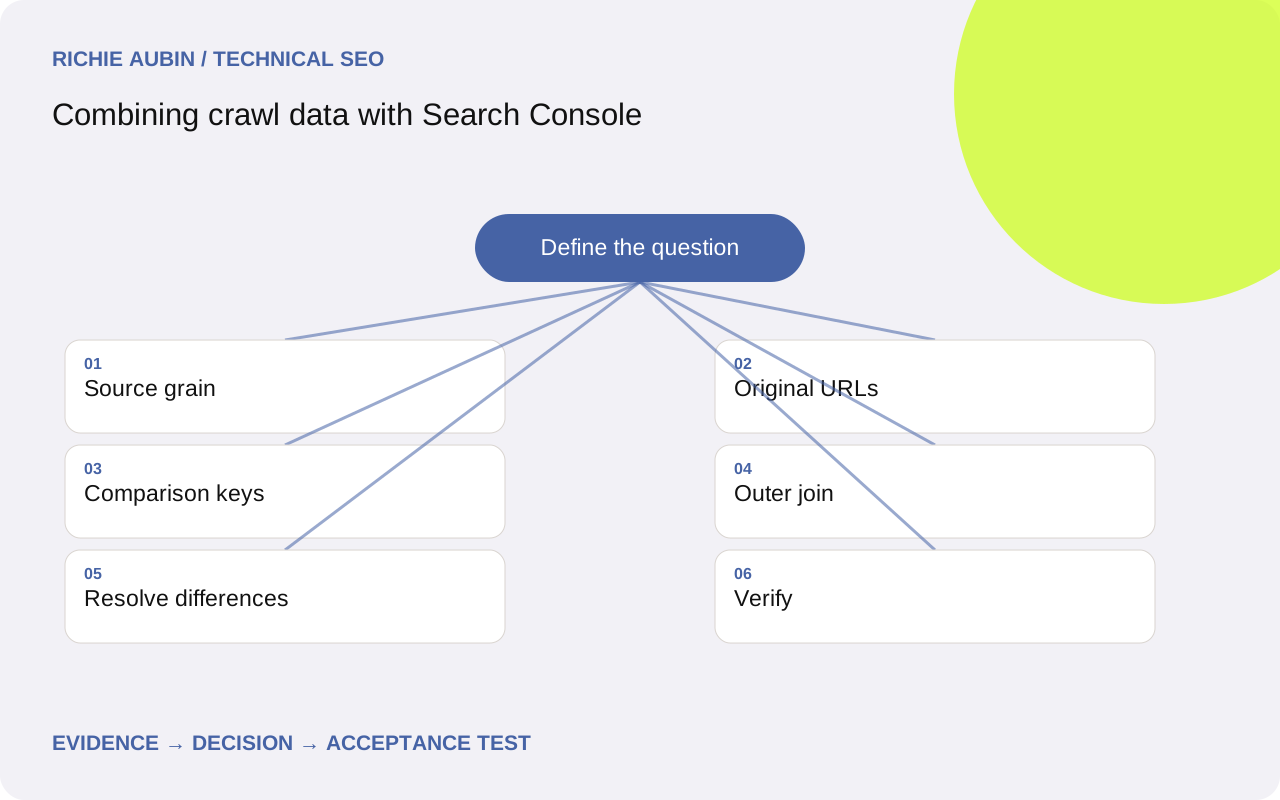
Choose a join that answers a specific question
Start with a decision such as identifying public landing pages that currently fail a technical expectation despite recent search exposure. That requires crawl observations and page-level performance data. A different question, such as which canonical Google selected, requires indexed-version inspection evidence rather than an impression count.
Write the grain of each dataset before combining them. A crawl may contain one row per requested URL. Performance data may contain one row per page, date, device and country. Inspection data represents a recorded observation for an inspected URL. Joining these without accounting for grain can multiply rows and inflate clicks or error counts.
Define the expected output in plain language: a table of known public URLs, current technical state, observed search exposure and evidence gaps. Keep discovery provenance and intended indexability attached. The crawl data analysis guide covers the crawl side; this workflow focuses on preserving meaning when independent sources meet. Resist adding query-level detail unless the question genuinely needs it.
Export sources with their coverage intact
Save the crawl’s configuration, timestamp, requested URL, response, final destination, directives and canonical observations. Keep a current sitemap or publishing inventory alongside it so you can distinguish a failed join from a URL missing in the crawl. Record whether the crawler rendered JavaScript and whether it followed destinations outside its original scope.
For Search Console, record the property, date window, search type, filters, dimensions and extraction method. Prefer complete recent periods when making comparisons, and note any incomplete data. API pagination helps retrieve available rows but does not make every possible page-query combination available. Fine-grained dimensions can reduce coverage and complicate totals.
Keep raw exports unchanged. Build a derived analysis layer that can be regenerated, rather than editing source cells until totals look aligned. Use separate labels for observed zero, no returned row and unavailable data. This is particularly important when reporting exclusions: a page absent from a performance export has no returned performance evidence in that extract, not a demonstrated indexing failure.
Preserve URL identity before normalisation
Create an original URL column and a separate comparison key. Lowercasing an entire URL, removing every parameter or forcing a trailing slash can merge distinct resources. Decide each transformation from actual routing behaviour. Host aliases and protocol redirects may justify a mapping, but the observed relationship should remain available for review.
Store redirect destinations and canonical declarations as relationships, not silent replacements for the requested URL. If a variant maps to a preferred page, retain both identities and the reason. Google commonly attributes performance to its selected canonical, which can explain why a crawled variant has no page-level performance row. That is a hypothesis to check, not permission to aggregate everything automatically.
Make an explicit alias table when the site’s known route policy supports it. Include the source, target, rule and evidence time. Compare exact joins before applying aliases so the analyst can see what changed. Follow canonical investigation when declared preferences, selected canonicals and redirect behaviour do not agree.
Use outer joins and validate cardinality
Begin with the union of relevant inventories rather than retaining only matched URLs. A left join from crawl data hides pages found only in Search Console. An inner join hides every unmatched row. Those missing populations may be the most useful part of the investigation, especially after navigation changes or migrations.
Aggregate performance to the intended page grain before attaching it to a one-row-per-URL crawl table. Confirm uniqueness on both sides and measure the row count before and after the join. Compare total clicks and impressions against the source extract at the same aggregation level. Unexpected multiplication usually means a key or grain error, not a sudden discovery of extra traffic.
Label populations clearly: observed in both, crawl only, Search Console only and independent inventory only. Add flags for response class, intended state and evidence freshness. Review a few exact examples from every population before producing charts. A small number of manual checks can expose encoded characters, host differences or duplicated keys that would otherwise distort the entire analysis.
Read discrepancies as hypotheses
A crawl-only URL could be new, low demand, intentionally excluded, a duplicate or absent from the selected export. A Search Console-only URL could be historical, externally discovered, removed from navigation, outside crawl scope or still valid but undiscovered. None of these categories is a diagnosis by itself.
Inspect current behaviour and chronology. Compare publication and release dates with the performance window and Google’s recorded crawl date. A page that now redirects can legitimately retain performance in an earlier date range. A current 200 response does not invalidate evidence that Google previously encountered a failure. Keep “then” and “now” visible in the analysis.
Use inspection selectively on representative URLs to resolve index-state and canonical questions, respecting available access and quotas. Use Search Console indexing diagnosis for that deeper investigation. If the question concerns whether Google requested a changed route, verified request evidence from logs may be more direct than repeatedly expanding performance exports. Choose the next source according to the unresolved claim.
Illustrative example: investigate an apparent orphan group
Illustrative example: a fictional publisher has 240 URLs in a recent page-level performance extract that are absent from its navigation crawl. These invented figures describe a teaching example, not a benchmark. Before calling the group orphaned, check crawl scope, response freshness, canonical attribution and whether the performance window predates a route change.
Suppose 180 URLs are old paths that now redirect to current articles, 40 sit outside an accidentally restricted crawl folder and 20 remain successful public pages with no links found in the intended hub. Keep the populations separate. The redirects need mapping checks; the folder restriction needs a corrected crawl; the final group needs a source-page investigation.
For those 20, inspect the publishing inventory and expected hub membership. A broken category association could explain the missing links, while deliberate archival policy could explain the same observation without a defect. Resolve the intended state before proposing links. The joined table narrows the investigation and gives it examples; it does not independently establish that Google cannot discover, index or rank the pages.
Specify data and development acceptance criteria
Treat analysis quality as part of the handover. The evidence checklist includes source files, extraction dates, filters, keys, alias rules, cardinality checks, missing-row meanings and representative manual validations. Keep the resulting finding reproducible so another analyst can update it without guessing how a dashboard was assembled.
For a confirmed hub-association defect, developer acceptance criteria should require published articles in the agreed class to appear as normal links on the correct hub, valid destinations to serve expected content and intentionally archived exceptions to remain outside that rule. Include new and existing records, and confirm the repair does not create links to drafts or unavailable pages.
Data acceptance criteria are different: unique keys at the declared grain, no unintended metric multiplication, preserved original URLs and explicit unmatched populations. Keep the two sets separate. Fixing the analysis pipeline can remove a false alarm without changing the website. Fixing the website should remain independently verifiable even if Search Console’s next data update has not yet arrived.
Account for lag, missing data and reversal
Search performance is influenced by demand, query mix, result presentation and other factors beyond current technical output. A before-and-after click comparison cannot isolate a technical repair without considering those changes. Use matched periods and relevant segmentation, but do not describe an uncontrolled comparison as proof of causation.
Preserve privacy and minimise unnecessary detail. Query-level exports are not always required to answer page-level technical questions, and unavailable rows should not be reconstructed through assumptions. A missing inspection result is unknown evidence, not a negative verdict. The analysis should make these limitations visible in labels and handover notes, rather than relegating them to an unread footnote.
Before changing routing or navigation based on a join, review original URLs and intentional exceptions. A mistaken normalisation rule can prompt destructive consolidation of distinct content. Keep a reversible mapping or configuration change, test a bounded sample and preserve the original join logic. Feed confirmed checks into technical monitoring, including the health of the data extraction itself.
Frequently asked questions
Does no Search Console row mean a page has no impressions?
It means the selected extract did not return a row for that page under its property, date range, dimensions and filters. Coverage limitations and canonical attribution can affect the result. Preserve that meaning instead of automatically converting it to zero. Use a more focused query or inspection evidence when the distinction matters to the decision.
Should URL parameters be removed before joining?
Only when you have established that the removed parameters do not define distinct resources for the analysis. Preserve the original URL and document the mapping. Parameters can change language, filters or content identity. Blanket stripping may falsely merge pages, move metrics between records and conceal the cause of a technical problem.
Which date should be used for the crawl comparison?
Record the crawl’s actual observation time and compare it with an explicit performance window. When investigating a release, separate pre-release and post-release periods and keep Google’s recorded crawl timestamps visible where available. Do not assume that performance collected over several weeks represents the exact response your crawler observed on one day.
Can this workflow establish that a technical fix caused traffic growth?
It can connect technical changes with subsequent observations and help test explanations, but the join alone does not isolate causation. Demand, content changes and search conditions can also affect performance. Verify the repair through technical acceptance criteria, then report search changes with their comparison method, timing and remaining alternative explanations.