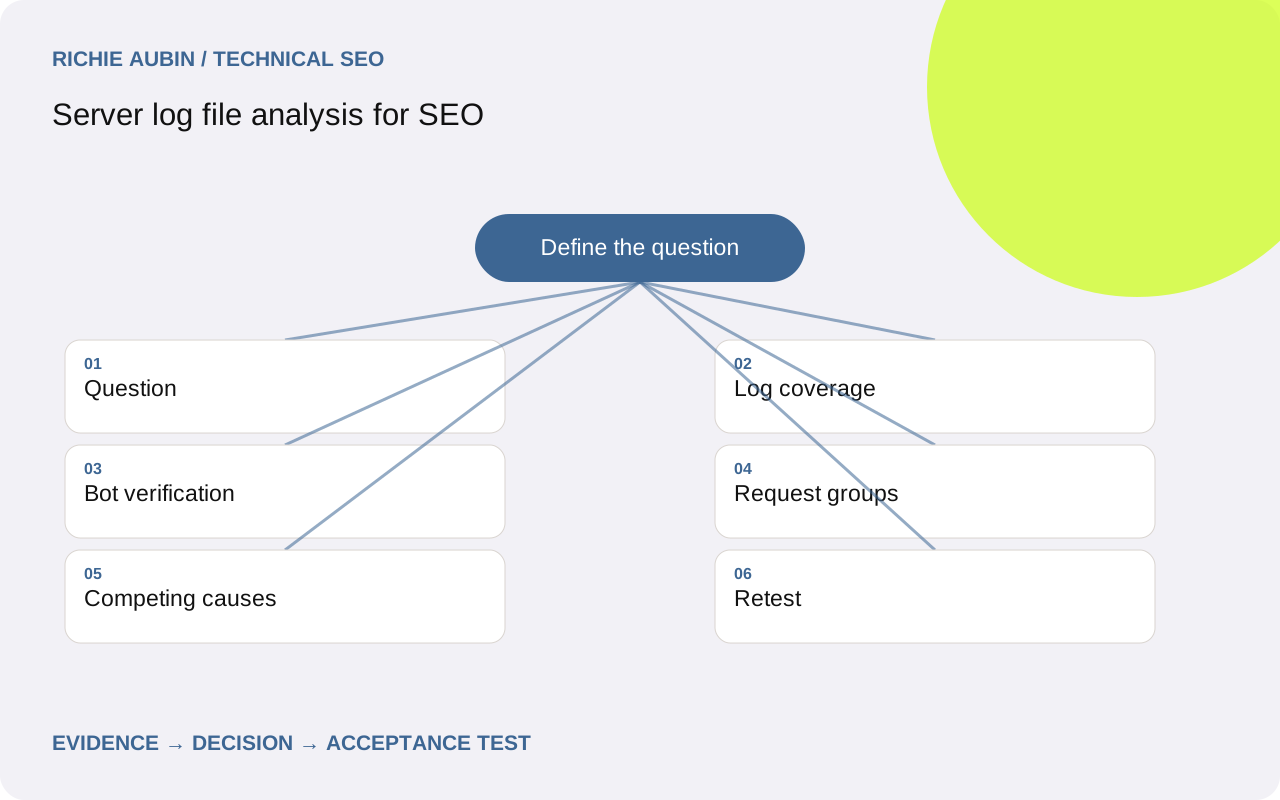
Define the request question before obtaining logs
Start with a question that logs can answer: did verified Googlebot requests encounter server errors on a newly deployed route group? That needs request timestamps, paths, response codes and trustworthy bot classification. “Why are rankings down?” is too broad; logs can test parts of that question but cannot describe demand, relevance or every indexing decision.
Agree the infrastructure boundary. Origin logs describe requests reaching the origin, while CDN or reverse-proxy logs can describe responses served before the origin is contacted. A lack of origin requests may reflect caching rather than a lack of crawling. Identify all relevant hosts, edge services, application nodes and retention windows before interpreting absence.
Ask for the smallest useful data extract, not an unrestricted collection of visitor information. Paths and query strings can contain personal or sensitive values. Coordinate redaction, access and retention with the responsible team. Preserve the fields required for the hypothesis, and document how redaction affects URL matching. A clean evidence boundary makes the analysis both safer and more credible.
Validate completeness, clocks and field meanings
Request a field definition with the logs. Confirm timestamp timezone, host, raw request target, method, status, user agent, client address or trusted client identifier, cache status and relevant timing fields. A duration may measure origin processing, edge response time or another interval; never label it as user experience without knowing its meaning.
Check the collection window for missing hours, rotation gaps, failed exports and sampling. Align clocks before comparing a release with response changes. If multiple systems log the same request, identify a reliable request identifier or keep the layers separate. Counting an edge record and its origin counterpart as two crawler fetches can distort both volume and error rates.
The evidence checklist includes source layer, export method, coverage window, sampling status, field definitions, redaction rules, clock assumptions and row-validation examples. Compare coarse request patterns with another available operational source to spot obvious gaps. A disagreement is a reason to investigate instrumentation, not to force the counts to agree through undocumented filtering.
Verify crawler identity instead of trusting a label
A user-agent string is a claim that can be copied. Use it to select candidate requests, then verify the source against Google’s current official verification methods. The appropriate published IP ranges depend on the crawler or fetcher category. Keep ordinary search crawling separate from special-purpose and user-triggered activity.
For manual verification, Google documents reverse DNS checking followed by a forward lookup that resolves back to the original address, with the appropriate hostname rules. For automated processing, use the documented IP-range approach and retain the verification source and retrieval date. Do not assume a hostname containing the word “google” is sufficient evidence.
Confirm how your infrastructure supplies the client address. Behind proxies, an untrusted forwarded header can be spoofed, while a log containing only the proxy’s address cannot identify the original requester. Ask the infrastructure owner which field is trustworthy. Keep verified, claimed-but-unverified and unknown traffic separate. This avoids mixing ordinary Googlebot activity with spoofed requests or manual inspection-tool traffic.
Build request and URL views separately
Retain a request-level dataset for chronology, repeated failures and response variation. Create a second URL-level summary for questions such as whether an important route was requested during the available window. Include first and last observed request, response mix and relevant crawler category. A count of requests and a count of distinct URLs answer different questions.
Preserve the raw request target before constructing a URL key. Host, encoding, parameter order and case can matter. Group routes using the actual application model rather than assuming every numeric segment is an interchangeable identifier. Review examples from each group, especially when parameters can change content or language.
Measure proportions with explicit denominators. “Five per cent errors” could mean five per cent of all requests, verified Googlebot requests or distinct public URLs. Those are materially different claims. Segment by host, template, response class and time interval to locate patterns. Avoid treating the most frequently fetched URLs as the most commercially important pages without additional inventory and journey context.
Test crawl hypotheses against the right comparison
For an availability hypothesis, inspect response patterns around deployment and compare affected routes with stable controls. For a discovery hypothesis, join verified requests with a current intended inventory and known publication dates. For a parameter-expansion hypothesis, inspect route families and repeated combinations rather than relying on total request growth.
Competing explanations often fit the same chart. Fewer origin requests might indicate reduced crawling, better cache coverage or an export gap. More errors might indicate a broken application, rate limiting or a changed logging definition. Resolve the layer and denominator before changing robots rules or increasing capacity.
Use crawl budget guidance when the question concerns a large, frequently changing inventory; log volume alone does not establish a crawl-budget problem. Use crawl and Search Console reconciliation to connect request evidence with present technical state and recorded search data. Keep the joins explicit, because a request at one time cannot prove the content or index state at another.
Illustrative example: distinguish caching from missed crawling
Illustrative example: a fictional publisher sees almost no origin requests for recently updated guides and suspects Googlebot has stopped visiting them. Competing explanations are missed crawling, edge-served responses and incomplete origin retention. The useful first step is checking CDN coverage and cache fields, not rewriting sitemaps.
Suppose verified crawler requests appear in complete edge logs, with successful cached responses for those guide URLs. The origin’s quietness now has a plausible infrastructure explanation. Inspect cache freshness and a representative response to establish whether the edge served the updated content or an older document. A successful response code alone cannot answer that question.
If the fictional investigation finds stale edge content, the ticket concerns cache invalidation on publication. If content is fresh, the “not crawled” interpretation should be withdrawn for the observed requests. In both cases, indexing remains a separate question for Google’s recorded evidence. These invented observations demonstrate how a better measurement boundary can change the diagnosis without claiming a traffic improvement or a universal revisit interval.
Write acceptance criteria for the confirmed mechanism
For a cache-invalidation defect, specify which publishing transition must invalidate which public routes and variants. Acceptance criteria should test a known content marker before and after publication, record edge and origin behaviour, and include unaffected pages as controls. Confirm that response status, directives and canonical output remain correct during refresh.
For a crawler-facing availability defect, specify the legitimate request conditions, route group and expected response behaviour. Include load and security requirements agreed with infrastructure owners. Do not recommend a blanket security bypass based only on a user-agent string. Verification supports diagnosis; production access decisions still need a narrow, defensible rule.
Retest with controlled requests and fresh log evidence, then observe actual crawler requests when available. Distinguish synthetic verification traffic from ordinary crawling so the validation does not manufacture its own success metric. The release QA workflow helps tie evidence to a deployed version. Close the repair against its technical contract rather than an expected number of bot visits.
Respect limitations and plan reversal
Logs usually show request metadata rather than the full document a crawler processed. A 200 response can still contain an error message or incomplete content. Requests do not establish rendering success, canonical selection, indexing or rankings. Pair logs with captured responses, rendering checks and relevant Search Console evidence when those are the claims under review.
Absence remains bounded by retention, sampling, host coverage, cache layer and bot-verification quality. State the observation window when saying a URL was not seen. Do not describe an unobserved request as proof that Google never knew the page existed. Short windows are particularly weak for conclusions about infrequently changing pages.
Rollback can also change the evidence. Reverting cache rules may increase origin load; changing security rules may alter which requests reach the application; a logging change may break comparisons. Preserve pre-change definitions, prepare a narrow reversal and watch both service health and telemetry quality. Use technical monitoring to retain the confirmed checks, while avoiding alerts based solely on arbitrary bot-frequency targets.
Frequently asked questions
Can user-agent filtering identify genuine Googlebot requests?
It identifies candidates, not verified identity. Anyone can send a familiar user-agent string. Use Google’s documented verification approach and a trustworthy source-address field. Keep crawler categories separate, because ordinary search crawlers, special-purpose crawlers and user-triggered fetchers do not represent the same activity or necessarily use the same published address ranges.
How much log history is enough?
Enough depends on the question, publication cadence and available retention. An immediate release failure may be visible in a short, complete window. A claim about uncrawled older inventory needs a more suitable observation period and independent context. State coverage and missing intervals explicitly rather than presenting one fixed duration as universally sufficient.
Does a 200 response to Googlebot prove successful indexing?
No. It establishes the logged response status for that request. The body might still be incomplete or inappropriate, and later processing may select another canonical or exclude the page. Inspect representative response content and use relevant Google-recorded evidence for indexing questions. Keep each conclusion tied to the source that can actually support it.
Why do edge logs and origin logs disagree?
The edge can answer requests from cache, block them or redirect them before the origin is contacted. Systems can also use different timestamps, sampling and retention. Compare field definitions and collection boundaries before aggregating. Preserve both layers when they answer different questions rather than forcing request counts to match through unexplained adjustments.