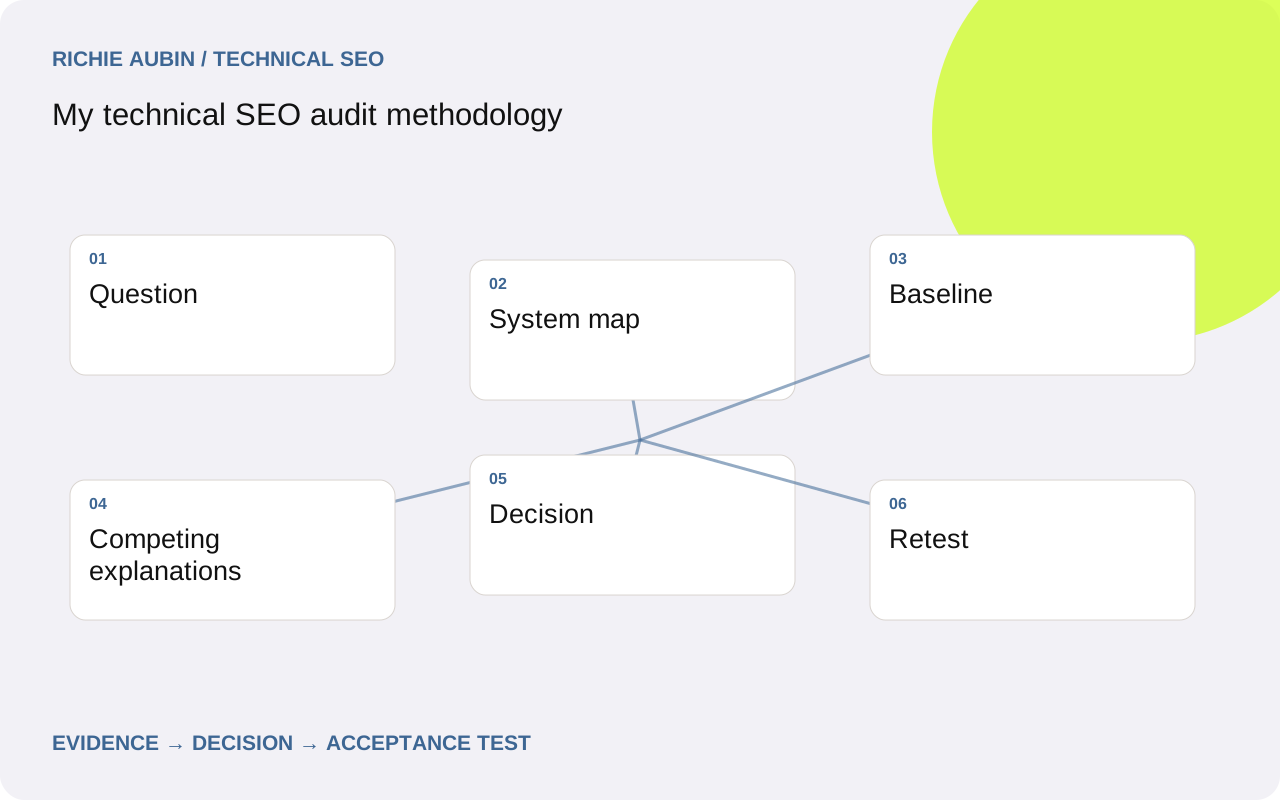
Frame a question with a clear stopping point
Replace “audit the site” with a question about a specific decision. For example: are newly published guides technically accessible and discoverable through the intended public routes? That question defines an inventory, a relevant time window and observable conditions. It also prevents unrelated warnings from taking over the investigation before the main concern is understood.
Write the expected state with the publishing and engineering teams. New guides might be expected to return successful responses, contain their main content on direct entry, permit crawling and provide an intentional canonical. Do not include a guaranteed ranking or indexing outcome in that definition. Those are decisions made by search systems beyond the implementation.
Set a stopping point: the evidence needed to confirm a mechanism, reject it or record that it remains unresolved. Record practical constraints such as missing historical logs, limited staging parity or incomplete CMS exports. A method is stronger when it names what cannot be known than when it presents every plausible explanation as an established cause.
Map the site’s systems before choosing tools
Sketch the path from a content record to a public response: publishing state, route generation, origin application, edge configuration and browser rendering. Identify where robots headers, canonical values, redirects and navigation links are created. This makes it possible to investigate the responsible layer rather than repeatedly inspecting the same output through different tools.
Build a URL inventory with source labels and intended states. Separate public documents, duplicates, retired content, private routes and unknowns. Sample across templates and state transitions, such as draft to published, available to unavailable and old route to replacement. A template name alone is a weak sampling strategy if behaviour changes with record state.
Choose the instrument after the question. A crawler can show internal discovery under its configuration; Search Console can describe recorded search evidence; a browser can reveal rendered output; logs can show requests at the captured infrastructure layer. The audit checklist keeps this coverage explicit, while the system map tells you where to investigate when observations disagree.
Create a reproducible evidence baseline
Keep a dated baseline before making recommendations. Record the crawl configuration, software version, start points, exclusions, rendering mode and request limits. Save source exports with their date ranges and filters. Retain original URL values even when you create normalised keys for analysis. Otherwise, an apparently tidy join can erase the very distinction under investigation.
For each sampled URL, capture the response chain, relevant headers, original HTML and rendered evidence where needed. Store the expected state beside the observation. If a page changed recently, note the release or publishing timestamp. Search Console’s recorded version may describe an earlier crawl, so do not silently treat it as a live test.
The evidence checklist should allow another person to repeat the observation: input, conditions, time, result, expected result, source and known limits. Avoid indiscriminate archives of sensitive content or full logs when a limited extract answers the question. Data volume does not strengthen a conclusion unless the extra records improve scope, comparison or reproducibility.
Design tests that separate competing hypotheses
List at least one plausible alternative to the preferred explanation. If a crawler misses a section, the site might lack links, the crawler might exclude the path, or links might appear only after rendering. A second crawl with the same configuration cannot distinguish these. Inspect known source pages and change one relevant condition at a time.
Use matched controls. Compare an affected and unaffected page sharing the same template, then inspect the differences in record state, navigation placement or response rules. Look for observations that would contradict the explanation. If you believe a global middleware caused a header issue, a stable unaffected route through that same middleware requires explanation.
Sequence tests by information value and cost. A raw header request may resolve a directive question faster than a full rendered crawl. A limited rendering comparison may establish whether a larger JavaScript investigation is justified. The aim is not to prove the first theory through accumulating examples, but to reduce uncertainty enough to choose a proportionate repair.
Illustrative example: separate discovery from rendering
Illustrative example: a fictional publisher says its new article hub is not being found. A basic crawl discovers only the hub landing page. The initial hypothesis is that JavaScript prevents link discovery. Competing hypotheses are a path exclusion in the crawler and missing links caused by a publishing filter.
First, request the hub response and inspect the links in its original HTML. If article anchors are already present, a JavaScript explanation weakens. Next, inspect the saved crawl exclusions. In this illustrative scenario, an old rule excludes the article folder. A corrected crawl can now follow those links, but that result establishes crawler coverage rather than Google indexing.
Check Google’s recorded evidence separately for representative published URLs. If those pages also lack visibility, investigate their age, selected canonicals and indexing conditions rather than declaring the configuration correction a search repair. The example shows why an audit must separate a measurement defect from a website defect. No fictional improvement percentage is needed: the meaningful outcome is a narrower, more accurate diagnosis and a corrected evidence base.
Assess confidence without concealing uncertainty
Separate observation, interpretation and recommendation in the finding. “The response contained noindex at this time” is an observation. “A preview rule leaked into public routing” is an interpretation that needs configuration or code evidence. “Restrict the rule to preview routes” is a recommendation whose safety depends on the intended route model.
State confidence in the cause and scope independently. You may have strong evidence of one incorrect response but only a sample-based estimate of affected pages. Conversely, a broad pattern may be obvious while its mechanism remains uncertain. Explain which further test would change the decision, instead of attaching an unexplained confidence score.
Consider false positives from stale caches, geolocation, consent, request throttling and extraction rules. Also consider false negatives: a successful warm-cache test may miss a cold-start failure. Use combined crawl and Search Console analysis when source disagreement matters. The discrepancy is evidence to investigate, not an inconvenience to average away into one status.
Specify a repair and its negative controls
Write the smallest change that corrects the confirmed mechanism. Describe the affected routes and state combinations, expected responses, responsible system and boundaries. Attach representative failures and unaffected controls. A developer should understand the intended behaviour without accepting every detail of the auditor’s preferred implementation.
Acceptance criteria must include both the desired repair and protected exceptions. For a publishing directive defect, confirm that public published routes have the intended directives, preview routes remain protected, missing content retains correct error behaviour and cached responses no longer carry stale headers. Specify relevant direct-entry and rendering checks if content delivery also changes.
Agree a bounded verification plan with the implementation owner. If a dependency must change first, record that relationship instead of raising several apparently independent tickets. Use issue prioritisation to compare the repair with other confirmed work. Keep speculative improvements outside the mandatory fix so deployment risk remains proportionate to the evidence and consequence.
Close the implementation and retain the lesson
Retest the original observation under the original conditions, then test nearby cases that share the changed system. Capture the deployed version and time. A fresh pass establishes the repaired technical behaviour; it does not prove an immediate search response. Keep any later observation window explicit and distinguish new crawl evidence from historical reports.
Plan reversal before rollout. Identify whether reverting application code also restores routing tables, CMS fields and edge configuration. Some changes outlive a release through caches or content migrations. A rollback can recreate the original defect or remove unrelated later work, so choose a narrow reversal where practical and state the failure that would trigger it.
Convert the confirmed failure mode into a durable check. That might be a public-route header assertion, an inventory reconciliation or a rendered-content test. The regression testing guide explains how to preserve behavioural expectations. End the audit with a decision record: what was found, what changed, what passed and which uncertainties remain open for a specific next review.
Frequently asked questions
Does this methodology require a particular crawler?
No. The method depends on reproducible observations, intended states and tests that separate explanations. A crawler is useful for discovery and scope, but other instruments answer different questions. Choose software that can preserve the necessary evidence and configuration. Do not substitute a tool’s default issue labels for a reasoned conclusion about the site.
How should conflicting evidence be handled?
First align the URL, timestamp, request conditions and source meaning. A live response and an indexed-version report can both be accurate while describing different moments. Preserve both observations, state the discrepancy and run a test that distinguishes timing, configuration or platform behaviour. Avoid selecting whichever source supports the preferred explanation without resolving the difference.
When is sampling sufficient for an audit finding?
Sampling can establish a reproducible mechanism and identify affected conditions, but it does not automatically quantify every affected URL. Expand coverage when behaviour varies or consequences are high. Use inventories or deterministic route rules to estimate scope where possible. Report the tested sample and inferred reach separately, including important states the sample did not cover.
What if the investigation cannot establish a root cause?
Deliver the confirmed symptom, tested alternatives, evidence limits and the next discriminating test. A bounded investigation ticket can be a valid outcome. Avoid recommending a broad rewrite because the mechanism remains unclear. Protect useful evidence before it expires and name the owner who can obtain the missing configuration, historical record or infrastructure observation.