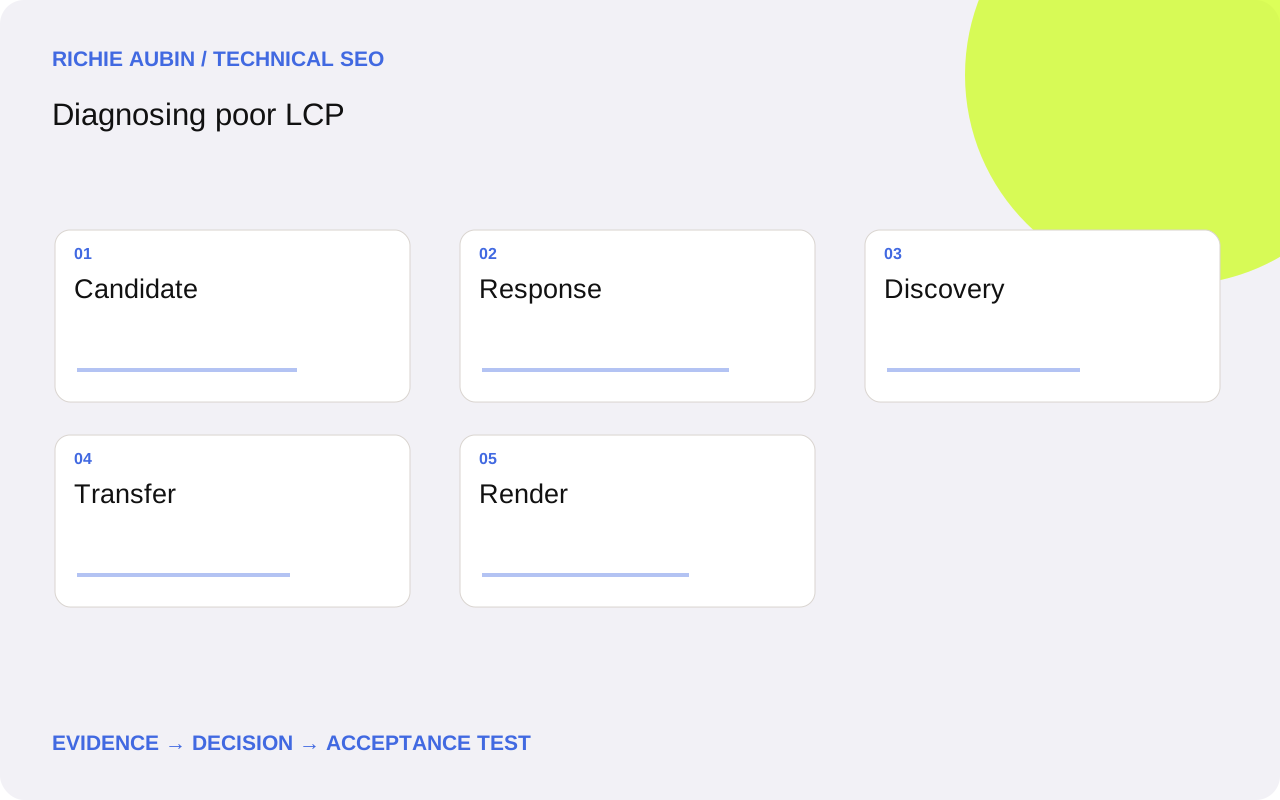
Find the winning element in the failing viewport
Start with the experience you need to explain: a specific URL, device category and field reporting window. LCP measures the rendering time of the largest eligible visible image or text block. A good field result is at or below 2.5 seconds at the 75th percentile. Do not assume the desktop hero is also the mobile candidate; responsive layouts, consent panels and gallery states can change which element wins.
Record a browser performance trace with screenshots and inspect the reported candidate. Save its selector, content type, resource address if relevant and visibility conditions. Repeat with a comparable viewport and cache state. If the candidate changes between runs, investigate why before comparing timings. A large text heading leads towards fonts and rendering dependencies, while an image introduces discovery and transfer questions. The audit methodology sets the broader sample. This first identification step prevents an entire optimisation project focusing on an attractive image that never controlled the failing measurement.
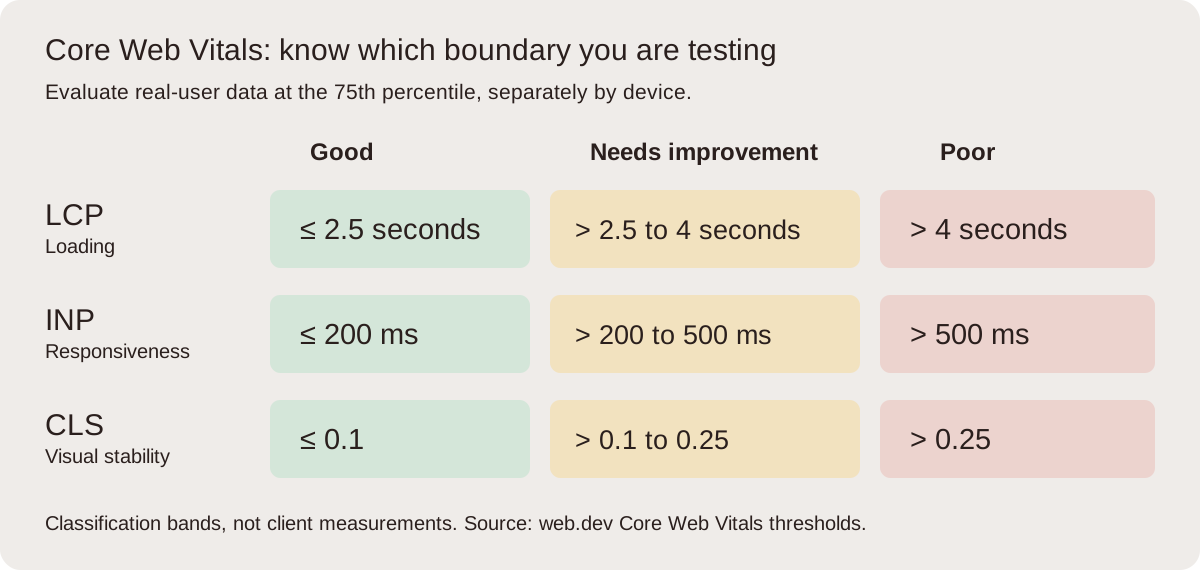
Separate server delay from everything after it
Examine navigation timing before touching the asset. If the HTML response starts late, every discovery in that response starts with a disadvantage. Compare response timing across templates, regions and cache states. Redirects, application rendering, backend queries and delivery configuration are competing explanations. A slow cold response and a slow warm response deserve different investigation paths.
Capture the response headers, redirect sequence and a trace of when useful HTML becomes available. Where server timing instrumentation exists, use it to narrow the application dependency, but do not assume every reported duration explains the entire navigation. Test the same route repeatedly and compare a static or simpler route on the same origin. Avoid attributing all waiting time to the hosting provider without evidence. A cache may appear to solve the problem while serving stale availability or personalised content incorrectly. Any delivery change needs explicit rules for cache keys, cookies, invalidation and content freshness, with a functional owner reviewing those rules.
Measure when the browser can discover the resource
For an image candidate, compare the HTML arrival with the first request for the selected image. A late start often points to the address being hidden in CSS or JavaScript, a lazy-loading rule on above-the-fold media, or a component that waits for application data. Inspect the initial HTML and the request initiator rather than guessing from the final rendered markup.
Prefer making the correct primary image discoverable in the initial response where the architecture allows it. Do not lazy-load a likely LCP image. Priority hints can help the browser distinguish important requests, but they do not repair an address that does not yet exist. A preload can be useful for a genuinely hidden critical resource, provided its responsive selection matches the eventual request. Otherwise it can download an unused candidate alongside the correct one. The image performance guide covers selection and sizing. Confirm the request begins earlier after the experiment; changing markup without checking the waterfall is not enough.
Distinguish transfer cost from rendering delay
Once the request starts, inspect how long it takes to complete and what happens afterwards. An oversized image, inefficient delivery path or inappropriate responsive candidate can extend transfer. Compare transferred bytes, intrinsic dimensions and rendered dimensions. Test different formats against visible quality requirements rather than assuming the smallest file always gives the best implementation.
If the file arrives well before LCP, compression alone is unlikely to remove the dominant delay. Look for render-blocking styles, hidden gallery states, font dependencies, decoding work and long main-thread tasks. A component may download its image early but deliberately keep it invisible until hydration completes. The right experiment could remove that visibility dependency while retaining enhancement. For a text candidate, image transfer does not apply, so follow the stylesheet and font path instead. Keep stages distinct when writing the ticket. An earlier resource completion that is cancelled out by a longer rendering wait can leave LCP unchanged even though the asset itself improved.
Build evidence that distinguishes competing causes
Use an evidence checklist containing the candidate, viewport, navigation response timing, request initiator, request start and completion, painting time, cache state and release version. Add initial HTML, relevant headers and a screenshot at the moment the content becomes visible. Preserve a comparable healthy URL or run to expose what changes when the fault is absent.
Test hypotheses one at a time. If lazy loading is suspected, remove that attribute for the candidate while retaining the image file and gallery code. If CSS visibility is suspected, allow the content to display before enhancement without changing download priority. If server delay dominates, compare an appropriately cached response without also replacing the image format. These controlled experiments are an original diagnostic workflow, not a guarantee that any particular fix will work. Read JavaScript performance when main-thread execution is the remaining dependency. The decisive evidence is the expected stage moving, not simply an aggregate score increasing.
Illustrative example: an early download that stays hidden
Illustrative example: a product image finishes downloading promptly in a controlled trace, but the gallery wrapper remains transparent until its application initialisation completes. The first proposal is to convert every product image to another format. The competing hypothesis is that the wrapper visibility rule, rather than transfer, controls the final paint. The trace supports testing the visibility dependency first.
Change the gallery so its initial image is visible in server-rendered markup, then enhance controls when scripts are ready. Keep the same source image, viewport and network profile for the comparison. Inspect whether LCP moves earlier, whether the candidate remains the product image and whether hydration creates flicker or a layout shift. Then test variation changes, missing images and JavaScript failure. If painting remains delayed, inspect critical CSS and main-thread work next. This example has no claimed measured saving: it demonstrates how to choose a discriminating experiment and protect the gallery behaviour while testing it.
Set acceptance criteria for the critical path
A developer should receive the exact page state and stage responsible for the delay. Specify the intended resource discovery path, visibility behaviour and responsive selection. For a primary image change, acceptance might require an address in initial HTML, no lazy loading on the confirmed candidate, no redundant preload download and stable reserved dimensions. These are implementation observations that can be verified directly.
Run repeated matched traces and compare the affected stage and overall LCP. Check narrow and wide viewports because the winning element can change. Include navigation, gallery controls, image quality, alt text and content availability in functional review. Then schedule a field comparison with unchanged cohort definitions, acknowledging the reporting window. Do not promise an exact time saving before measuring the release. A useful target names an agreed experience threshold and the dependency removed, while the evidence explains whether the change delivered it. Keep the raw comparison traces so a later regression can be distinguished from ordinary run-to-run variation.
Recognise false positives and rollback hazards
A slow laboratory run can reflect an unusual cache miss or contention on the test machine. A fast run can reflect warmed assets that first-time visitors lack. Field and lab may also identify different candidates because their viewports and page states differ. The field and lab guide explains how to reconcile those cases. Missing field data does not prove the loading experience is good.
Treat preload and caching changes as reversible experiments. Excessive priority can delay styles or other useful images; an incorrect responsive preload can waste bandwidth; HTML caching can expose stale or inappropriate content. Retain the previous markup and asset variants during rollout. Define rollback triggers around broken galleries, wrong content, increased errors and deterioration in interaction or stability. Account for edge caches when reversing the change. Close the investigation only after the measured critical path behaves as intended and the surrounding journey remains usable. LCP improvement does not itself guarantee better search positions.
Frequently asked questions
Should every hero image be preloaded?
No. First confirm which image is the LCP candidate and whether discovery is actually late. An image already discoverable early may need no preload. Multiple promoted resources can compete, and a preload that does not match responsive selection may be wasted. Check the resulting request sequence rather than applying the hint universally.
Why did a smaller image leave LCP unchanged?
The transfer may not have controlled painting. If JavaScript, CSS or a visibility rule holds the element back, a smaller resource can finish earlier without becoming visible earlier. Compare request completion with the final paint, then test the dependency filling that gap. Also check whether another element became the candidate.
Can text be the LCP element?
Yes. A large eligible text block can be the candidate. Investigate when its HTML becomes available, which styles allow it to render and whether font loading changes visibility. An image-focused checklist alone will miss that path. Recheck the candidate after font or layout changes because the measured element can change.
Does better server response always solve poor LCP?
No. Earlier HTML gives the page a better starting point, but late discovery, expensive transfer or rendering dependencies may still dominate. Break the timing into stages and inspect the whole path. Protect content freshness and personalisation when testing caches, rather than accepting faster incorrect responses as a successful fix.