Give each source a clear job
Use field data to establish whether an experience affects observed users and which groups need attention. Use laboratory data to reproduce a behaviour, inspect its dependencies and compare a controlled change. Neither source can replace the other. A fast controlled load cannot establish that every visitor receives the same experience, while an aggregate field value rarely explains the exact blocking task.
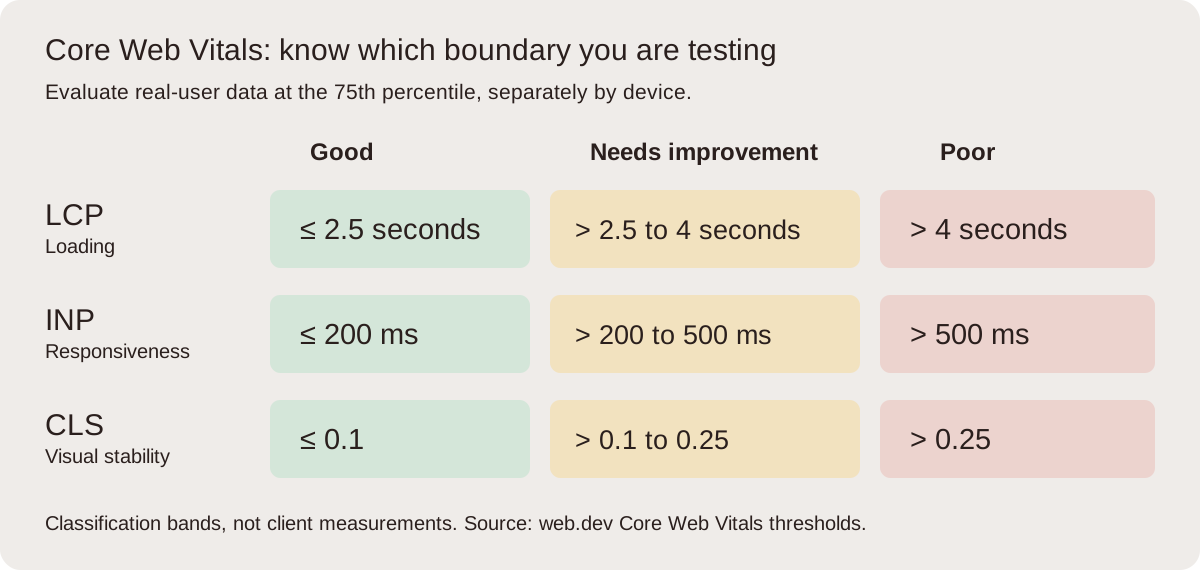
Core Web Vitals good thresholds are LCP at or below 2.5 seconds, INP at or below 200 milliseconds and CLS at or below 0.1 at the field 75th percentile. That percentile is a distribution boundary, not an average visit. Keep mobile and desktop separate. Laboratory scores may combine several measurements using their own scoring model, so do not compare the score directly with one field metric. The Core Web Vitals overview explains the practical outcomes. Start every reconciliation by writing the question you need answered: prevalence, cause or release effect.
Match URL, origin and page-group scope
Check whether the field value belongs to the exact URL, an origin or a grouped set of pages. Some reporting surfaces fall back to broader data when the requested URL lacks sufficient observations. That broader view can be useful context, but it cannot certify the individual page. Save the scope label with the number rather than relying on the address typed into the tool.
Compare templates before drawing conclusions from a whole origin. A service can contain a fast blog and a slower application, with traffic concentrated differently across devices. Search Console grouping is also not the same as a trace of one representative URL. Inspect examples to understand the grouping and then test meaningful variants. Missing URL-level field data is an evidence gap, not a failing score. The audit methodology describes deliberate sampling. An evidence checklist should include requested URL, returned scope, source, device, reporting window and whether an origin fallback occurred. Without those fields, an apparent contradiction may be a comparison of unrelated populations.
Align reporting windows and deployment dates
A rolling field window mixes experiences from before and after a deployment until older visits leave the window. A laboratory run describes its own test time. Comparing yesterday's release with a long-window field value as though both represented the new code creates false failure reports. Annotate deployment time, asset version and the relevant cache rollout alongside every comparison.
Use recent real-user monitoring, where available and suitable, to examine post-release cohorts earlier. Keep sample sizes and coverage visible because shorter windows are noisier. Separate deployment cohorts if the instrumentation supports it, but do not pretend that a few sessions establish a population-wide improvement. Also inspect concurrent campaigns, regional traffic changes and major content changes. A new audience can change the distribution without any performance regression. The task is to determine which evidence is ready now and which needs more observations. Record a scheduled review point and an owner rather than repeatedly rerunning a public test until its colour changes.
Recreate devices, networks and cache conditions
Real visitors use different processors, connections, viewports and browser states. A laboratory profile is a deliberate approximation of a subset of those conditions. Record its CPU and network settings, location, browser version and whether the cache is cold. Emulation can make comparisons repeatable, but it is not a complete substitute for testing a representative physical device.
Cache differences are particularly easy to miss. Repeated local tests can benefit from cached assets, while new visitors need downloads and initialisation. Conversely, a cold synthetic test can be harsher than many returning visits. Neither is inherently wrong; they describe different conditions. Test both when the decision depends on them. Compare consent, authentication, advertising and experiments too, because they change the page itself. A clean test session with no third-party activity may not resemble the affected field cohort. Preserve these conditions as test metadata and change one at a time when trying to reproduce the reported problem.
Compare journeys and measurement definitions
A standard loading test usually stops before the full visit. Real users scroll to embeds, open filters, accept consent and leave the page open while background tasks run. These differences matter for interaction responsiveness and post-load stability. Add scripted actions that match the affected journey rather than assuming a loading score covers them.
Do not substitute Total Blocking Time for field INP. It can reveal main-thread pressure during the tested period, but the real interaction can occur later and involve different work. Likewise, a stable initial screenshot cannot disprove later layout shifts. Use interaction diagnostics for control-level tracing and layout shift diagnostics for movement across the visit. Some telemetry cannot observe all embedded-frame behaviour, and field datasets have eligibility requirements. Treat differences in measurement coverage as hypotheses to investigate. The useful question is which event or population one source includes that the other omits, rather than which vendor deserves to be believed.
Illustrative example: fast loading, poor responsiveness
Illustrative example: a category page receives a strong laboratory loading score while its field responsiveness remains poor. The first hypothesis is that the field report is stale. Two alternatives are a slower mobile audience and a filter interaction that the loading test never performs. A trace of the populated filter journey reveals extensive rendering work after selection, even though initial loading remains quick.
Run controlled filter tests with the same data volume on representative device settings. Compare that trace with the field interaction attribution where available, then test a narrower DOM update. The laboratory result can now support a causal experiment without claiming to replace the field distribution. Review the post-release cohort separately from the older rolling window. If the reported field value remains unchanged initially, the correct conclusion is that the long-window confirmation is pending, not that the controlled experiment was meaningless. This example illustrates reconciliation; it reports no client result, measured saving or guaranteed threshold outcome.
Define release acceptance in two stages
The immediate acceptance stage should confirm that the targeted cause changed under matched laboratory conditions and that the journey still works. Record repeated runs rather than selecting the best score. Check the relevant timing breakdown, candidate element or layout sequence, alongside functional correctness and errors. A code change that merely shifts cost into another interaction needs further work.
The later field stage should compare equivalent page, device and visit cohorts with adequate observations. Keep the release annotation and any known population changes visible. Define in advance what would count as improvement, inconclusive evidence or regression. Use performance monitoring to maintain those checks after the project ends. Developer acceptance criteria should also specify metadata needed for comparison: release identifier, template label and collection timestamp, subject to privacy constraints. This makes later diagnosis possible without collecting sensitive page content. Separating technical verification from population confirmation lets a team ship responsibly while remaining honest about what it has proved.
Avoid false certainty and preserve rollback options
A field percentile moving slightly can reflect sampling and traffic changes; a laboratory run improving can reflect a warmed cache or a less busy runner. Compare distributions and repeated evidence before assigning causality. Missing data is not a zero. A small subgroup can have a serious experience even when the broader value looks acceptable, so review important journeys rather than letting one aggregate hide them.
Set reversal conditions around broken functionality, content visibility, elevated errors and a sustained credible performance regression. Do not wait for a long rolling report to reflect an obvious broken release. Keep earlier assets and configuration available, and account for caches when reversing. Conversely, do not roll back a sound fix merely because older field experiences still dominate the reporting window. Document the observation that would change the decision and when it will be reviewed. The final judgement should state the tested scope and remaining uncertainty clearly. Neither green laboratory scores nor good field thresholds guarantee search rankings or indexing.
Frequently asked questions
Which source is more accurate?
Each is accurate within its design and coverage. Field data describes eligible observed experiences, while laboratory data describes controlled tests. Decide whether you need prevalence, causal detail or release comparison, then choose the relevant evidence. Most apparent disputes become clearer after matching scope, device, reporting window and journey.
Does no field data mean a page is fast?
No. The source may lack enough eligible observations or the requested scope may not be represented. Use a clearly labelled broader view where useful, collect suitable real-user evidence if available and run controlled diagnostics. Keep the uncertainty visible instead of converting missing data into a pass.
Why do mobile and desktop results differ?
The devices, connections, layouts, content candidates and user journeys can differ. Desktop testing may also hide CPU-heavy work that affects less powerful phones. Treat the categories separately and reproduce the failing context. Combining them into a single average makes it harder to identify the experience that needs attention.
Can a release be accepted before a rolling field window changes?
Yes, if matched tests verify the targeted cause and functional checks pass, while field confirmation remains explicitly pending. Monitor early cohorts and errors, define rollback conditions and assign the later review. Do not claim population-wide success before enough comparable observations support it.