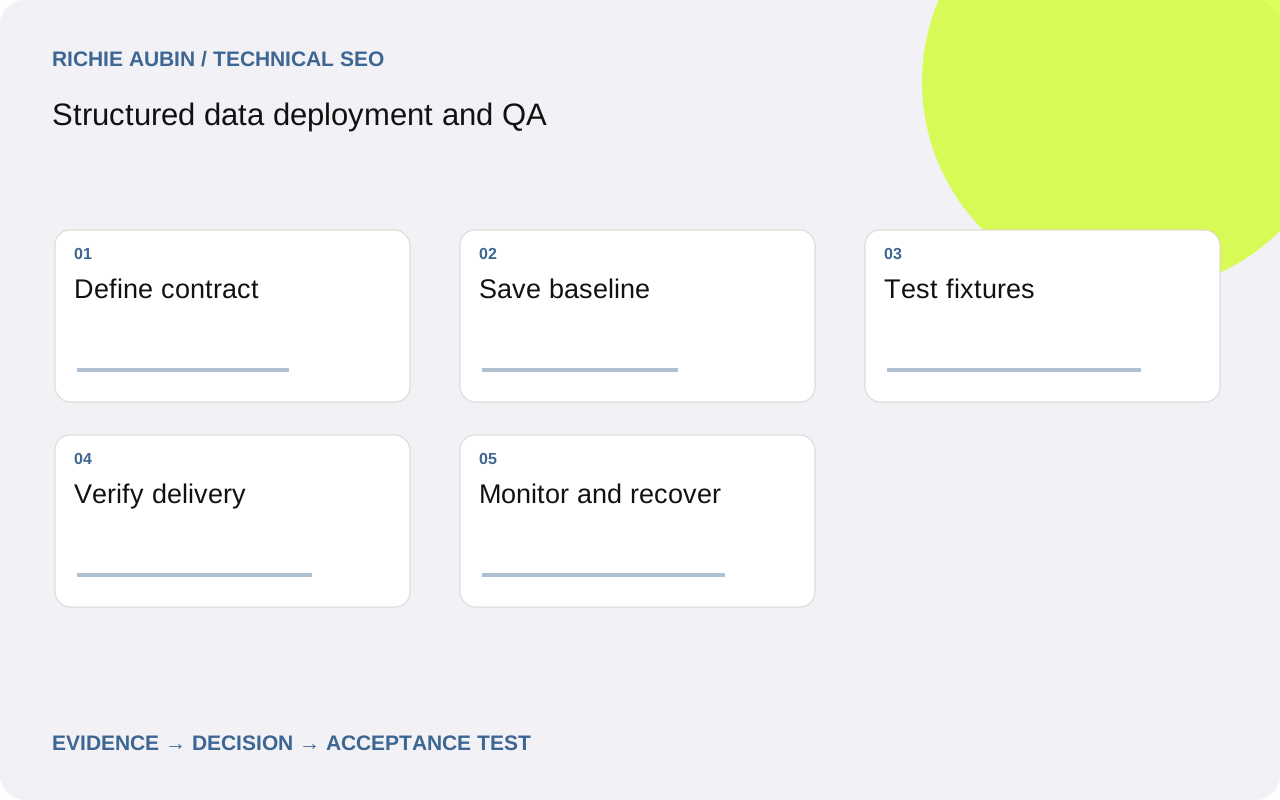
Define the release contract before implementation
Structured data QA should establish what a release is meant to publish, where it is meant to appear and who owns its accuracy. A successful build or a green tool result is insufficient if the wrong author, organisation or trail reaches production. Write the expected entities and relationships into the release brief before editing the generator.
Specify affected templates, source records, intended identifiers and relevant Google features. Include explicit exclusions: a service page should not accidentally inherit a product offer, and a multi-author directory should not become a single-person profile. These negative expectations catch over-broad conditions that otherwise look like increased markup coverage.
Keep this contract small enough to review. The structured data planning guide explains how to choose the model. Release QA then verifies that approved model across generation, delivery and maintenance boundaries. It does not establish that Google will display a particular enhancement or that search performance will improve after deployment.
Map generators, records and independent publishing layers
Inventory every system capable of emitting data: PHP includes, content plugins, client components and tag managers. Record which owns each entity definition and which only adds page-specific relationships. A code release can pass while an independently published tag container continues to inject an old organisation record. Ownership needs to include that layer.
Create a compact dependency map from approved content fields to generated properties. Shared business facts should have a clear source, while an article’s headline and author assignment belong to its record. Identify the person who approves factual changes as well as the engineer who maintains serialisation. These are different responsibilities.
Check whether deployment can mix incompatible versions. New templates may expect fields absent from old content exports; old cached HTML may load new client code. Define compatibility and cache handling before release. A deterministic graph in a build fixture is useful evidence, but it does not show what the public delivery system serves during or after the transition.
Capture a concrete pre-release evidence checklist
Save representative raw responses, rendered output, extracted data blocks, visible supporting content and relevant public asset responses. Label them with URL, timestamp, release identifier and source-record revision. Retain the existing expected entity identifiers so a later diff can distinguish a deliberate migration from accidental identity churn.
The evidence checklist also includes strict parsing results, vocabulary review, applicable feature tests, content approval and any accepted omissions. Record testing mode and tool scope. A screenshot of an overall pass message without its URL or detected item is weak release evidence because it cannot establish which model was tested.
Select both stable fixtures and a small production sample. Include records missing optional fields, values with punctuation, different author assignments and pages that should emit no specialised type. Retain one representative fixture per generator branch. Broad template coverage is more informative than repeatedly testing many ordinary pages that all exercise exactly the same code path.
Use separate gates for syntax, semantics and factual claims
At the generation gate, require each JSON-LD payload to parse and embed safely in its containing HTML. Exercise quotes, Unicode and closing-tag-like text values. At the model gate, compare types, property meanings and identifiers with the approved graph. At the content gate, review claims against visible material and verified records.
Apply the current Google requirements for any relevant supported feature as another gate. A missing required field differs from a recommendation, and a type outside a Google tool’s coverage differs from invalid Schema.org vocabulary. Keep results separate so one passing item cannot conceal another missing or inaccurate entity.
The validation workflow explains those tool boundaries. Automate deterministic assertions where they protect meaningful contracts, but retain human approval for factual identity and sensitive affiliations. A comparison script can detect a changed employer string; it cannot independently establish whether that employment relationship is genuine or current.
Verify the deployed URL before broad rollout
Use an existing release mechanism that permits a limited rollout or rapid recovery where available. Check the actual public URL after deployment, including status, final destination, canonical identity and emitted blocks. Compare its release marker and data values with the approved build. Do not assume that a successful upload replaced every cached document.
For client-generated data, inspect direct entry and navigation between distinct records. Confirm that the second page does not retain the first page’s author, headline or breadcrumb. Check relevant resource failures and any conditions that suppress the generator. Test an ordinary public context rather than relying on an authenticated editorial preview.
Use rendered HTML testing when execution can change the output. URL-based feature testing complements code fixtures because it exercises delivery dependencies. Do not weaken staging access controls just to obtain a public test result; validate isolated code during development, then verify the intended production delivery path within the authorised release process.
Illustrative worked example: a shared publisher component
This illustrative release changes a fictional guide library from per-template publisher strings to one approved organisation record. It is a deployment scenario, not a client case or performance claim. The release contract requires the same publisher identifier across articles, accurate visible attribution and unchanged valid breadcrumb output.
The baseline includes a normal guide, an older guide with no optional summary and an about page. Generation tests pass. After a limited deployment, the normal guide contains the new organisation name, but rendered output also includes an old name added by a tag container. Competing explanations include an old page cache, a second generator and incorrect source data.
The raw response contains only the approved node, while the additional node appears after tag execution. This identifies duplicate publishing ownership. The responsible tag output is corrected without removing unrelated tracking or navigation components. Acceptance requires matching public output across the sample and no obsolete publisher claims. It does not require a knowledge panel change or any immediate search-report response.
Interpret monitoring changes without conflating causes
After release, a falling count of detected items could mean removed markup, collection failure, changed tool coverage or a genuine reduction in applicable pages. A rising invalid count could indicate malformed shared output or newly tested records exposing an older defect. Preserve the denominator, affected templates and collection method before interpreting a trend.
Compare current public evidence with historical reports. Search Console can reflect earlier crawls, and not every vocabulary type has an equivalent enhancement report. Google retired FAQ rich results in May 2026; QA should not depend on restoring that retired feature or its old reporting behaviour. Keep useful FAQ content without obsolete presentation promises.
If a search treatment is absent despite passing current checks, consider selective presentation and content eligibility alongside implementation faults. Do not repeatedly change a stable graph simply to produce a different visual result. The schema error diagnostic helps classify reproducible defects before they become release incidents.
Make acceptance criteria explicit and proportionate
Require every intended block in the sample to parse, match its approved entity role and contain no unsupported factual claims. Verify stable identifiers, correct page-specific relationships and the absence of inappropriate specialised types. Required properties for an intended supported feature must pass its current checks; justified optional omissions should be documented.
Require public delivery verification for each changed generator, plus checks for duplicate ownership and stale caches. Define how unresolved collection failures are handled. Unknown output must not be counted as a pass. A factual disagreement about an identity link should block that claim until resolved, rather than force the entire unrelated content release to stop.
Keep performance checks proportional to the implementation. Server-emitted metadata and a newly added client library have different risks. If client work changes, assess performance separately: good Core Web Vitals thresholds are LCP at most 2.5 seconds, INP at most 200 milliseconds and CLS at most 0.1, evaluated at the 75th percentile of field visits.
Prepare rollback triggers and preserve compatibility
Define rollback triggers before release: site-wide parse failure, incorrect entity assignment, unsupported claims or loss of required page content caused by the implementation. Keep a known accurate generator and compatible data revision available. If the defect is limited to one field, prefer a targeted record correction when that restores truth more safely than a broad revert.
Rollback risks include restoring obsolete contact details, breaking references after a URL migration and leaving independent tag output unchanged. Verify the public response after recovery, including caches and assets. A syntactically passing old record is not safe if its business facts are no longer current. Preserve valid navigation and visible editorial content throughout recovery.
Add the demonstrated defect to the stable regression set and assign ownership for future reviews. The wider SEO release process covers neighbouring checks. Structured data QA cannot guarantee rankings, indexing, rich results or AI citations. Its completion criterion is a verified, maintainable implementation with recorded limitations and a workable recovery path.
Frequently asked questions
Should structured data errors always block deployment?
Block or correct failures that violate the agreed release contract, especially false claims, broken shared serialisation or incorrect identities. Assess optional recommendations proportionately. A narrow disputed field can often be omitted while unrelated accurate content proceeds, provided the omission does not break a relevant required relationship.
Which pages belong in a release sample?
Cover changed generators and materially different content states. Include normal records, missing optional fields, punctuation-heavy values, distinct authors and pages where specialised markup should be absent. Add confirmed previous defects as permanent fixtures. Volume alone does not compensate for testing only one generation branch.
Why test public URLs after code fixtures pass?
Fixtures verify generation under controlled inputs. Public URL checks reveal stale caches, access problems, independently injected blocks and resource failures. Record both outcomes, because valid code and incorrect production output can coexist. Release acceptance should confirm the boundary users and crawlers can actually reach.
What should be monitored after deployment?
Track the original contract: parsing, intended entities, important values, relationships and duplicate definitions across the agreed sample. Use applicable Search Console reports as additional historical evidence. Keep collection failures separate from content failures, and do not expect every Schema.org type to have a dedicated report.
Can a rollback use the previous data record automatically?
Only after checking that its facts and references remain current. An old record may contain retired contact details or pre-migration identifiers. Restore compatible code and accurate data deliberately, then verify the public response. A rollback is successful when it recovers the intended contract, not merely when deployment finishes.