Classify the failure before editing the graph
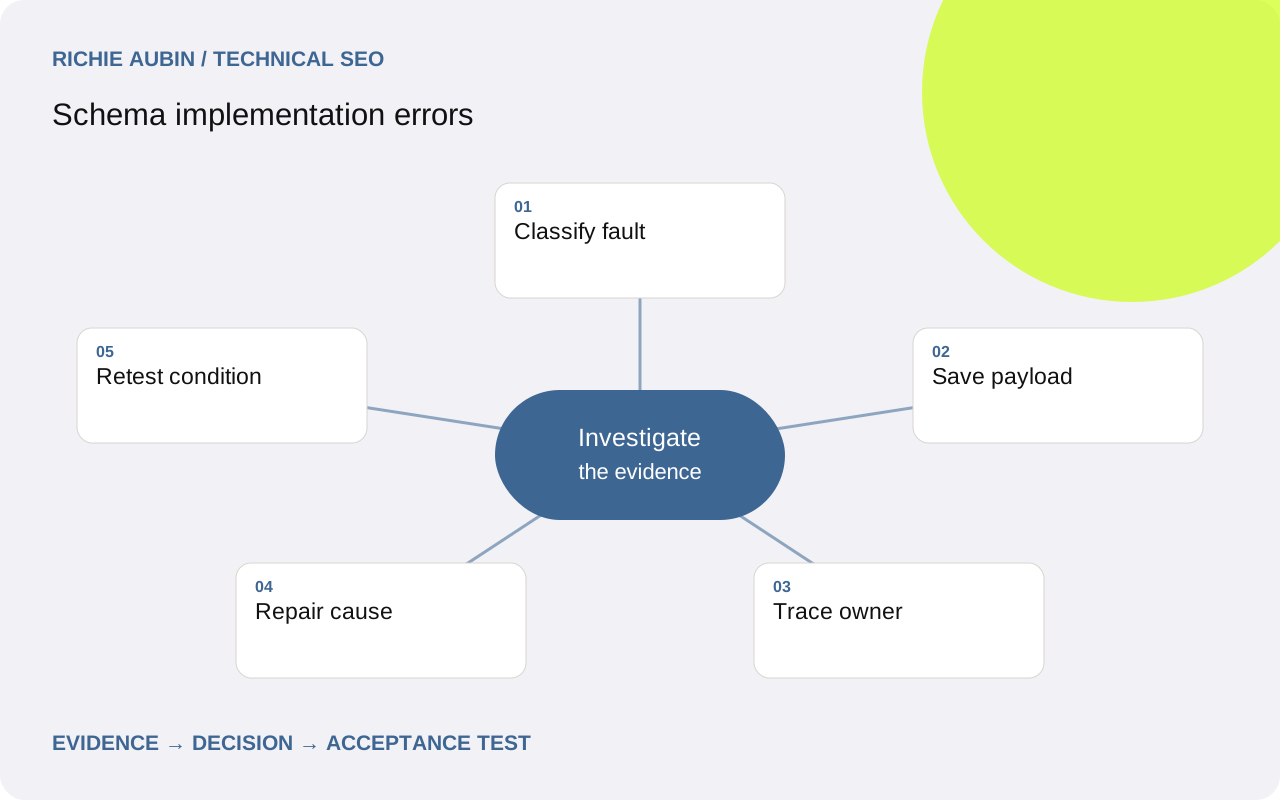
Schema implementation errors fall into different classes: unreadable syntax, unsuitable vocabulary, incorrect relationships, unsupported factual claims and failed delivery. A missing search treatment is an observation that needs investigation, not an additional error class that automatically proves the markup is broken. Start by stating precisely what failed and where it was observed.
A parser error can invalidate a block before its properties are considered. A missing required field affects a particular supported feature. An inaccurate employer or fabricated rating can remain syntactically perfect. These defects require different owners and different verification. Grouping them under one generic schema score makes prioritisation less useful.
Use the layered validation workflow to identify the boundary. Record the expected entity, exact observed output and tool context. A useful incident statement says that an author reference points to the wrong person on a named template, rather than saying that schema is bad across the site.
Preserve an evidence checklist before attempting repairs
Save the affected URL, final destination, response status, raw document, rendered output and release identifier. Extract all structured data blocks without silently deduplicating them. Keep the original error text, testing mode and capture date. Add one working sibling from the same template to establish whether the problem follows a record or shared code.
Map each block to its generator: server include, plugin, tag manager or application component. If ownership is unclear, inspect when the block appears and which release introduced it. Do not begin by deleting every unfamiliar script element. A separate block may describe a legitimate entity that is unrelated to the reported defect.
Include evidence of the visible claim and its approved source. For a wrong business name, compare the live page, business record and generated value. For a broken breadcrumb, open the destination and check the intended hierarchy. Retain enough detail that an engineer can reproduce the failure without depending on a transient validator interface.
Resolve syntax defects at the serialisation boundary
Common syntax defects include trailing commas, unescaped quotation marks, invalid control characters and partial output after an encoding failure. Identify whether the source record is malformed or whether the template assembled a valid record incorrectly. The repair should fix the generation rule, rather than require editors to avoid ordinary punctuation.
Parse each delivered block independently. If only titles containing quotes fail, inspect string concatenation and output filtering. If a block ends unexpectedly, inspect its containing HTML and any closing-script-like sequence in a value. A valid development fixture does not establish that the production response survived every transformation.
The JSON-LD implementation guide covers strict encoding and embedding. Add the failing input to the generator’s regression fixtures, including its actual character sequence. Replacing a curly quote with a plain quote may appear to fix one record while leaving the underlying encoder unreliable for the next ordinary editorial value.
Find identifier collisions and misplaced properties
A graph can parse while expressing the wrong relationships. Check whether a page and its author accidentally share an identifier, whether several distinct staff members collapse into one node or whether one person receives different identifiers on every article. The intended publishing model determines which references should match.
Review property placement and meaning. An article headline belongs to the article, not its publisher. A sameAs link should identify the same entity, rather than a topic page or a company the person once mentioned. A valid URL value does not establish a valid identity relationship.
Check for merge behaviour across generators. A server template and a plugin may use the same @id but disagree about the entity’s name or type. Multiple blocks alone are not the problem; contradictory assertions are. Establish one authoritative record or a deliberate division of responsibilities. Avoid adding arbitrary new identifiers merely to make a diagnostic display look less crowded.
Distinguish required fields, recommendations and obsolete advice
Read the current guide for the feature actually being targeted. A required property and a recommended property carry different implications. Do not populate every warning with a guessed value. A missing optional image on an accurate profile is a different priority from a missing required relationship or an invented professional qualification.
Check whether older instructions describe a retired feature. Google retired FAQ rich results in May 2026. A site can keep useful questions and answers, but their absence from a current rich-result tool does not justify changing every FAQ block until an obsolete screenshot is reproduced.
Vocabulary guidance and consumer rules also differ. A Schema.org property can be meaningful without producing a Google enhancement. Conversely, a recognised item can fail Google’s content requirements despite valid vocabulary. Document which rule is being enforced and its source. This prevents an audit from converting tool limitations or outdated expectations into unnecessary engineering work.
Investigate absent items with competing explanations
When expected data is not detected, consider at least four hypotheses: the generator did not emit it, the public response is stale, client execution failed or the tool does not support that type. Test delivery before modifying the model. Compare raw response, rendered output and a pasted version of the exact deployed payload.
If pasted code passes and the URL fails, inspect access, caching and resource dependencies. If both expose the same graph but only a Google tool reports nothing, inspect feature coverage. If the data is valid but the search result lacks a treatment, check current guidelines and reporting evidence without assuming that more properties will force display.
Check Search Console’s Manual Actions report where policy enforcement is suspected. A structured data manual action concerns rich-result eligibility; do not automatically present it as a general ranking penalty. Other unrelated site problems can coexist. Keep each diagnosis attached to its actual evidence and avoid attributing a traffic movement to one schema warning without a defensible analysis.
Illustrative worked example: two publishers from one template
Consider a fictional professional site after a plugin update. The visible page names one publishing business, but the delivered document contains a server-generated organisation node and a plugin-generated node carrying an old trading name. This is an illustrative diagnostic example, not a client case or a claim about search outcomes.
The first hypothesis is that two blocks are inherently invalid. The second is that separate legitimate businesses are being described. The third is stale duplicate ownership. Comparing @id values and approved business records shows that both blocks intend to represent the same publisher, while the plugin retains an obsolete configuration value.
The repair removes the redundant publisher generator and preserves its unrelated breadcrumb function. Acceptance checks require one coherent publisher identity, unchanged visible attribution and valid breadcrumb output across the template sample. A rollback plan retains the previous plugin version but flags its stale configuration as unsafe. The result is verified factual consistency, with no promised knowledge panel, ranking or indexing effect.
Prioritise impact and define repair acceptance
Prioritise false identity or misleading claims, shared syntax failures and defects that block an intended relevant feature. Estimate scope from template coverage and affected records, not from the number of repeated warnings in an export. One shared encoder fault can explain thousands of identical observations and usually needs one well-tested repair.
Define acceptance before implementation: the intended block parses, identifiers resolve consistently within the model, factual values match approved records and the relevant feature checks pass. Include negative cases where the specialised markup should be absent. A product graph accidentally attached to a service page should disappear, rather than gain enough fields to satisfy an inappropriate feature.
Assign code and content ownership separately when necessary. A serialisation repair belongs to engineering, while a disputed affiliation needs editorial verification. Use technical issue prioritisation to compare this work with access or content failures elsewhere. Schema warnings should not automatically outrank a page that cannot deliver its main body.
Plan recovery and monitor the original failure condition
Retain the original failing payload and a known accurate baseline. If the repair introduces wider defects, revert the responsible generator or configuration and confirm the public response. Account for caches and independently published tag containers. A rollback that restores old false business details is not acceptable simply because it restores valid JSON.
Monitor the exact condition that caused the incident. Count parsing failures by generator, identity conflicts by identifier or wrong breadcrumb destinations by template. A global item total can remain stable while all affected records carry the wrong values. The schema QA guide describes how to preserve targeted checks after deployment.
State residual limits clearly. A sample cannot establish every record’s factual accuracy, and a passing tool cannot guarantee search display. Structured data repairs do not guarantee rankings, indexing or AI citations. Close the incident when the demonstrated fault is corrected and the agreed evidence is complete, while keeping unrelated performance questions in their own investigations.
Frequently asked questions
Does every structured data warning need fixing?
No. Determine whether it identifies a required field, a recommendation, a vocabulary concern or an irrelevant feature expectation. Fix genuine defects and document justified omissions. Never invent a value merely to remove a warning; accurate incomplete optional data is preferable to a complete-looking false claim.
Are duplicate JSON-LD blocks always wrong?
No. Separate blocks can describe different entities or intentionally reference the same node. Inspect the combined claims and ownership. Conflicting definitions, stale values or accidental identifier collisions require repair; the number of script elements alone does not establish a defect.
Can valid syntax still violate Google guidelines?
Yes. Automated parsing cannot establish that a claimed review, affiliation or qualification is genuine. Review the visible content and approved source records against applicable quality guidance. Technical validity is one layer of correctness, not an exemption from factual accuracy or content policies.
Should schema be blamed when rankings fall?
A ranking change needs broader evidence. Check whether the supposed schema issue is real, when it began and what other releases or conditions changed. A missing search enhancement and a loss of ordinary rankings are different observations. Avoid presenting a correlation as a proven cause.
When is removing markup appropriate?
Remove or disable a block when its purpose is unsuitable, its claims are unsupported or its generator cannot currently emit reliable data. Preserve useful visible content. Check dependent relationships and other generator responsibilities so a narrow correction does not remove valid navigation or author information.