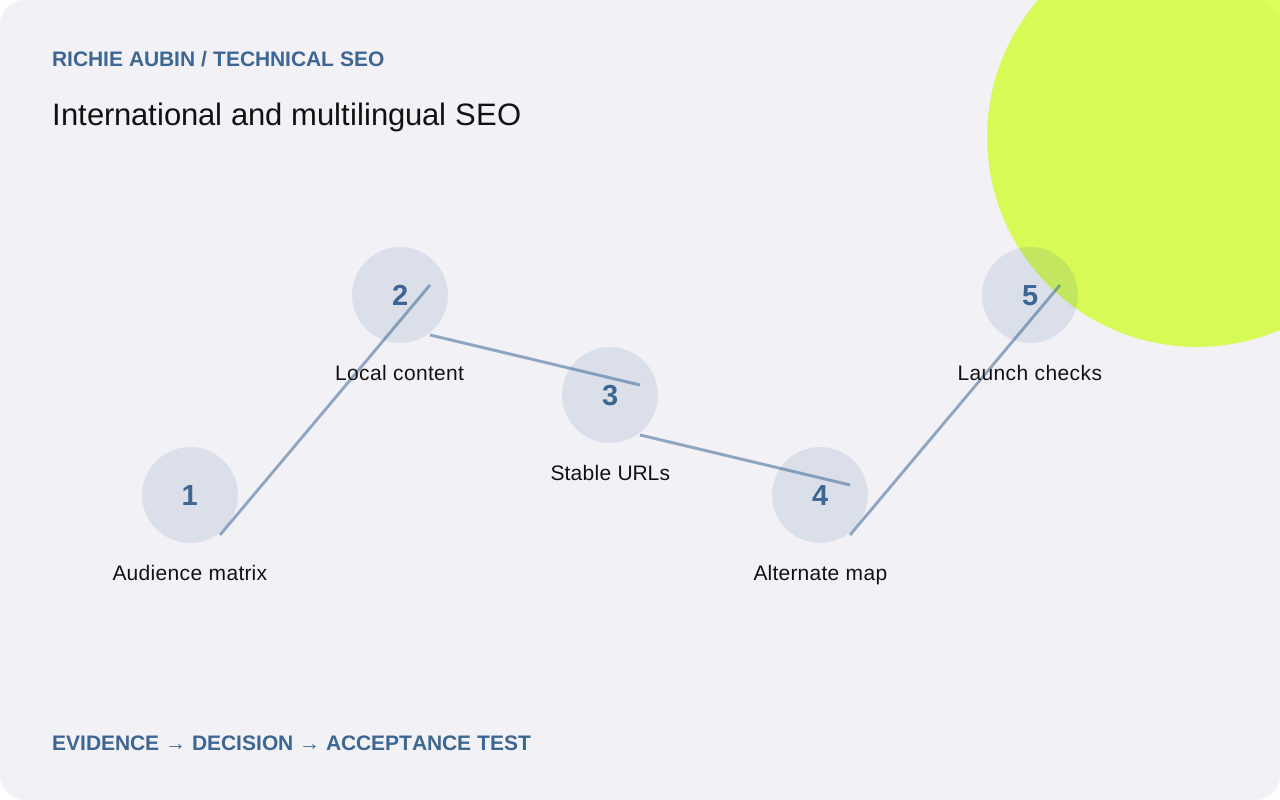
Start with markets, languages and service boundaries
International SEO starts with an audience model. A language is not a market, and a market may require several languages. French content for Canada can have different delivery, legal and support requirements from French content for France. Define where the business serves customers before creating folders or annotating alternate pages.
Build a matrix of market, language, currency, availability, fulfilment and responsible editor. Specify whether a page is a translation, a regional adaptation or a separate offer. These distinctions determine which pages are useful equivalents and which should remain independent. Avoid multiplying every page into every locale when the underlying service cannot support that combination.
For each proposed edition, identify a sustainable publication and maintenance process. A translated sales page with outdated eligibility rules can be worse than a clear statement that the service is unavailable. Treat launch readiness as a combination of content accuracy, accessible routes and technical consistency, rather than a quota of country folders.
Give each intended edition a stable public address
Use distinct URLs for intended language versions so visitors can bookmark and share their chosen edition. A single URL whose main content depends on a cookie creates ambiguity for discovery, caching and testing. An automatic country redirect can also prevent someone from viewing an edition they deliberately requested.
Choose between country domains, subdomains and subdirectories according to ownership, infrastructure and long-term maintenance. Country domains have a geographical meaning; a directory name alone does not establish the language of its content. Do not assume a hosting location settles audience targeting, especially behind distributed infrastructure. The detailed trade-offs belong in international URL structure planning.
Preserve a user's explicit selection. A location suggestion can explain available options without making every deep link jump to a homepage. Test direct requests without existing cookies or a browser language preference, because those requests expose dependencies that ordinary staff browsing may conceal. Document how the site handles a genuinely unavailable regional product.
Make the content and journey coherent within each locale
Localisation includes navigation, instructions, support routes, prices, units and contractual details where relevant. Translating a title while leaving the main article in another language does not create a complete translated resource. Ask a competent language reviewer to check whether terminology and calls to action match the intended audience and actual offer.
Set appropriate document language metadata for accessibility and browser behaviour. Google determines page language from visible content rather than relying on the HTML lang attribute or hreflang alone. These mechanisms have different purposes; accurate metadata cannot compensate for a largely untranslated body or a language selector that points to unrelated pages.
Test the complete journey from category to detail to contact or purchase. Regional availability may change after a visitor follows a global recommendation. Explain that boundary clearly and retain the context when suggesting another edition. Include translated error messages and unavailable states in acceptance review, since these are often omitted from an otherwise polished launch.
Model equivalent pages before generating annotations
Use stable content identifiers to connect editions of the same resource. A language cluster might contain a British English guide, a French translation and a German translation. A different product in the German catalogue is not automatically an alternate simply because it occupies the same position in a menu.
Hreflang annotations describe language and regional alternatives. Canonical preferences address duplicate or very similar URLs. For distinct translated content, a self-referencing canonical on each intended edition is a practical starting point; same-language regional duplication needs a deliberate consolidation decision. Read hreflang versus canonical tags before applying a global rule.
Choose one maintainable hreflang delivery method: HTML head elements, HTTP response headers or XML sitemap annotations. Google treats the methods as equivalent. A shared content-to-locale registry should drive the output and exclude unpublished or unrelated substitutes. Include the page itself in its alternate set and validate reciprocal relationships between published equivalents.
Provide discovery routes beyond the language selector
Each edition needs its own useful internal architecture. A selector linking only homepages does little to help someone find a particular manual in their language. Connect local categories, related resources and detail pages with ordinary anchors, preserving task context where an equivalent exists. Label a broader destination honestly when there is no equivalent.
Sitemaps provide an additional inventory and can carry language relationships. They do not replace navigation or guarantee index inclusion. Use multilingual sitemap validation to check publication state, final destinations and alternate mappings independently from the site's visible links.
Review infrastructure per host and locale. A correct global template does not prevent one regional host from returning an authentication challenge, robots disallow rule or intermittent error. Compare representative HTML responses, rendered content and response headers. Keep localisation systems, cache configuration and search directives in the same release discussion so one team does not accidentally invalidate another team's assumptions.
Gather evidence and test competing explanations
When a country receives an unexpected landing page, do not immediately blame hreflang. Competing hypotheses include missing translation coverage, a cross-language canonical preference, forced regional redirection, weak local content, a mistaken equivalence map and a reporting filter that excludes the intended property. Each predicts different evidence and needs a different intervention.
Use an evidence checklist: requested and final URL; status; visible language; product availability; canonical declaration; indexing rules; alternate set; reciprocal response; internal parent links; sitemap membership; and relevant Search Console observations. Record the collection date and distinguish current tests from historical indexed data. Inspect both the intended edition and the version actually receiving visits.
Segment search reporting by page, query and country without equating country with language. An English-speaking user in Germany may reasonably receive English content. Small samples and changing query mixes can distort percentages. The international SEO audit methodology develops this into a repeatable investigation and prioritisation process.
Illustrative worked example: a bilingual Canadian launch
Illustrative worked example: a fictional training provider serves Britain and Canada. It publishes a British English course page, a Canadian English edition with different attendance conditions, and a Canadian French translation. The team initially proposes sending every French-speaking visitor to the French homepage and canonicalising all course editions to Britain.
Review separates two issues. The homepage redirect loses course context and prevents direct access to the requested edition. The blanket canonical policy fails to reflect the substantive Canadian conditions and French translation. The proposed design retains stable course URLs, exposes contextual language links and uses self-referencing canonicals for these independently maintained editions.
The alternate registry maps the course identifier to en-GB, en-CA and fr-CA destinations. A reviewer checks availability and translation completeness before publication. Acceptance tests request each course URL without cookies, confirm its specific conditions and traverse its language links. This fictional example demonstrates decisions and evidence; it makes no claim about client performance or the search outcome of launching another market.
Agree acceptance criteria and a reversible launch
Acceptance requires every launched locale to have an accountable editor, accurate service boundaries, stable final URLs and coherent navigation. Sample each template, incomplete translation state and unavailable product state. Verify that alternate mappings represent equivalent resources, canonical policies reflect content decisions and XML output agrees with the publication registry.
Test a clean session and deliberate language changes across mobile and desktop. Check that cache behaviour does not serve one country's prices or conditions on another edition. For performance, assess real-user field data at the 75th percentile where available: good thresholds are LCP at most 2.5 seconds, INP at most 200 milliseconds and CLS at most 0.1. Laboratory tests diagnose changes but do not replace that field assessment.
Rollback risks include removing newly shared addresses, restoring forced redirects and publishing stale locale mappings. Retain previous routing and registry versions, but preserve new content records. Prefer disabling the defective locale relationship or routing rule narrowly while keeping valid published resources available. Assign responsibility for cache invalidation and post-rollback checks.
Measure useful coverage and maintain local ownership
Monitor response errors, translation completeness, alternate relationship failures and canonical selection for representative cohorts. Compare new and established locales separately. A small regional edition can suffer a complete publishing failure while aggregate site charts remain stable. Route alerts to owners who can fix local content or infrastructure rather than sending every issue to a global dashboard.
Review search demand and user outcomes alongside technical coverage. Correct annotations cannot create demand, guarantee rankings or ensure that every eligible URL is indexed. A competitor's stronger local offer or a mismatch between the page and the query may remain relevant after all technical checks pass. Record those limitations in launch expectations.
Keep the locale registry current when products retire, translations lag or service boundaries change. Remove obsolete relationships in the same publication transaction as the content change. An international site remains reliable when each edition has a clear purpose and maintainable journey, with evidence that its technical signals continue to represent that purpose over time.
Frequently asked questions
Is international SEO just hreflang?
No. Hreflang describes alternatives, but the work also covers market suitability, translation quality, stable URLs, discovery, duplicate handling and local journeys. A technically valid annotation cannot make an unavailable service or an incomplete translation appropriate for a country.
Does every country need a separate website?
No. Some audiences can share a language edition where the offer and requirements are the same. Create regional versions when there is a defensible audience need and the organisation can maintain them. Distinct domain ownership is an operational choice rather than a universal requirement.
Should visitors be redirected by their IP address?
Avoid forcing a requested edition to another locale based only on inferred location. People travel, use corporate networks and choose languages independently of country. Provide an understandable suggestion and explicit choice, then test whether deep links remain usable without prior preferences.
Can international fixes guarantee the correct result everywhere?
No. Annotations and consistent routing help explain the intended relationships, but Google still evaluates content, relevance and other signals. Verify the implementation directly, monitor representative search data and distinguish technical failures from legitimate differences in user language, intent and location.