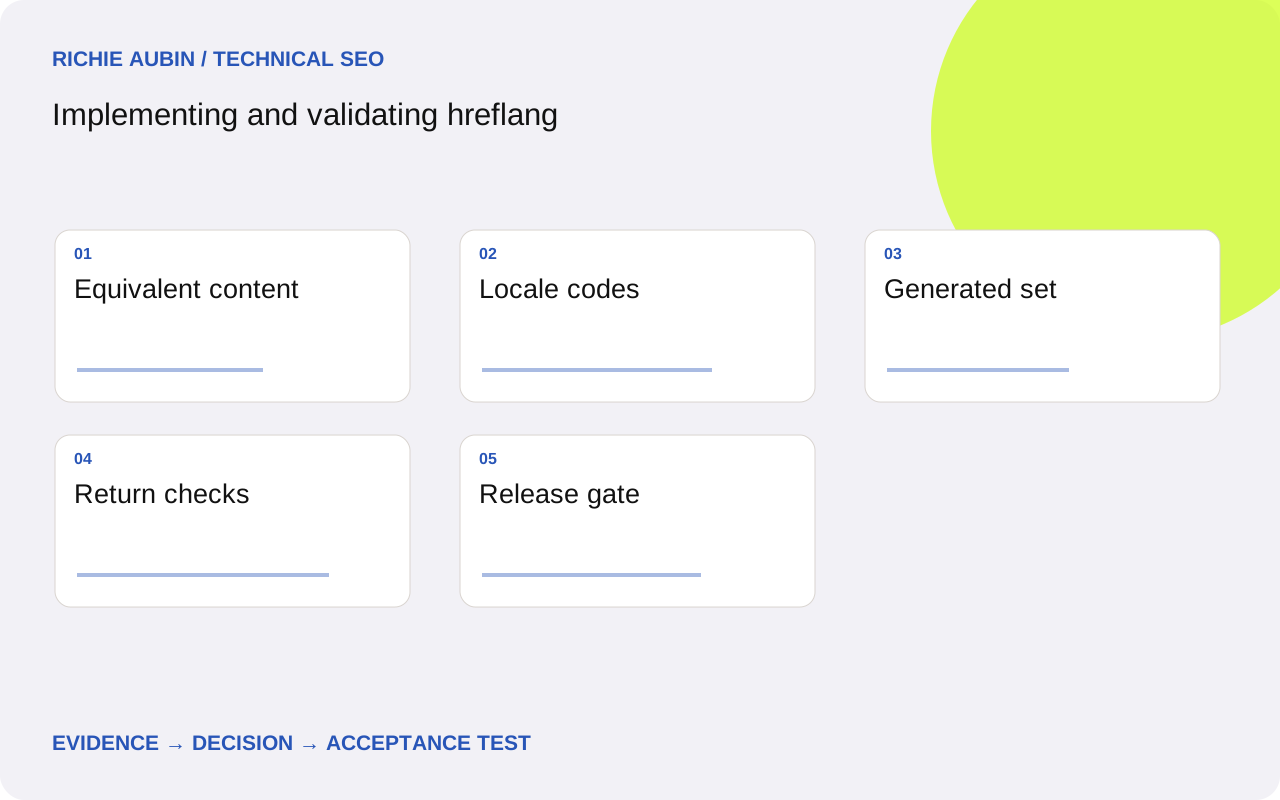
Define which resources are genuine alternatives
Hreflang describes versions of a resource intended for different languages or regions. Begin with the content relationship, not the tag generator. A translated article and its original can form an alternate set; a translated homepage is not a substitute for every article missing a translation. Regional editions should serve substantially corresponding tasks even when prices, conditions or terminology differ.
Create a registry keyed by stable content identifier. Each published record should contain its locale, final public URL, publication state and intended equivalence group. Avoid generating relationships by replacing directory names in strings. Translated slugs, missing products and different catalogue structures make that shortcut unreliable at scale.
Agree who can approve equivalence and how the registry handles withdrawn translations. The broader international SEO framework establishes the audience model behind these choices. Hreflang is an annotation of that model; it cannot translate content, repair regional availability or establish that an unrelated destination meets the same need.
Validate language and regional values deliberately
For Google's supported syntax, use a language code such as en or fr, optionally followed by a supported region code such as en-GB or fr-CA. A region alone is insufficient. Use GB for the United Kingdom in hreflang, rather than UK. Business shorthand such as EU or a sales territory name is not a substitute for a supported country code.
Distinguish a language-wide edition from a regional one. An English catchall can serve English readers outside specifically represented markets when its content is suitable. It can share a destination with an existing regional page if that is a deliberate choice. Do not manufacture a separate generic page merely to fill a validation table.
Maintain an approved code list and validate input before publication. Where script subtags are relevant, follow Google's documented supported values rather than assuming every internal locale format is accepted unchanged. Keep CMS locale identifiers separate from output values so legacy abbreviations can be mapped explicitly without silently changing the audience meaning.
Choose one delivery method with a clear owner
Google supports hreflang in HTML head elements, HTTP Link headers and XML sitemaps. The methods are equivalent for Search; implementing all three provides no inherent benefit and increases the chance of disagreement. Choose the route that can reliably access the full publication registry and be tested during releases.
HTML is often straightforward for server-generated pages. HTTP headers can describe non-HTML resources such as PDFs, but require careful inspection of the actual response through proxies and delivery layers. XML is useful where a central generator can maintain relationships across a large catalogue. Its correctness depends on publication data and generation discipline, rather than on file size alone.
The multilingual sitemap workflow covers XML-specific details. If multiple methods already exist, inventory them before removing anything. Choose an authoritative source, compare live outputs and retire redundant implementations in a controlled release. A correct new template does not neutralise contradictory annotations still emitted by an older sitemap generator.
Generate complete escaped examples and inspect placement
For an HTML implementation, emit separate alternate elements inside a valid head. Use fully qualified URLs, including scheme and hostname. Keep canonical declarations separate from alternate declarations. The following illustrative pair belongs on both versions of the same guide; the English and French destinations each identify themselves as well as their counterpart.
<link rel="alternate" hreflang="en" href="https://example.com/en/guide/">
<link rel="alternate" hreflang="fr" href="https://example.com/fr/guide/">
This is a relationship example, not a complete page template. The registry must supply the correct URLs for the resource being rendered. Escape attribute values and verify the parsed document structure, because an apparently correct element placed outside the head can fail the intended implementation.
Inspect both server HTML and the rendered document where client code changes metadata. Prefer stable output available in the initial response for a conventional static or server-rendered site. Test final responses after redirects and cache handling rather than assuming the application template is what every visitor receives.
Check self-references, return relationships and fallback
Each published language version should list itself and its relevant alternates. Validate reciprocity by fetching the destination and checking that it points back to the originating equivalent. Google requires return relationships for the links it processes; a missing return link is not proof that every other valid relationship on the entire site is discarded.
Compare expected sets from the registry with observed sets from responses. Report missing destinations, extra unrelated destinations, duplicate locale assignments and inconsistent addresses separately. A summary percentage cannot distinguish a harmless formatting variation from a product mapped to the wrong translated product.
Consider x-default when there is a suitable fallback for unmatched languages, particularly a selector or appropriate default edition. It is not a language code, not mandatory for every cluster and not a replacement for the real language entries. If a deep resource has no suitable fallback, do not automatically map it to an unrelated homepage just to satisfy an internal checker.
Review target suitability and canonical interactions
Fetch every intended destination and check its status, content, indexing rules and canonical preference. As an implementation acceptance policy, use stable final public URLs that serve the intended resource. Flag redirects, missing pages, accidental noindex directives and login challenges for review rather than publishing them blindly as alternates.
Canonicalisation and hreflang answer different questions. Distinct translated editions generally retain their own canonical identity. Near-identical same-language regional versions require a reasoned duplicate policy and may combine a preferred canonical with regional annotations. Avoid treating every cross-region canonical as automatically wrong. The decisions in hreflang versus canonical depend on content and intended consolidation.
Visible navigation remains necessary for people. Test contextual language links independently of metadata, because hreflang annotations are not a usable selector. Ensure requesting the French URL actually returns the French resource without a forced redirect based on inferred location. Otherwise the published relationship and the delivered experience disagree.
Illustrative worked example: publishing three guide editions
Illustrative worked example: a fictional engineering publisher maintains one installation guide in British English, German and Austrian German. The registry assigns en-GB, de-DE and de-AT to three reviewed final URLs. Austria has different compliance notes, so its edition is maintained separately. A Spanish translation remains in draft and must not appear in the published set.
The team chooses HTML output because the server template already reads the registry. It generates the same three alternate entries on each published guide. A test first compares locale-to-URL pairs with the approved registry, then fetches each target and verifies reciprocal entries and the local compliance section.
An initial failure reveals that the Austrian template still emits an old German URL after a slug change. The repair updates the registry reference and invalidates the affected cache entries. Acceptance checks the final live responses, including the German return relationship. This example illustrates publication controls; it supplies no measured client outcome and makes no claim that annotations determine rankings or guarantee index inclusion.
Use a concrete evidence pack and competing hypotheses
Retain the requested URL, response timestamp, final URL, raw annotation output, parsed alternate set, publication identifier, canonical declaration and target checks. Add one unaffected resource from the same template. This evidence pack lets developers reproduce the defect without reconstructing the entire audit or relying on a screenshot of a crawler warning.
Test competing hypotheses when only part of a catalogue fails. A registry error predicts the wrong mapping in every delivery method. A cache defect predicts disagreement between application output and public responses. A template problem predicts failures grouped by layout, while an outdated sitemap generator predicts a discrepancy isolated to XML. The appropriate fix follows the evidence boundary.
Use hreflang error diagnosis for investigation patterns. Search performance is supporting context, not a syntax validator. An unexpected regional landing page can also reflect missing content, relevance or canonical selection. Verify the implementation directly before assigning a causal explanation to a change in country-level traffic.
Define release gates, rollback and maintenance limits
Release acceptance should require approved equivalence groups, supported locale values, absolute final destinations, self-inclusion, reciprocal relationships and agreement with publication state. Include a newly published translation, a withdrawn edition, a changed slug and a partially translated resource in the fixture set. Validate exceptions explicitly instead of suppressing a whole category of warnings.
Rollback risks include reviving retired targets, removing valid new translations and serving mixed registry versions through caches. Version the registry and generator independently. Restore the faulty component narrowly and invalidate affected responses; do not overwrite all content with an older database snapshot. Recheck both ends of the relationship after reversal.
Schedule checks when URLs, locales or publication states change. No validator can establish translation quality or guarantee how Search will present every result. Its role is to confirm that published relationships are accurate and maintainable. Assign the editorial equivalence decision and technical delivery decision to named owners so failures have a clear route to correction.
Frequently asked questions
Is x-default compulsory?
No. Use it when an appropriate fallback exists for users whose languages are not represented. A selector can be suitable, but a deep page should not automatically point to an unrelated homepage. Keep fallback selection separate from ordinary language and region assignments.
Can alternates live on different domains?
Yes. The relationship can span domains. You still need accurate fully qualified destinations and reciprocal annotations on the corresponding resources. Coordinate publication and testing across the owners of those domains, including status, access rules and cache behaviour.
Does hreflang replace the HTML lang attribute?
No. Hreflang describes the audience of alternate resources, whereas document language metadata serves browser and accessibility purposes. Set both accurately where applicable. Google determines the language of the page from its content rather than treating either attribute as a translation instruction.
Must every annotation be repeated in HTML and a sitemap?
No. Choose a maintainable supported method. Multiple implementations add coordination work and can become inconsistent during publication changes. If several already exist, compare them, establish one authoritative generator and remove redundant output through a tested release rather than leaving conflicting versions.