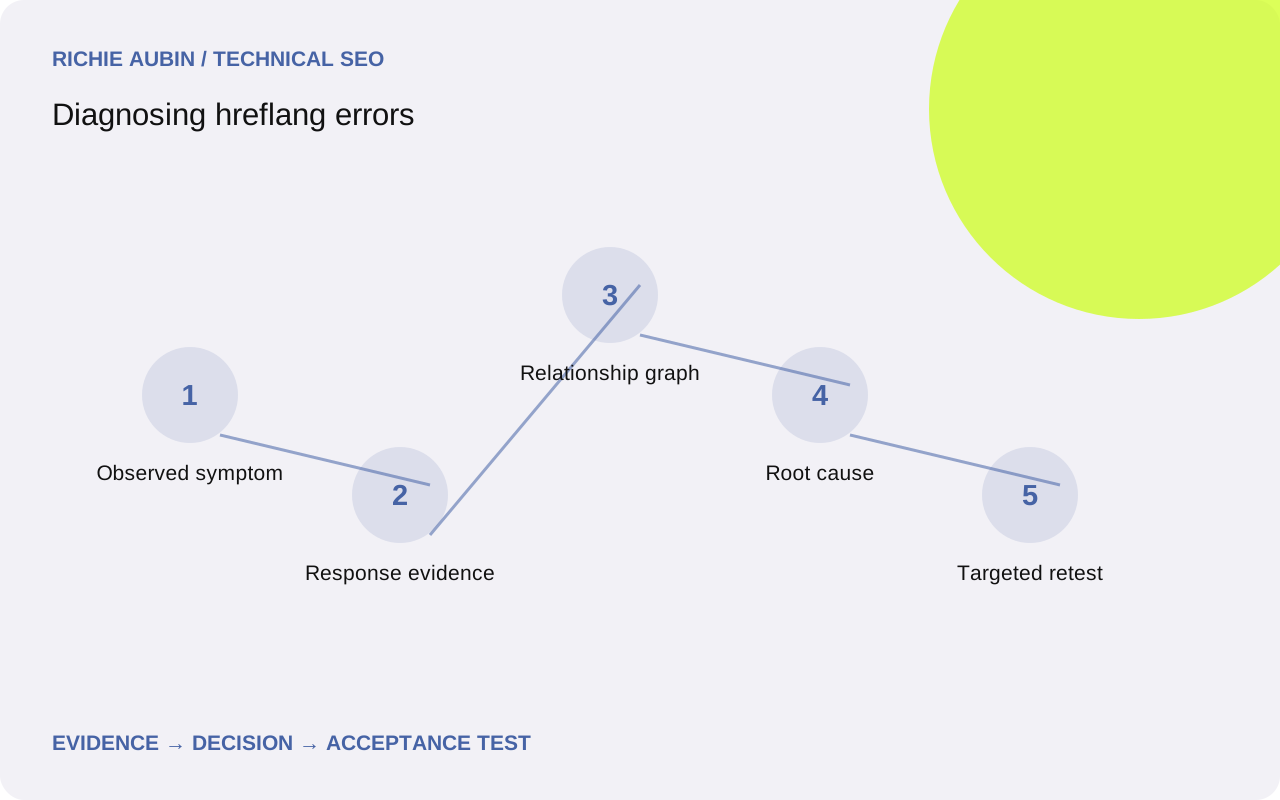
Separate annotation defects from search symptoms
A crawler warning and an unexpected search landing page are different starting points. The first may identify a reproducible annotation defect; the second requires an investigation into content, access, canonicalisation and relevance as well as hreflang. Keep the reported symptom, observed response and inferred cause in separate fields.
Classify failures by layer: invalid locale values, malformed delivery, missing return relationships, unsuitable destinations, incorrect equivalence and publication drift. A single generator defect can produce thousands of affected URLs, while one wrong product mapping can be serious despite a small count. Report the faulty rule and its affected population rather than ranking issues only by warning volume.
Begin with the expected relationships documented in the hreflang implementation guide. If there is no approved content-to-locale registry, establish a reviewed sample before assuming that the current output is the specification. Otherwise the audit risks certifying internally consistent links between the wrong resources.
Capture evidence from the public response
Use a concrete evidence checklist for every representative failure: requested URL, timestamp, status, final destination, content identifier, visible language, delivery method, parsed alternate values, canonical declaration and indexing directives. Save the actual response fragment or HTTP header and identify the expected counterpart. Include publication state and the generator or template version where available.
Inspect the production delivery path, including CDN and cache behaviour. An application preview can be correct while a public cache serves yesterday's registry. Compare a clean request with an ordinary browser session where cookies or location settings may affect routing. Record the request conditions rather than treating every response difference as random.
For HTML, check that alternate elements sit inside a valid head. For headers, inspect the GET response from the final resource. For XML, parse the sitemap rather than relying on its browser presentation. Retain one unaffected resource from the same content type as a control, so the boundary between working and failing cases is visible.
Validate syntax without rewriting the audience model
Check supported language and optional regional values against an approved mapping. Common mistakes include using en-UK instead of en-GB, emitting a country without a language, or using a commercial territory such as EU as though it were a supported country code. x-default is a special fallback value, not an ordinary locale.
Require fully qualified alternate URLs. Relative paths can appear sensible in a template but do not meet Google's documented hreflang requirements. Check escaping and XML namespaces where applicable. A malformed ampersand or truncated attribute may prevent a parser from seeing the intended URL even when a developer recognises it visually.
Do not auto-correct unfamiliar codes without confirming the target audience. Changing a French Canadian edition to generic French is a content decision, not punctuation repair. Preserve the original CMS locale identifier and map it to approved output explicitly. Distinguish invalid values from valid values that describe the wrong edition, because those failures need different owners and acceptance tests.
Trace reciprocal relationships as a graph
Represent each annotation as a directed edge labelled with the target locale. Fetch the counterpart and look for its return relationship to the source. Include self-references and compare the complete observed set with the expected published equivalents. A pair of pages can be reciprocal while still omitting a newly launched third edition.
Google may ignore relationships without return links; that does not justify claiming that one missing edge invalidates every language on the whole site. Report missing pairs precisely. If full coverage is temporarily incomplete, identify which reciprocal pairs remain and document the intended recovery sequence rather than describing the cluster with a single pass-or-fail label.
Check for duplicate assignments that send the same locale to unrelated addresses. A URL can intentionally serve more than one audience value, but one language value pointing to competing resource versions needs review. Compare by stable content identifier, not just by a shared filename or folder suffix. Those surface similarities are weak evidence of true equivalence.
Investigate redirects, exclusions and duplicate signals
Follow target responses and inspect what is actually delivered. A redirect may lead to a replacement, a global selector or an unrelated homepage. A successful status may conceal an unavailable-product message or the wrong language. Treat final destination and visible content as first-class evidence rather than assuming that any 200 response is suitable.
Check robots access and accidental noindex rules. Examine canonical declarations and Google's selected canonical where available, while keeping current live tests separate from historical indexed information. A cross-language canonical deserves scrutiny; same-language regional consolidation can be intentional. Use canonical and hreflang diagnosis before applying a blanket self-canonical rule.
Inspect language selectors and local navigation too. An accurate alternate set cannot repair a forced redirect that prevents the intended edition from being fetched reliably. Conversely, a perfectly usable selector does not prove the metadata is reciprocal. Test these mechanisms independently and record which one actually fails in the observed journey.
Use competing hypotheses to locate the faulty system
Suppose HTML annotations are correct but an audit still reports stale targets. Competing hypotheses include an outdated XML generator, a crawler using cached data, and a reverse proxy serving different responses. Compare delivery methods and timestamps before changing the working template. The narrowest reproducible discrepancy usually identifies the next useful test.
If all French pages map to the English homepage, investigate a missing-translation fallback rule. If only renamed pages fail, inspect slug history and registry invalidation. If one regional hostname fails intermittently, inspect availability and cache routing rather than the locale code list. Each explanation predicts a different distribution across templates, locales and publication cohorts.
The international audit workflow helps connect these findings with wider access and content evidence. Preserve rejected hypotheses briefly when they explain why a proposed fix would be misplaced. The aim is a defensible repair boundary, not an exhaustive catalogue of every theoretical hreflang mistake.
Illustrative worked example: stale alternates after a rename
Illustrative worked example: a fictional software publisher renames a German implementation guide. English HTML points to the new German URL, but the German page points back to an old English URL that now redirects. The sitemap generator still lists both historical addresses. A crawler reports inconsistent return links and redirecting alternates.
The first hypothesis is that the new German page lacks a translation relationship. The second is that different generators read different versions of the relationship registry. Inspecting CMS identifiers confirms the correct translation pair exists. Comparing the HTML and XML jobs reveals that the XML job uses a nightly export while the German template retains a cached English route.
The proposed repair invalidates both affected template entries and updates the XML job's publication dependency. Acceptance fetches both final pages, compares their locale maps with the current registry and reparses the regenerated sitemap. This fictional scenario demonstrates diagnosis across systems; it is not evidence that any particular warning caused lost traffic or that correcting it guarantees recovery.
Specify acceptance criteria at the defect boundary
Write acceptance criteria that reproduce the original failure and verify the corrected rule. For a stale-route defect, require all published members of affected clusters to reference current final URLs, retain expected self-references and return relationships, and omit withdrawn aliases. Check fresh publication, rename and retirement transitions rather than only the page that triggered the investigation.
For malformed XML, require parser success and semantic validation against the registry. For a bad fallback, require resource-specific equivalents and honest selector behaviour where none exists. The multilingual sitemap checks explain why valid XML alone cannot establish correct relationships.
Keep blocking release failures separate from review warnings. An unpublished destination or a wrong product relationship can justify blocking publication. A deliberate absence of x-default should not fail a release merely because an audit tool prefers it. Document accepted exceptions with their business rationale and owner, so the same issue is not repeatedly reopened without new evidence.
Control rollback risk and monitor the repaired relationship
Rollback can reintroduce stale addresses, remove recently added translations or create inconsistent output between HTML and XML. Retain previous generator configuration and registry versions, but avoid restoring a whole content database to reverse one metadata change. Identify which cache keys and generated files must move together to keep both ends coherent.
After release, rerun the failing checks against production and monitor a sample of unaffected clusters for collateral changes. Track unresolved pairs and newly published exceptions by locale. Use SEO release QA to attach the relationship checks to the deployment that owns them, rather than leaving the repair dependent on a future manual crawl.
Technical validation has limits. It cannot establish translation quality, prove causation from a traffic chart or guarantee regional result selection. Report implementation recovery immediately when evidenced, then assess search observations over an appropriate period without promising a processing date. Keep the corrected publication rule under monitoring as the catalogue changes.
Frequently asked questions
Does one missing return link break every locale?
Do not assume so. Identify the specific non-reciprocal relationship and inspect the remaining published pairs. Google documents return-link requirements and can process reciprocal relationships even where coverage is incomplete. The repair should restore the intended set without overstating the scope of failure.
Is every redirecting alternate equally serious?
No. A short redirect to the correct replacement differs from a redirect to an unrelated homepage. Both deserve a final-URL review, but content suitability and affected journeys determine priority. Update generated relationships to current intended destinations rather than treating status codes alone as impact measures.
Why do tools disagree about hreflang errors?
They may inspect different delivery methods, request conditions, cache versions or URL populations. Compare raw evidence and collection times before comparing totals. A crawler that does not read sitemap annotations cannot establish their correctness, and a valid XML parser cannot establish translation equivalence.
Should an unexpected country result trigger an immediate tag change?
No. First confirm the requested resource, user language, indexing evidence and current annotations. Relevance, unavailable translations, duplicate selection and reporting scope can also explain the observation. Change the implementation when a specific defect is demonstrated, and monitor search behaviour separately.