Distinguish audience alternatives from duplicate preference
Hreflang and canonical declarations express different relationships. Hreflang identifies corresponding versions intended for particular languages or regions. A canonical declaration expresses a preferred representative among duplicate or very similar URLs. Neither instruction translates a page, changes its address for visitors or guarantees Google's final selection.
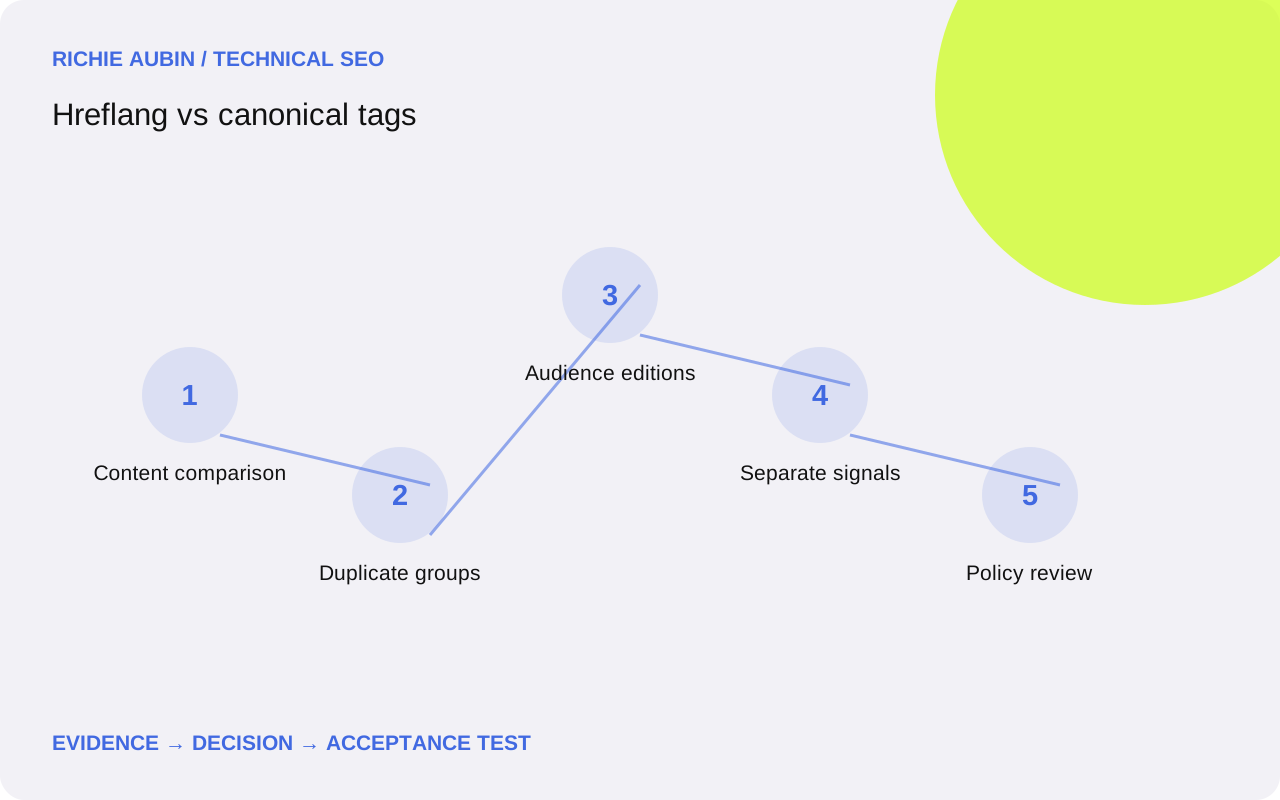
Consider two independent maps. The first groups useful audience editions of a resource. The second groups duplicate addresses around their preferred representative. These maps can overlap, especially for same-language regional editions, but they should not be generated from the same simplistic rule. A language folder is insufficient evidence that every page inside it requires either consolidation or independence.
Start from the content and publication purpose. A genuinely translated article normally remains a separate language resource. Two parameter URLs displaying the same French article normally belong to the same duplicate group. The canonical tag guide explains duplicate preference more generally; international work adds audience relationships to that existing decision.
Protect the identity of genuinely translated content
A substantive translation serves readers in another language and is not merely an alias of the original address. For independently published translated pages, a self-referencing canonical for each intended language URL is a practical default, paired with accurate hreflang relationships. A blanket rule pointing every language back to English can express the wrong preference.
Review the main content rather than the presence of a translated menu. If the body remains English while only the footer changes, the pages may still be duplicates. Conversely, matching images, layout and product identifiers do not make a fully translated explanation the same-language duplicate of its original. Template similarity is not the deciding evidence.
Inventory incomplete translations separately. Decide whether to publish, withhold or clearly label them based on actual usefulness and editorial policy. Hreflang cannot turn an untranslated body into a French edition, and changing the canonical cannot fix terminology or missing instructions. Keep editorial completion and duplicate handling as related but independently verifiable workstreams.
Make a deliberate policy for same-language regions
Regional pages in the same language require closer judgement. British and American editions may differ substantially in service eligibility, compliance instructions or product specification. Alternatively, they may duplicate almost all content while changing a currency symbol. Document whether the business intends distinct maintained resources or a preferred representative of near-identical material.
Google's international guidance allows canonicalisation together with hreflang for similar or duplicate same-language regional content. It would therefore be inaccurate to declare every cross-region canonical invalid. Equally, that guidance does not justify canonicalising a distinct French translation to an English page. Compare the actual content and audience need before approving a rule.
Use a small decision record: resource identifier, editions compared, meaningful differences, intended preferred URL and rationale. Have regional content owners confirm the differences that matter to customers. The wider international SEO strategy should explain why the editions exist, so technical preferences follow a coherent publishing model rather than an arbitrary plugin default.
Resolve duplicate aliases within the correct language
Tracking parameters, historical routes, alternative hostnames and print views can create duplicate addresses around each language edition. Separate these aliases from the locale map. A French tracking URL can prefer the clean French URL while that clean URL participates in a language alternate set with English and German equivalents.
For hreflang implementations, Google's canonical guidance recommends a canonical in the same language, or the best available substitute where none exists. Avoid using that exception as a routine shortcut for missing translations. If there is no equivalent resource in a locale, do not invent an alternate by pointing at an unrelated page.
Align internal links and sitemap inventory with intended preferred addresses. Check redirect destinations as well as declarations: a French alias redirected to English while its canonical points to French conveys a confused publication policy. The duplicate content workflow helps distinguish useful consolidation from accidental loss of distinct content. Keep the original alias inventory for regression checks after routing changes.
Keep canonical and alternate output separate
Emit canonical and alternate declarations as separate elements. Combining hreflang with a canonical link does not express both relationships correctly. For a distinct English edition, the following illustrative fragment shows one preferred address and two audience alternatives; the French edition would use its own canonical while maintaining the reciprocal alternate set.
<link rel="canonical" href="https://example.com/en/manual/">
<link rel="alternate" hreflang="en" href="https://example.com/en/manual/">
<link rel="alternate" hreflang="fr" href="https://example.com/fr/manuel/">
Inspect the parsed head and the final response. A correct template can be undermined by an HTTP canonical header from another layer or client code rewriting the declaration. Use a single authoritative canonical generator where possible and compare it with the locale registry.
Follow hreflang implementation checks for self-inclusion, fully qualified destinations and return relationships. Maintain canonical decisions independently so a change to duplicate handling does not silently rewrite every language relationship.
Collect evidence and test competing explanations
Use an evidence checklist covering the current URL, final response, main-content language, substantive regional differences, canonical declaration, HTTP metadata, robots rules, alternate set, internal links and sitemap entries. Record indexed canonical information separately from current live observations. The live inspection test does not predict Google's eventual canonical selection.
Competing hypotheses for an unexpected representative include a copied canonical template, near-identical regional content, old internal links and inconsistent redirects. A template defect predicts the same erroneous declaration across pages using that layout. A content-similarity explanation predicts consolidation among otherwise correctly configured near-duplicates. A routing defect predicts disagreement before the HTML is even inspected.
Compare affected and unaffected resources, including a fully translated page and a same-language regional pair. Do not infer that hreflang is ignored merely because a report shows a different canonical. Use content evidence and delivered relationships to establish what is intended, what is published and what Google has observed, keeping those three states distinct.
Illustrative worked example: translated manuals and regional copies
Illustrative worked example: a fictional manufacturer publishes a British English manual, a French translation and an Australian English edition. The French guide contains a fully translated procedure. The Australian page initially repeats the British procedure exactly, while a forthcoming revision will add different electrical compliance instructions.
The team rejects a proposed global canonical pointing all three to Britain. It retains a self-referencing canonical for the French translation and reviews the current Australian duplication separately. If the current Australian page is maintained as a near-identical regional copy, a documented preferred canonical plus regional annotations can be considered under Google's regional guidance.
When the Australian compliance revision becomes substantive, its independent resource policy is reassessed rather than inheriting the earlier duplicate decision indefinitely. Acceptance tests compare the published content, canonical policy and alternate registry for that release. This example illustrates a changing editorial model; it does not present client results or predict which URL Search will choose in any particular country.
Define acceptance at both relationship layers
Acceptance criteria should specify the expected canonical for each tested URL and the expected audience set for each resource. Check clean URLs, parameter aliases, renamed translations and same-language regional duplicates. Require successful intended destinations, stable declarations in the final HTML and agreement between links, redirects and sitemap inventory.
Where an exception deliberately consolidates regional copies, record the content rationale and reviewer. Where translated editions remain separate, verify that a shared template does not point them back to the source language. Test canonical and alternate output independently; matching strings alone cannot prove the relationships are semantically correct.
Use international SEO audit evidence to prioritise the affected population. A cross-language mistake across a whole translated catalogue may deserve immediate attention, while one intentional regional duplicate needs documentation rather than removal. Close a defect only when the original failure is reproducible as corrected and the adjacent unaffected cases still pass. Search reporting can then monitor subsequent processing without becoming the release gate.
Plan rollback and recognise processing limits
Canonical changes can alter duplicate preferences across many resources, making an indiscriminate rollback risky. Preserve the previous mapping and generator configuration, and identify the exact affected cohort. If the new release consolidates distinct translations unexpectedly, reverse that rule narrowly and invalidate the relevant caches while retaining current content.
Do not use robots blocking to force a canonical preference or noindex as a substitute for careful duplicate consolidation. Those controls serve different purposes and can prevent the content or declarations being processed as intended. Check the delivered response after reversal; restoring application code alone may leave stale metadata at the edge.
Google may select a different canonical despite a consistent declared preference, and processing can take time after changes. Technical correctness does not guarantee index inclusion, rankings or a chosen regional result. Monitor representative URLs, document observation dates and revisit the content model when editions become more distinct or redundant. The durable outcome is an explicit, maintainable relationship policy.
Frequently asked questions
Should translations canonicalise to the original language?
For genuine independently published translations, a self-referencing canonical on each intended edition is the practical default. A blanket preference for the source language can misrepresent those resources. Review cases where only navigation was translated separately, because the main content may still be duplicate.
Can regional pages share a preferred canonical?
Yes, similar or duplicate same-language regional content can use canonicalisation alongside hreflang under Google’s guidance. Decide deliberately based on the content and intended consolidation. Do not extend that policy automatically to translated or materially different regional resources.
Does hreflang override canonical selection?
Treat them as separate signals with different jobs. Hreflang describes audience alternatives, while canonicalisation concerns a preferred representative of duplicates. Consistent output helps explain the intended model, but neither guarantees Google’s selection or makes a conflicting content policy coherent.
Can a live URL test confirm the selected canonical?
A live test checks aspects of the current response and potential indexability. Google-selected canonical information belongs to indexed observations, which may reflect an earlier crawl. Record the dates and compare those observations with current output instead of assuming the two represent the same state.