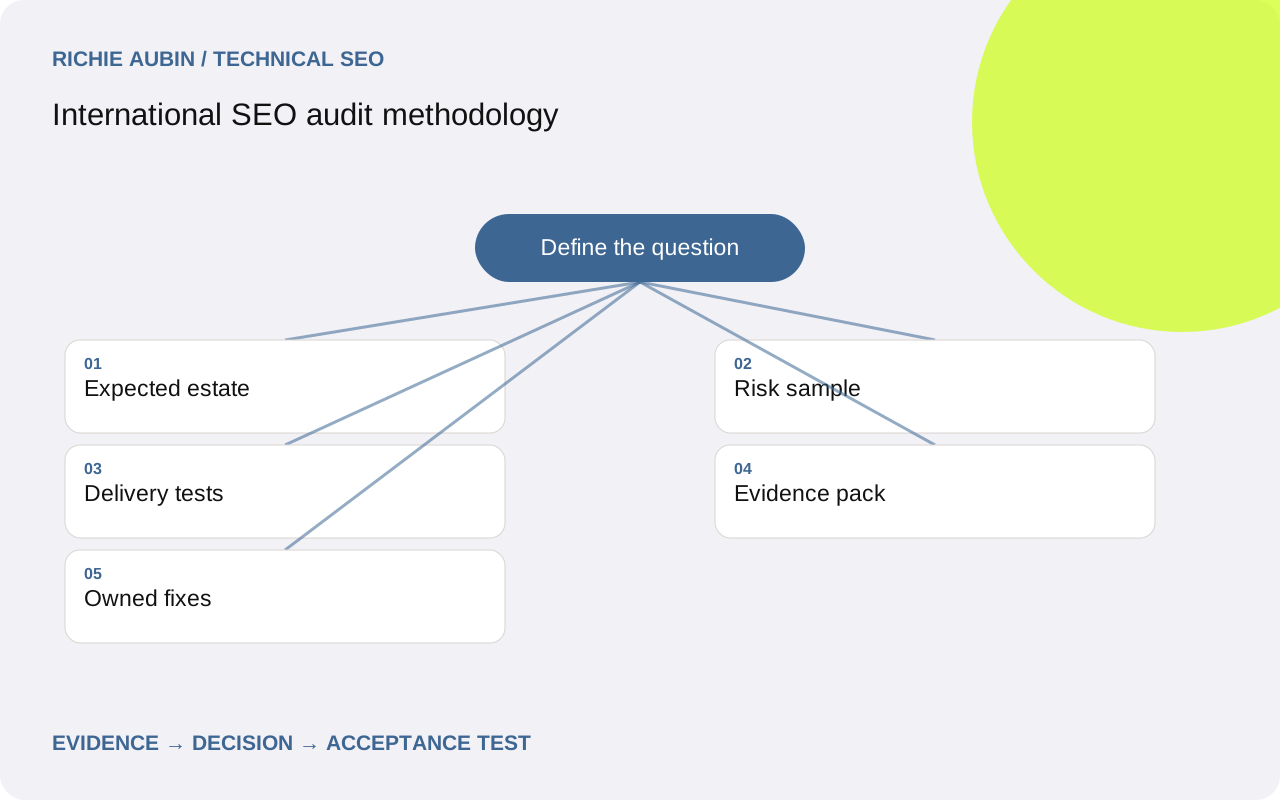
Define the expected international estate
An international SEO audit needs a specification of what should exist before it can judge what is missing. Build a market-and-language matrix covering public hosts, locale prefixes, supported products, service boundaries and editorial owners. Distinguish launched editions from planned translations and deliberate exclusions. A missing page in an unsupported market is not automatically a technical defect.
Document the audit period, crawl roots, rendering settings and property access. List sources that can establish the expected inventory: CMS publications, translation records, product availability data and approved route mappings. These sources should remain separate from the crawl, which describes observed delivery and discovery rather than the complete intended estate.
Use the international SEO framework to confirm the purpose of each edition. Record unresolved business questions early, such as whether Canadian French is a complete service offering or a limited support archive. Technical recommendations become unreliable when they assume a commercial scope the organisation has not approved.
Combine estate-wide checks with purposeful samples
Run machine-readable checks across all known public URLs where practical, but choose manual samples by risk rather than random volume alone. Include each locale, host, template and publishing system. Add resources with many translations, partial coverage, renamed slugs, retired products and recent releases. Sample small locales deliberately so the largest market does not dominate the evidence.
Keep the expected inventory keyed by stable content identifier, with separate URL records for each edition. Preserve raw addresses and redirects rather than merging them prematurely. This supports questions such as whether a missing French URL is an unpublished translation, a renamed route or a discovery failure on an otherwise live resource.
Mark checks as complete, sampled or untested, with reasons. A successful sample from one shared template cannot establish that an independently managed regional host behaves identically. Prioritise expanding the sample when findings show a new boundary, such as failures affecting only a specific catalogue integration or a translation provider's latest publication batch.
Test direct delivery before interpreting metadata
Request intended URLs without prior cookies, then compare ordinary sessions and explicit language selections. Record status, final destination, main-content language, visible availability and authentication or consent barriers. Test whether an inferred location overrides the requested edition. A valid hreflang annotation is of limited practical value when the destination consistently serves a different resource.
Inspect public host configuration: robots access, certificates, response reliability and cache behaviour. Compare source HTML with rendered content on templates where scripts load translations or regional conditions. Check complete journeys through categories, detail pages and contact routes instead of treating the homepage as representative of the estate.
Preserve request conditions and collection times in the evidence. Differences may arise from a legitimate stored preference or an erroneous cache key; those hypotheses require different tests. The URL structure guide helps distinguish stable locale identity from content that varies invisibly at one address. Escalate access failures before debating annotation punctuation.
Audit alternate and duplicate relationships independently
Build expected alternate sets from approved content equivalence, then compare observed HTML, HTTP headers or sitemap annotations. Validate supported values, fully qualified destinations, self-inclusion and return relationships. Check that the targets serve the same resource task rather than merely the same category position. A syntactically valid set can still connect unrelated products.
Review canonical declarations separately, including duplicate aliases and same-language regional policies. Distinct translations usually retain their own intended identity; near-identical regional copies may have an intentional preferred representative. Record the rationale rather than labelling every cross-region declaration as defective. Compare internal links, redirects and sitemap entries with that policy.
Use hreflang error diagnosis to locate failures in templates, registries, caches or generators. Avoid double-counting a single root cause as hundreds of independent issues. Report the faulty rule, affected clusters and representative evidence, then show the extent of exposure as a separate measure of scope.
Review local usefulness and discovery routes
Ask language reviewers to inspect main-content completeness, terminology, local conditions and accuracy of support information. A technical crawler cannot establish that a translated safety instruction or eligibility statement is correct. Document who reviewed the content and distinguish confirmed editorial faults from observations that need specialist assessment.
Trace local navigation from appropriate public roots. Confirm that categories expose the intended catalogue, contextual language links preserve resource identity and missing translations receive honest treatment. Compare sitemap inventories with published records and discovered URLs. An edition can be present in XML while remaining disconnected from useful browsing routes.
Measure performance by relevant locale and device where field samples allow. Core Web Vitals good thresholds are LCP at most 2.5 seconds, INP at most 200 milliseconds and CLS at most 0.1 at the 75th percentile of real-user experiences. Laboratory tests help investigate fonts, scripts and delivery changes; they do not establish that a low-volume regional page passes field thresholds.
Use an evidence checklist and competing hypotheses
Every actionable finding should include the expected behaviour, observed response, collection date, representative URLs, affected population, reproduction conditions and responsible system. Add status, final destination, language, canonical, robots rules, alternate relationships, internal parents and sitemap membership where relevant. Separate current response evidence from Search Console's indexed observations.
Test competing hypotheses for unexpected landing-page patterns. A country report favouring English could reflect English-language queries, missing translations, a cross-language canonical defect, forced redirection or a property filter excluding regional hosts. Compare query language and coverage before asserting a tag failure. One chart rarely establishes a specific technical cause.
Use indexed URL Inspection data carefully and record its crawl date; a live test answers different questions. The audit should say which explanation the evidence supports and which remain unresolved. Do not convert a lack of access or sample coverage into an affirmative pass. Explicit uncertainty makes the next investigation concrete and prevents a confident but misplaced implementation change.
Illustrative worked example: a missing French support cohort
Illustrative worked example: a fictional equipment brand expects 240 support articles in Canadian French. The CMS registry confirms all are published, but an internal crawl reaches 180. Search reporting also shows visits to English support pages from Canada. The team considers missing navigation, incomplete translations and incorrect hreflang as competing explanations.
Direct requests find the 60 absent articles live and translated. Their alternate sets are reciprocal and their canonical declarations match the intended French URLs. Both source and rendered category pages omit them. Comparing publication fields shows that the local navigation query excludes a newly introduced support topic. The strongest confirmed defect is therefore discovery, not hreflang syntax.
The repair changes the local category rule and adds a publication fixture for the new topic. Acceptance requires an unseeded crawl to reach the 60 intended articles and verifies that unpublished records remain excluded. The invented figures explain reconciliation and causality testing; they are not client results, and the Canadian traffic observation alone does not prove the impact of the omission.
Turn findings into owned implementation decisions
Prioritise by severity, affected useful resources, strength of evidence and ease of safe correction. A regional host returning errors can block an entire edition; a wrong equivalence map can misdirect visitors to a different product; an absent optional fallback may need no change. Keep those distinctions visible rather than sorting solely by the number of affected URLs.
Write acceptance criteria that a developer and content owner can review. Name the record class, expected delivered resource, allowed locale set and publication transitions to test. Require checks for unaffected siblings and boundary cases, including missing translations, renamed routes and withdrawals. Mark dependencies such as editorial approval or product availability data explicitly.
Use SEO release QA to place each check in the appropriate deployment. Close confirmed implementation defects when production evidence passes the stated criteria. Keep follow-up search measurement as a separate observation task, because a correct release cannot guarantee immediate recrawling, indexing, ranking changes or a particular regional result.
Plan rollback, monitoring and audit limitations
For each material change, identify rollback triggers and the narrow configuration to reverse. Risks include exposing drafts through a wider category query, consolidating distinct translations, redirecting local customers to unavailable offers and mixing cached locale versions. Preserve route and registry versions without planning to overwrite new editorial work during reversal.
Monitor by locale and template after release: public response failures, discovery coverage, incorrect alternates, canonical exceptions and publication lag. Assign owners and expected response times. The multilingual sitemap workflow can provide an independent publication reconciliation, especially when several platforms share one international catalogue.
State limitations plainly: incomplete property access, unavailable logs, language review gaps, low-volume performance data and sampled templates all constrain conclusions. An audit cannot establish every user location or prove why every search result appeared. Its value lies in a defensible account of confirmed failures, unresolved hypotheses and the concrete controls that keep maintained editions consistent over future releases.
Frequently asked questions
Can an audit be completed with a crawl alone?
A crawl describes observed URLs and links under its configuration. It cannot define the intended markets, verify translation quality or reveal every published resource independently. Combine it with publication records, availability requirements, representative manual journeys and appropriate indexed observations.
How should small locales be sampled?
Give each locale explicit representation, then add cases based on publishing risk and infrastructure differences. An estate-wide sample dominated by the largest language can miss a complete failure in a smaller edition. Expand testing when a new template or system boundary appears.
Should all country traffic differences become technical findings?
No. Demand, query language, offer suitability and reporting coverage can differ substantially. Turn a pattern into a hypothesis, then test delivery, content and relationships. Report a technical defect when there is reproducible evidence rather than treating unequal traffic as proof of incorrect configuration.
When is an international audit finding resolved?
Resolve the implementation issue when the stated acceptance checks pass on production, including relevant adjacent cases. Continue monitoring indexed observations and user outcomes separately. Search processing time and wider relevance considerations mean a technical closure cannot promise a specific traffic recovery or result selection.