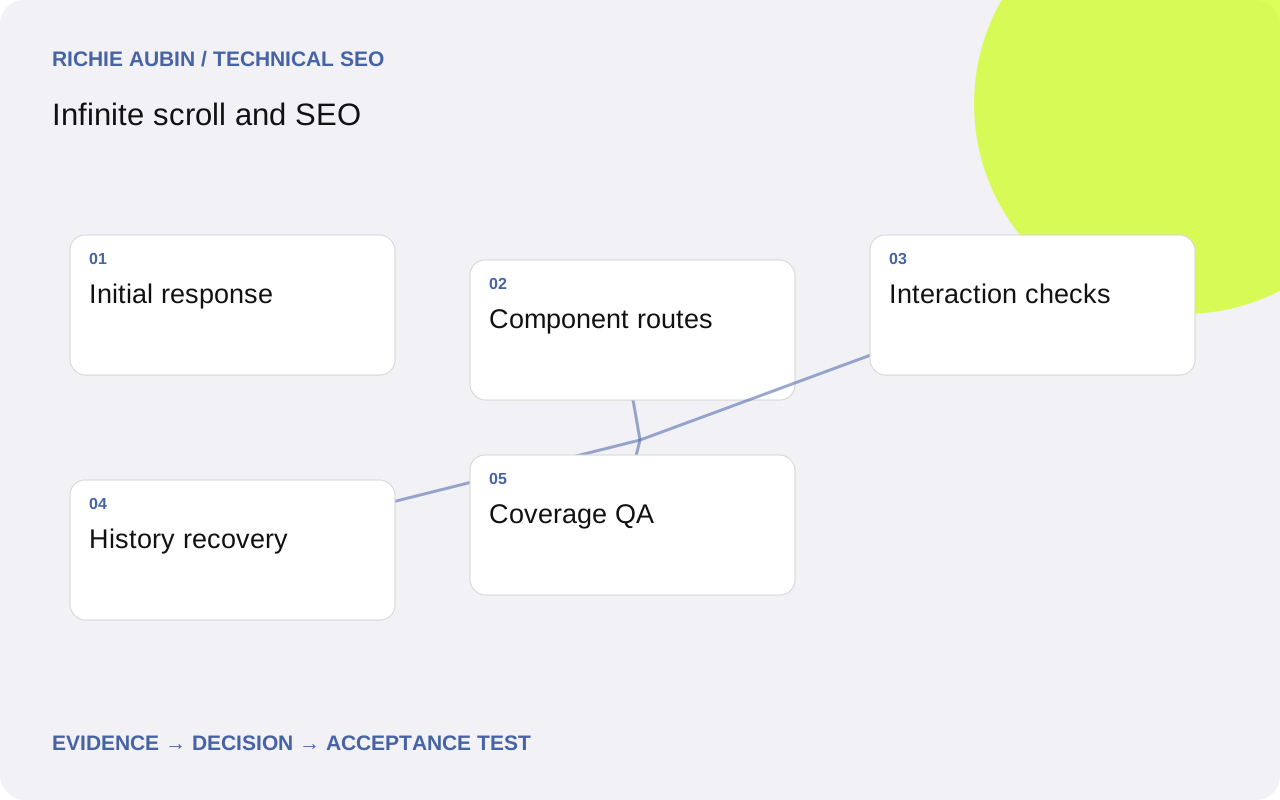
Separate the enhancement from the content route
Identify what the interface loads at each step and which public URL represents that component. The scrolling mechanism may call an API, but an API endpoint is not automatically the page a user or search engine should open. Define the public route and ensure it returns a useful collection state independently of the prior scroll session.
Google’s crawlers generally do not trigger interactions such as clicking load-more controls. Do not use successful manual scrolling as proof that later items are discoverable. The underlying sequence needs crawlable links and distinct retrievable addresses where those components expose additional content. A fragment-only address is not a dependable substitute for that sequence.
The pagination guide covers component identity and boundaries in detail. Infinite scroll adds interface state, automatic loading and history management, so its acceptance checks need to cover both the underlying sequence and the experience layered on top.
Capture the evidence checklist without scrolling first
Open the initial URL in a clean session and save the server response, source links, rendered links, canonical and visible item identifiers before interaction. Then scroll or use load more and record network requests, address changes and newly visible identifiers. Compare those observations with the public component URLs the application is supposed to support.
Request a later component directly in another clean session. It should not depend on a cursor stored only in memory or a cookie created on page one. Confirm the response contains the intended collection state and that the interface still offers a sensible route towards earlier or later items.
Add an inventory comparison using a catalogue or CMS export. A crawler reaching only the first batch may miss later items, but an item absent from the crawl can also be unpublished, filtered out or moved during testing. Preserve times and item identifiers so the investigation can distinguish routing failures from normal membership changes.
Test competing causes of missing later content
The obvious hypothesis is that later batches require scrolling, but check whether the issue is actually an API failure, consent dependency, expired cursor or rendering error. Inspect a failed request rather than assuming the crawler merely waited too little. A response that works after authentication is different from an anonymous public collection.
Compare source and rendered links. If a next-component anchor exists and works directly, a crawler configuration or resource failure may explain a missing route. If only an event listener knows the next destination, the architecture lacks a dependable discoverable edge. Increasing a rendering timeout will not create that missing contract.
Use missing rendered content diagnosis when the component route works but its items disappear after client scripts run. Hydration or state restoration can overwrite useful server output, producing the same visible symptom as an infinite-scroll discovery problem while requiring a different fix.
Design durable component URLs and boundaries
Use a stable public page-number or equivalent route that can retrieve a meaningful component. Keep the initial ordering and page-size policy explicit. Internal API cursors can remain implementation details, but users should not need to replay every previous request to open a saved public address. For fast-changing feeds, document what persistence the route can reasonably provide.
Define first, final and invalid components. Once the final batch is reached, loading must stop without requesting an endless series of empty successful responses. Invalid component numbers should have a consistent response policy. A server that returns the first batch for every number can create duplicates and misleading history states.
Keep default sorting separate from user-selected filters. Switching to a smaller set may reset the component, but the URL and displayed state should agree. The parameter workflow helps specify that parser behaviour so page numbers, filters and campaign values are not accidentally merged or discarded.
Treat history, focus and recovery as functional requirements
Decide when the address should represent a newly visible component and whether transitions replace or add history entries. The choice affects what Back means after a user opens a detail page. MDN documents that replaceState changes the current history entry without loading the new address; that is why an address-bar update is not evidence that the route can be requested directly.
Test returning from a detail page, reloading midway through the collection and opening the copied address on another device. Preserve a reasonable position or component context without creating hundreds of unwanted history entries. Define behaviour when state restoration is unavailable rather than assuming every browser will retain memory.
Automatic loading should not trap keyboard users or make the footer permanently unreachable. Provide clear loading and failure states, and a usable retry path. A load-more control can be an appropriate interaction enhancement, provided the content also has dependable public routes. These are user requirements alongside the crawl requirements, not optional refinements after launch.
Worked example: a directory that stops at the first batch
Illustrative example: a professional directory displays a first batch of profiles and loads the rest through an intersection observer. The address changes to page two, yet requesting that address directly returns the initial batch. A search crawl discovers only the first profiles. The competing hypothesis is that profiles themselves are blocked or unavailable.
Request several missing profile URLs directly to establish that they work. Then compare the second public component with the API response generated during scrolling. Correct the public route so it resolves the same component state and add crawlable continuation links beneath the enhancement. Keep the observer as a presentation choice rather than the sole source of discovery.
Verify all retained profiles through the component sequence in a bounded test collection. Open page two directly, reload it, navigate to a profile and return. The accepted result is consistent content and navigation across these paths. No measured traffic improvement is implied by the example, and independent profile quality remains a separate question.
Write developer acceptance across interface states
The acceptance matrix should cover initial entry, direct later entry, automatic load, manual retry, final batch, empty collection and invalid component. Record expected item identifiers, URL, canonical and next link. Test with a failed API request and slow response so loading errors do not silently leave users at a false end of the collection.
Check the underlying sequence in an HTML-oriented crawl and inspect a rendered sample for client-side regressions. Not every site must return all collection items in the first response, but essential discovery routes must not depend on interaction. Confirm that newly published items appear in the appropriate collection and that unpublished profiles disappear without breaking continuation.
Use rendered HTML testing for representative component states. Assertions should compare the requested component with the displayed records, not merely check that a container exists. Include mobile viewport and keyboard journeys because observation thresholds and focus handling can behave differently from a desktop mouse test.
Release with a usable fallback and clear limits
Preserve the ordinary paginated experience as a fallback where practical. If automatic loading fails after release, users should still have a way to continue. Store the previous history and observer configuration so the enhancement can be disabled without removing the underlying component routes. That reduces rollback risk and makes faults easier to isolate.
Monitor failed batch requests, unexpected repeated item sets, non-terminating routes and direct-entry errors. Use catalogue coverage to check whether the long tail remains reachable. Avoid treating the number of indexed component pages as the sole success measure; collection components and detail pages have different purposes and search systems may select them differently.
Be explicit about live-feed limitations. Records can move between batches as content changes, and a saved component may not reproduce an exact historical view. If exact continuity matters to the product, engineering needs a snapshot or cursor design that supports it. SEO annotations cannot repair an application contract that never guaranteed stable retrieval.
Frequently asked questions
Is infinite scroll inherently bad for SEO?
No. The risk is hiding additional content behind interactions without dependable public routes. Keep distinct retrievable components and crawlable continuation links underneath the interface. Then verify that direct requests, rendered content and the scrolling experience agree about which records each component contains.
Does updating the browser URL solve discovery?
No. A history API update can change the address without loading or even checking that the new route exists. Request the address in a fresh session and inspect its content. Also verify the component is exposed through ordinary links rather than known only to an interaction handler.
Can a sitemap compensate for missing continuation links?
It can provide additional discovery for listed detail URLs, but it does not repair a broken collection journey or prove coverage stays complete. Maintain useful browse routes and test publishing behaviour. Sitemaps are supplementary evidence and discovery support, rather than a substitute for a working public collection.
What should happen when the loading request fails?
Keep existing content usable, explain the failure and offer a retry or ordinary continuation route. Do not silently present a temporary error as the end of the collection. Test recovery, browser history and focus so users can continue without losing their place or repeating all previous loading steps.