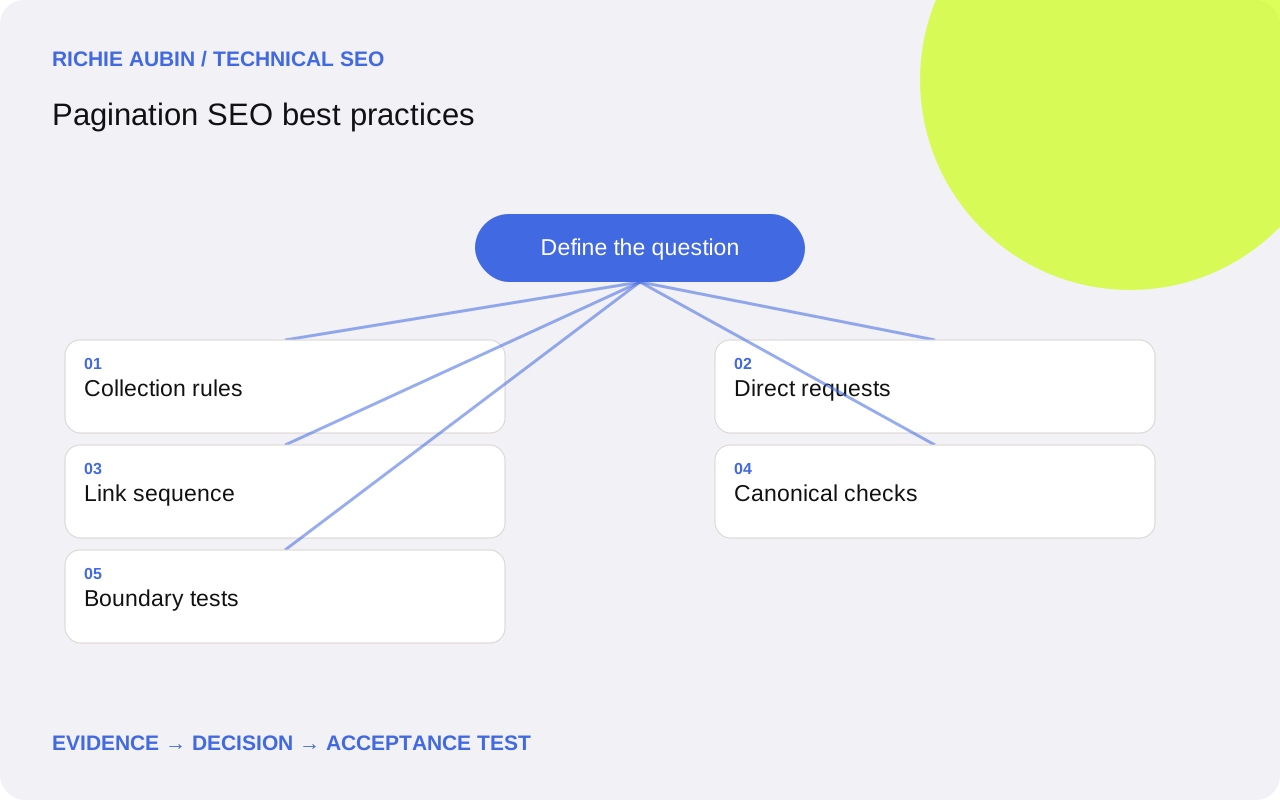
Establish what each page actually represents
Identify the collection, default ordering, page size and membership rules. A product category sorted by a stable default has different requirements from a live news feed or a personalised recommendation list. Write down which records belong in the collection and which state the server returns when there are no cookies or prior interactions.
Each component page needs a retrievable identity if it exposes items that are otherwise unavailable through the sequence. Query parameters are acceptable for page numbers; a folder rewrite is not inherently better. What matters is that a request for a particular component returns its intended content rather than always resetting to the beginning.
Keep pagination separate from sorting and filtering. A later page is a continuation of a set, while a filter changes membership and a sort changes order. The URL parameter guide helps separate these behaviours so one broad rule does not inadvertently block useful continuation routes.
Capture an evidence checklist across the sequence
Test the first, second, middle and final valid pages, plus the first out-of-range page. Save response status, requested URL, final URL, canonical, robots directives, visible item identifiers and next-page destination. Include a one-page collection and an empty collection because their boundary behaviour often differs from the main example.
Request component URLs in a clean session. Compare source HTML with the rendered page and inspect ordinary anchors between components. Do not assume a control labelled next has a usable href. An interaction-only button can work for users while leaving the underlying URL sequence undiscoverable to a crawler that does not trigger it.
Use a navigation crawl and a catalogue export to check coverage. An item absent from one run may have changed position during the crawl, so preserve timestamps and ordering rules. Repeated or missing records can indicate unstable data rather than a link defect. The evidence should support both explanations until you test them.
Make continuation links and direct requests agree
A next-page link should lead to a URL that can be opened independently and returns the same component state. Test copying the address into a fresh browser session. A URL that works only after the first page stores a cursor in memory is not a reliable public continuation route. Keep any private API cursor separate from the durable public route design.
Provide sensible navigation back to the collection start and previous components where useful. You do not need to display every page number in a large collection. The important engineering requirement is a finite, followable route through the set, with clear user orientation and no dead ends before the last component.
If an interface uses a load-more or scrolling enhancement, preserve the same direct-request contract underneath it. The infinite scroll guide covers history and interaction behaviour. A changed address bar on its own does not prove the server knows how to return that component.
Set canonical and indexing policies deliberately
For a sequence whose pages expose different items, each component normally identifies itself as canonical. Do not point every later page at page one merely because the template and introductory copy repeat. First establish whether the main content is genuinely equivalent. A canonical preference cannot turn different product sets into the same document.
Likewise, excluding all later components from indexing should be a deliberate policy with an understanding of discovery consequences, not an inherited plugin default. If detail pages rely on those routes, retain dependable links to them. Sitemaps can supplement discovery, but they do not repair a broken browsing sequence or prove all listed items are useful.
Google no longer uses rel next and prev annotations to identify pagination. Ordinary page links and working URLs still matter. The canonical guidance is useful when a platform combines page numbering with alternate sort orders, because duplicate sort variants require a different decision from distinct continuation pages.
Test boundaries and unstable ordering
Request invalid values: zero, negative numbers, non-numeric values, a very large page number and repeated page keys. Define a consistent outcome that does not create endless successful copies of the same content. Returning the last valid page for every large number can produce a large duplicate URL space even though the interface never links to those states.
Review ordering when items share the same primary sort value. A secondary stable identifier can prevent records moving unpredictably across boundaries during repeated requests. For rapidly changing feeds, perfect snapshot consistency may require a different data design; document the limitation rather than claiming the pagination can freeze a live catalogue.
Check filter and sort transitions. Moving from page eight to a narrow filter may need to reset pagination because the new set has only one component. If the interface quietly displays page one under a stale page-eight URL, the address, canonical and visible content can disagree. Reproduce the state through a direct request as well as the interface.
Worked example: a category with page-one canonicals
Illustrative example: a category contains several valid components, but its template sets the canonical to the base category on every page. A crawl follows next links and finds different product identifiers on each component. The competing hypothesis is that page parameters are ignored by the backend and all pages actually duplicate the first.
Request the second and final components directly and compare their item sets. If the backend returns distinct sets consistently, correct the canonical logic to use the current component URL. If it returns the first set, fix routing and query handling before adjusting metadata. These are different failures despite a similar crawler warning.
Retest an empty category, a single-page category and a multi-page category. Validate the final next-link boundary and confirm item coverage from a navigation crawl. Record the engineering result without inventing search outcomes: the component URLs, visible contents and canonical preferences now agree. Indexing decisions remain outside the developer’s acceptance contract.
Give developers a finite acceptance matrix
Specify expected status, item set, canonical and navigation controls for each boundary case. Include page one with and without an explicit default parameter, a valid later component, an out-of-range component and a filtered collection. Decide which equivalent first-page URL is preferred and ensure generated links consistently use it.
Require that a direct request and an enhanced interface transition reach equivalent content. Tests should verify item identifiers and route state, not only screenshots or the presence of a next button. Confirm a newly added item becomes reachable and a removed item does not create a broken final component.
Run a crawl with a sensible cap to detect runaway routes. The crawl trap workflow helps investigate sequences that never terminate. Check that repaired page-number handling does not break bookmarks, analytics attribution or users returning from a detail page. Those behaviours are part of a functioning collection, not optional cosmetic extras.
Release safely and interpret results carefully
Keep the previous route and canonical configuration so an error can be reversed independently. If a metadata fix accidentally strips filter state or an ordering change hides products, roll back that component without restoring an unrelated pagination defect. Monitor response errors, final-page behaviour, item coverage and growth in unexpected URL variants.
Do not interpret a fall in indexed component pages as automatic success. It may reflect consolidation, demand, content changes or a broken route. Inspect representative detail-page discovery and canonical selection alongside the page family’s technical behaviour. A neat Search Console total is not the goal if visitors can no longer reach products.
Document limits for fast-changing collections and cursor-based feeds. A single crawl cannot establish permanent completeness when inventory moves between requests. Use stable samples, repeated boundary checks and application-level membership tests. Maintain the contract as collection sizes change; a sequence that worked at launch can fail when the final component disappears or a new sorting option is added.
Frequently asked questions
Should page two canonicalise to page one?
Normally not when it contains a different subset of the collection. Give each distinct component its own canonical identity and test the actual item sets. If the backend ignores the page parameter and repeats the first page, repair that behaviour rather than using metadata to disguise the duplicate responses.
Does pagination need numbered links to every page?
No. A practical interface can use sequential links and a limited selection of page numbers. It still needs a finite route through the collection and directly retrievable component URLs. Test coverage and boundary behaviour rather than requiring a huge block of numbered links on every component.
Can I use hash fragments for page numbers?
Do not rely on fragment-only differences to expose separate collection components to Google. Use distinct retrievable URLs for the components. Fragments may support an in-page interface, but the server and crawlable continuation links need a URL design that identifies the relevant item set independently.
Should titles be unique on every component?
Google permits the same titles and descriptions within a paginated sequence. You may add page context if it helps users, but rewriting metadata is not the primary diagnostic task. Prioritise distinct content retrieval, appropriate canonicals, followable links and correct handling of the final and invalid components.