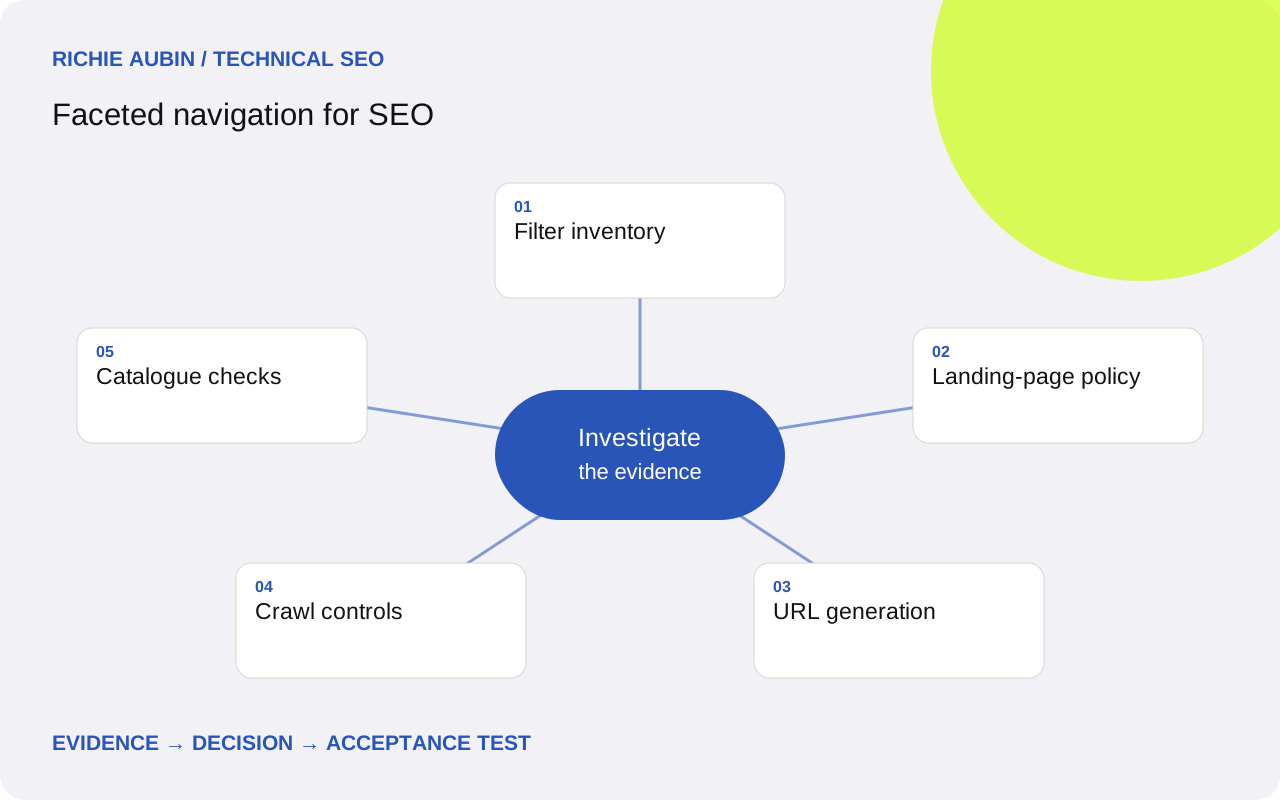
Separate shopper controls from search landing pages
A filter can be useful on the website without deserving its own search result. Size, colour, price, availability and compatibility may all help selection, yet their combinations often describe temporary or very narrow states. Start with a policy for indexable collections rather than applying the same treatment to every filter key.
A retained landing page needs a clear task, sufficiently useful content and an owner who can maintain it. Search demand can support the decision, but a keyword phrase alone does not justify a page whose inventory disappears unpredictably. Consider whether an editorial category would provide a more stable experience than exposing every combination generated by the interface.
The website architecture guide helps decide which collections belong in the permanent hierarchy. This guide addresses the remaining filter machinery: how URLs are formed, how crawling is controlled and how useful product routes survive those controls.
Build a filter evidence checklist
Inventory every filter key, allowed value, default, multi-select rule and interaction with sorting or pagination. Capture URLs generated by the live controls, not just the platform’s documentation. Include mobile controls, reset actions and links in product feeds or editorial content. Different components may serialise the same filter state differently.
Compare crawl samples and verified bot requests where available. Group by key combinations and response behaviour rather than reviewing thousands of URLs individually. Record canonical targets, robots access, indexing directives, item counts and representative item identifiers. A large URL count is a warning to investigate, not proof that all those URLs are being crawled heavily.
Test impossible combinations, repeated keys, duplicate values, reversed selection order and zero-result states. Preserve the original URL in your evidence. An aggressive normalisation step can erase exactly the duplicates you need to demonstrate. Note when stock changes affect the item set so transient empty results are not mistaken for permanent route defects.
Evaluate competing causes of URL growth
Combinatorial filtering is one explanation for growth, but tracking parameters, session identifiers and unstable sorting can create similar reports. Determine which controls change collection membership, which only reorder the same items and which have no visible effect. Those distinctions determine whether a URL is a meaningful alternate view, a duplicate or simply an invalid state.
Also distinguish existing indexed URLs from newly discoverable ones. Blocking future crawling will not necessarily remove historical search entries. Conversely, adding noindex does not stop the server cost of fetching a large filter space. Use the robots.txt versus noindex guide when the desired outcome is unclear.
Trace the source of unexpected combinations. A crawler may have found links in a sidebar, a campaign template or an old sitemap. Fixing URL generation at that source is often more durable than adding another broad rule after the variants have already been published across the site.
Choose controls that match the intended outcome
If a filtered URL is not needed in search and resource use is the problem, design a crawl policy for that family. Google’s current faceted-navigation guidance discusses robots controls and fragment-based states for unwanted filter crawling. Either approach still requires useful item discovery through other maintained routes.
If a currently accessible page needs an indexing exclusion, the crawler must be able to fetch its noindex directive. Combining a new robots block with noindex can prevent that instruction being seen. Sequence changes deliberately and inspect representative historical URLs. Do not promise a removal timetable from a configuration change.
Canonical annotations express a preferred representative for duplicate or similar content; they are not a strict crawl firewall. Avoid relying on them to contain an unlimited combination generator. Where a filter view genuinely serves a separate landing-page purpose, give it consistent self-identity, appropriate links and maintained content rather than contradictory instructions that simultaneously promote and suppress it.
Make URL generation deterministic and finite
Choose one order for filter keys and a defined order for multiple values where order has no meaning. Reject repeated filters and impossible combinations according to the application contract. Do not let users or bots append arbitrary values and receive endless successful copies of the same collection. Confirm encoding and separators are handled consistently by the frontend, backend and cache.
For nonsensical filter combinations and combinations with no results, Google’s guidance calls for a proper 404 response. Work through temporary stock cases carefully: a maintained category awaiting stock is a different entity from an arbitrary impossible combination. Do not apply an empty-result rule to every editorial category without reviewing its purpose.
Keep valid pagination intact inside allowed collections. A rule blocking all query strings can suppress continuation pages along with filters. The parameter diagnosis workflow provides a way to classify keys before writing patterns, including mixed URLs where a valid page number appears alongside an unwanted sort or tracking state.
Worked example: preserving useful material collections
Illustrative example: a furniture retailer exposes material, colour, price band and stock filters. Material categories support durable buying decisions, while every price-and-stock combination changes frequently. The initial proposal blocks all query strings, which would also block the category’s page-number routes and some useful material views.
Create a finite list of maintained material landing pages and link them from the furniture hub. Define the remaining controls as on-site selection states with a separate crawl policy. Test a retained material page, a multi-filter combination, a later unfiltered component and an impossible material-value pair. Compare their responses against the written policy.
The repair is successful when maintained material pages remain accessible, products retain crawlable routes and unneeded combinations stop proliferating through generated links. It does not imply every material page will be indexed or rank. Keep the previous filter configuration so a mistaken rule can be reversed without removing the new category links.
Specify acceptance tests for mixed filter states
Build a test matrix around behaviour: allowed landing page, optional shopper filter, invalid value, duplicate key, zero results and final pagination component. Record expected URL, status, canonical and robots treatment for each. Include parameters in different orders so a pattern that works only when a key appears first does not pass unnoticed.
Require the product catalogue to remain reachable through ordinary browse routes without applying filters. Test the catalogue’s long tail, not only featured items. Confirm a newly added product receives its intended category link and that blocked filter URLs are not included in maintained sitemaps or editorial components.
Review user functionality separately. Sharing a selection, resetting filters and returning from a product should behave as designed. The pagination checks should be rerun after any filter routing change because page state and filter state commonly share the same query parser. A crawl-policy success cannot excuse a broken collection interface.
Monitor limitations and keep reversal practical
Monitor new URL patterns, representative bot requests, server errors and product coverage. A reduction in fetched variants is useful only if important pages remain available. Existing URLs may continue appearing in reports because search systems retain history. Separate historical inventory from fresh links before concluding that the new generation rules failed.
Store previous robots rules, filter serialisation settings and the retained landing-page list. Rollback risk is highest when a broad block accidentally catches useful categories or page numbers. Restore access to the affected family promptly, then replace the pattern with narrower tested rules. Avoid blindly reverting all protections and reopening the full filter space.
Document what the analysis cannot prove. A crawl sample may miss rare combinations, current stock may hide empty-state bugs and server logs may have limited retention. Add regression cases when new filters launch. Filter policy is an application contract that must evolve with merchandising, rather than a one-off SEO instruction pasted into robots.txt.
Frequently asked questions
Should every filtered page be noindexed?
No single rule fits every collection. Some filtered views can support maintained search landing pages; others are transient selection states. Decide their purpose first. If crawl cost is the problem, noindex alone still requires fetching. If indexing exclusion is the goal, the crawler must be able to read the directive.
Can canonical tags stop a filter crawl trap?
Do not treat them as a reliable containment mechanism. They indicate a preferred representative for similar content and may influence crawling over time, but they do not prevent requests. Fix the generation of unnecessary combinations and apply a tested crawl policy where those URLs do not need search exposure.
What if useful landing pages use query parameters?
Query strings do not automatically make a page unsuitable. Retain a finite, useful set with consistent URLs, appropriate content and clear links. Distinguish those pages from uncontrolled combinations. A folder-based rewrite changes presentation, but it does not by itself solve duplicate states, poor content or unbounded filter generation.
Should an empty filter redirect to the category?
Avoid hiding impossible or invalid combinations behind generic successful pages. Define appropriate failure responses and distinguish arbitrary empty filters from maintained categories temporarily without stock. Test the interface message as well as the status code so users understand how to broaden or reset their selection.