Define what should be searchable
Begin with an inventory of intended search pages, not a demand that every known URL enters the index. Product details, useful categories and substantive guides may belong in that inventory. Basket states, account pages, internal searches and tracking variants usually serve other purposes. Record the intended outcome for each URL family before interpreting any exclusion report.
Give each family an owner and an explicit rule: available for search, consolidated elsewhere, accessible but excluded, or removed. A live page is not automatically a search landing page. Equally, an old page with limited recent traffic may still answer a valuable support question. Product and editorial judgement belong beside the technical evidence.
This inventory becomes the denominator for your investigation. If a site generates thousands of filter permutations, a low proportion of indexed known URLs may be entirely unsurprising. Measure coverage of the intended inventory and freshness of important changes instead. The practical question is whether valuable pages are accessible and represented appropriately, not whether an aggregate chart looks tidy.
Separate discovery, fetching, rendering and selection
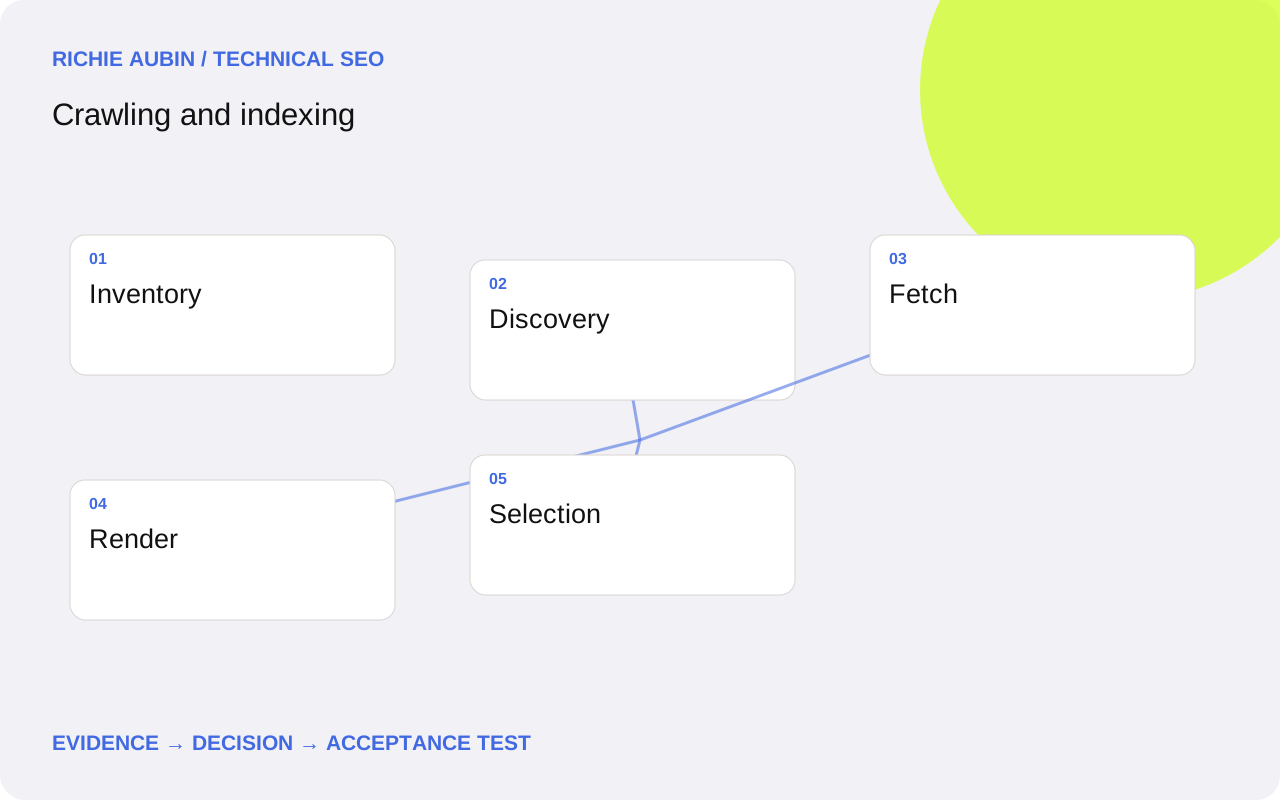
Discovery means Google has encountered a URL through a link, sitemap or another route. Fetching means a request reached the site and received a response. Rendering can expose content and links produced by JavaScript. Indexing then involves processing content and deciding how it should be represented, including which URL represents duplicates.
Each boundary needs different evidence. A sitemap can support discovery but cannot repair a blocked request. A successful HTTP response cannot prove that the main content was present. A complete rendered page cannot compel index inclusion. Keep these distinctions visible in tickets so teams do not mistake one successful check for completion.
Use single-page indexing diagnosis when a valuable URL is missing. If the initial response contains little usable content, investigate JavaScript SEO before treating the issue as a content decision. Work from the earliest demonstrable failure, while recording later checks that remain unknown. This avoids changing canonical settings to solve an unrelated delivery failure.
Build an evidence pack that preserves timing
For representative URLs, capture the exact address, intended outcome, request time, response status, redirect destination, relevant headers, robots permissions, canonical declaration and visible main content. Add sitemap membership and at least one internal discovery path. Keep raw and rendered observations separate. A browser screenshot is useful context but does not replace the response evidence.
Then inspect the URL in Search Console. Record the last crawl date and the Google-selected canonical where available. Distinguish indexed information from a live test: they describe different moments and answer different questions. If the last crawl predates a release, the stored result cannot verify that release.
Use server logs to establish whether a genuine crawler requested the URL, where that evidence is available. A user-agent string alone is not identity verification. Note log retention, missing edge logs and timezone conversions. An incomplete log window supports only a limited conclusion. These details often explain apparently contradictory evidence without requiring a new SEO theory.
Choose between competing explanations
A page absent from search might lack discovery routes, be blocked, return an error, render an empty state, duplicate another page or simply remain unselected. Write down two plausible explanations and the observation that would separate them. This turns an open-ended audit into a small investigation.
For example, if newly published guides are not being fetched, compare their internal links with established guides and check host availability. If requests exist but content is missing, compare the returned document with the rendering output and application dependencies. If Google selects another URL, inspect both pages for genuine equivalence and conflicting signals.
Do not infer a site-wide quality problem from one reporting label. Conversely, do not assume every exclusion has a technical fix. When delivery works and a page substantially repeats existing material, the useful intervention may be consolidation or a clearer purpose. Duplicate-content analysis helps distinguish accidental copies from pages that deserve separate treatment. Record what would falsify your preferred explanation before assigning implementation work.
Match the control to the desired outcome
Use crawl permissions to manage access, indexing directives to exclude accessible content, redirects for genuine moves and canonical annotations to express a representative URL among equivalent pages. These controls are related but not interchangeable. Read robots.txt versus noindex before combining restrictions.
For important search pages, align internal links, sitemap entries and canonical preferences around the intended URL. Remove accidental contradictions rather than adding more directives. A canonical pointing at a blocked or failed destination leaves the site expressing an impractical preference. A sitemap full of redirecting URLs similarly describes yesterday's inventory.
Prioritise deterministic faults affecting valuable templates: an accidental noindex rule, a broken product response or a navigation component that removed all category links. Investigate broad crawling efficiency only when scale and observed delays justify it. Most modest sites gain more from dependable publishing and clear architecture than from elaborate crawl-budget adjustments. A control should have a specific purpose that can be tested independently of eventual search performance.
Illustrative example: missing replacement-part guides
Illustrative example: a retailer publishes twelve replacement-part guides after a CMS change. Four established guides remain indexed, while the new guides do not. The initial hypothesis is weak discovery because the new guides appear only in the sitemap. A second hypothesis is a publishing restriction inherited from draft mode.
Inspection of the live responses finds a noindex header on the new template. The HTML itself contains no such instruction, so a source-only crawler would miss the conflict. Internal discovery is also weak, but the header is the first confirmed barrier. The proposed change removes that header from published guides and adds relevant links from the maintenance hub.
Test old and new guides, drafts, preview URLs and downloadable manuals separately. The acceptance condition is correct publishing behaviour across these classes, not twelve immediate index inclusions. After deployment, preserve the release timestamp and monitor subsequent crawl observations. If the header reappears through cached responses, the next task is cache invalidation and configuration ownership rather than repeated indexing requests.
Make developer acceptance criteria observable
A useful implementation ticket names affected templates, reproduction URLs, expected responses and excluded cases. For a publishing fix, require that public pages return the intended successful response, present the main article, permit crawling and carry no unintended indexing restriction. Require drafts to remain protected through the agreed access controls.
Test URL variants as well as the clean address. Include protocol and hostname redirects, trailing slashes, parameters and known legacy routes where relevant. Verify the final public response through the same edge configuration that serves visitors. An origin-only check can overlook a CDN rule that rewrites headers.
Set rollback conditions before release. Unexpected exposure of drafts, broken authentication or large-scale redirects to the wrong destination should trigger reversal or a narrowly scoped disablement. Preserve configuration snapshots and affected URL lists. Restoring a previous build may not restore cached headers or sitemap output, so include those components in the recovery plan. Separate engineering acceptance from later search observations in the change record.
Monitor useful coverage and recognise limits
After a fix, check representative live responses first, then observe later crawling and indexing evidence. Track valuable URL families separately from expected exclusions. Annotate releases and compare similar publication cohorts rather than explaining every daily fluctuation. A changing known-URL total can alter the apparent exclusion rate without changing the health of important pages.
Watch for false positives. A crawler can miss links because of its own scope settings. Search Console can retain evidence from an earlier crawl. A selected canonical can be intentional. A temporary service incident can leave an exclusion report that outlasts the incident. None of these observations should be dismissed, but each needs context before remediation.
Escalate with a reproducible evidence pack when important pages remain inaccessible or incorrectly consolidated. Where the site meets technical requirements but Google does not select a page, review its distinct usefulness and relationship to existing pages. Avoid promising a deadline for crawling or indexing. The defensible outcome is a coherent, accessible site whose important pages can be discovered and understood.
Frequently asked questions
Does a successful crawl mean a page will be indexed?
No. A successful fetch establishes delivery at a particular time. Google still needs to process the content and may consolidate it with another URL or decide not to include it. Check the returned content and canonical information before interpreting the outcome.
Should every non-indexed URL be fixed?
No. Compare it with the intended inventory. Redirects, duplicates, retired resources and deliberately excluded utility pages may be behaving correctly. Investigate exclusions that contradict an explicit publishing decision, especially when they affect valuable templates or recently changed pages.
When should I request indexing?
Use a request selectively after a meaningful correction to an important accessible URL. Confirm the live response first and retain the change date. Requests do not replace internal links or a reliable sitemap and do not guarantee inclusion or a particular processing time.
How do I know whether this is a crawl-budget problem?
Look for delayed fetching of important pages alongside evidence about request allocation, URL proliferation or serving limits. A small site with pages already fetched usually needs another explanation. Diagnose the failing stage before investing in infrastructure or broad robots rules.