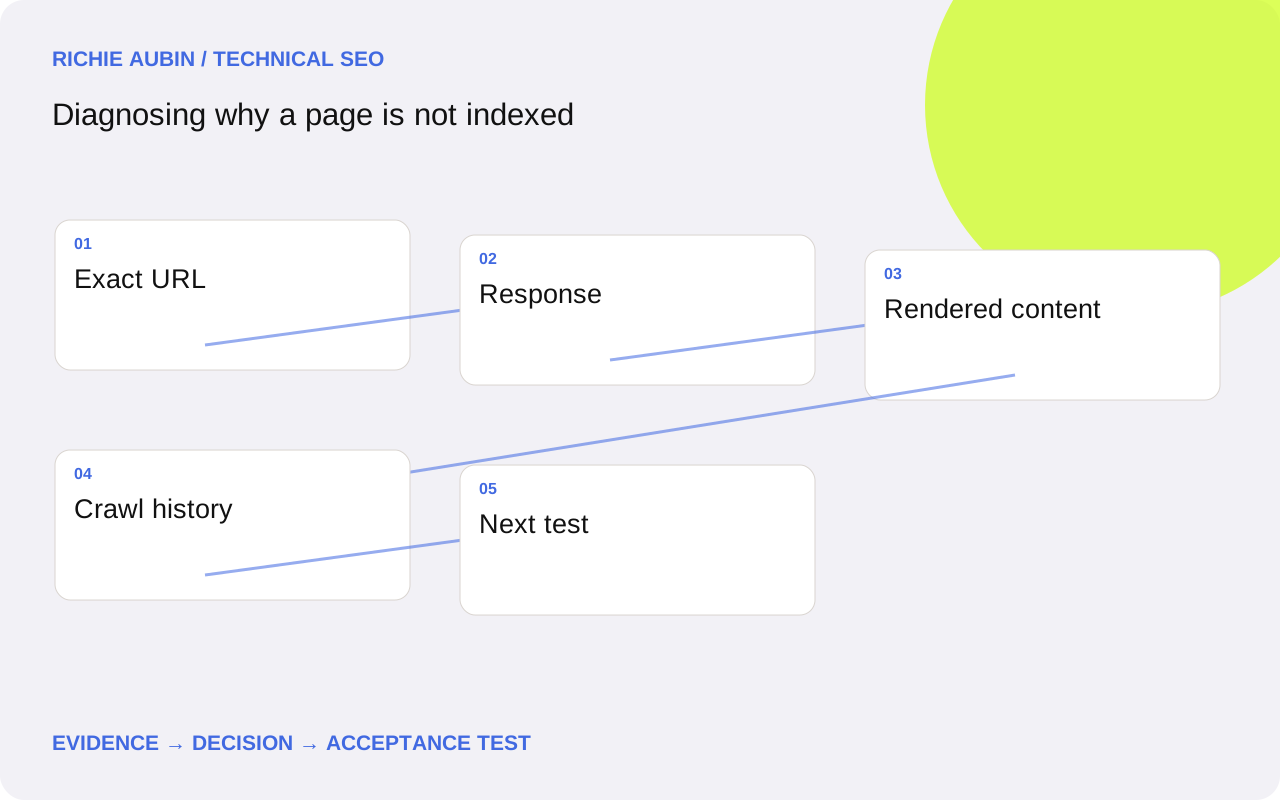
Confirm the page and the symptom
Copy the full URL from the published page and preserve its exact spelling, hostname, path, case and parameters. Record the publication date, intended search purpose and why this page should exist separately from others. A support article and its print version may have different addresses but only one intended search representative.
Use URL Inspection for the exact address. An unsuccessful title search or site query is a weak starting point because search results are not a complete index inventory. If inspection says the page is indexed, investigate visibility and relevance as a different problem rather than forcing an indexing diagnosis.
Check whether a redirect, selected canonical or alternate hostname explains the apparent absence. Inspect the destination as well as the original address. Keep the broad crawling and indexing framework in mind, but resist expanding a single-page investigation into a site-wide audit without evidence. Write the symptom in one sentence that a developer can reproduce.
Inspect the actual response, including headers
Fetch the page without relying on a logged-in browser session. Record the status, redirect chain and final address. Inspect response headers for indexing restrictions and compare the returned HTML with what an ordinary visitor sees. A public page that works only after an editor has authenticated is not reliably public.
Test a normal GET response rather than relying entirely on HEAD requests. Some applications handle those methods differently. Where access varies, compare edge and origin behaviour with the infrastructure owner. A CDN challenge can produce a successful-looking response containing an interstitial instead of the article.
Check the robots permissions for the exact path and relevant crawler. Inspect both generic and crawler-specific indexing directives. A permissive meta tag does not cancel an applicable noindex header. If the response is a genuine error, fix delivery before discussing content quality. The HTTP status guide explains how to distinguish removal, temporary failure and misleading successful responses.
Check that the intended content survives rendering
Identify the smallest set of content that establishes the page's purpose: its main heading, substantive explanation, product information or other unique material. Compare these elements in the initial HTML and rendered output. A navigation shell with a title is not equivalent to the complete page.
Use the live inspection output where available, including the rendered HTML and resource information. Look for failed dependencies, consent-dependent content, geographic assumptions and API responses requiring cookies. Reproduce with a clean browser context so cached application data does not disguise a dependency problem.
A missing screenshot element alone is not proof that text is absent from Google's processed document. Inspect the text itself. Equally, seeing a complete page in your own browser does not prove the crawler received it. For deeper investigation, use missing rendered-content diagnosis. Capture specific failed resources and response bodies so the ticket identifies a broken delivery path rather than vaguely requesting server-side rendering.
Reconcile current checks with the last crawl
Record the last crawl timestamp from inspection before running a live test. The stored result concerns Google's earlier observation; the live test concerns current accessibility. If an indexing restriction was removed yesterday and the stored crawl is older, these results can legitimately disagree.
Where verified crawler logs are available, locate requests for the exact URL and its redirect destination. Check status, time and serving layer. Logs confirm requests and responses but rarely prove all rendered content was processed. Missing logs can reflect short retention or a CDN that did not forward the request to the origin.
Build a simple chronology: publication, significant template changes, crawler observations and corrective releases. Avoid assigning causation to changes that happened after the recorded failure. If the reported status changes between inspections, retain both observations with their dates. A chronology gives developers a useful boundary for regression analysis and prevents repeated work on an issue that is already corrected but not yet reflected in stored reports.
Test the strongest competing hypotheses
For a discovered but unfetched page, compare discovery strength, host availability and the timing of publication with a similar page that was fetched. For a fetched but excluded page, examine content delivery, duplication and the selected canonical. Do not treat these branches as interchangeable.
If the page is technically accessible, compare it with the closest indexed alternative. Does it answer a different question, describe a different product or provide materially different instructions? Shared navigation and disclaimers are normal. Replacing a place name in otherwise identical copy is much weaker evidence of a distinct purpose.
Use canonical-tag diagnostics if another URL represents the page. Possible explanations include accidental canonical mapping, genuine equivalence and an incomplete render making pages look alike. Each calls for a different fix. Set out the competing explanations, the observation supporting each and the next discriminating check. Avoid concluding that a reporting label alone proves low quality or a hidden penalty.
Illustrative example: an installation guide excluded
Illustrative example: an installation guide for a new controller is reported as crawled but not indexed. The live test succeeds. One hypothesis is duplication with the previous controller guide; another is that the latest article was unavailable when Google last visited.
The chronology shows the recorded crawl preceded a content deployment. The old response contained the previous model's instructions and a canonical pointing to that older guide. Today's response has different wiring instructions, but the canonical still points backwards. Comparing only today's screenshot would miss the remaining defect.
The proposed change corrects the new guide's canonical, updates the product-page link and checks the sitemap entry. Before release, inspect related controller guides to establish whether the mapping bug affects the whole template. Keep the old guide available if its instructions remain valid for the older model.
Success means the public response consistently identifies the intended new URL and retains the distinct instructions. A later Google crawl can then reassess the page. This example illustrates an investigation, not a measured result or a promise of eventual index inclusion.
Write acceptance criteria for the actual failure
Name the exact broken behaviour. If an inherited noindex header is responsible, specify which publication states should receive it and which should not. If content is missing, name the absent elements and dependency failure. If canonical mapping is wrong, supply explicit source-to-target examples and counterexamples.
Acceptance criteria should cover the final GET response, applicable indexing rules, canonical destination, visible main content and relevant discovery link. Include mobile rendering when the failure depends on presentation or application state. Test a healthy control page from the same template to detect unintended collateral changes.
Define rollback risks in terms of user and publishing behaviour. Removing an exclusion globally may expose drafts. Reverting a renderer can restore the missing content while breaking interactive instructions. Keep changes narrow and preserve the earlier configuration. If rollback requires cache purges or restored route mappings, assign those steps explicitly. Do not make a future Search Console status the only condition for accepting a technically complete fix.
Observe recovery without manufacturing certainty
Recheck the public response after deployment and keep a dated evidence sample. Use an indexing request selectively for an important corrected page, subject to the tool's limits. Monitor subsequent crawl information and canonical selection rather than resubmitting repeatedly while the underlying evidence remains unchanged.
If delivery is correct but inclusion does not follow, reassess the page's independent value and overlap with existing content. That review should be specific: missing model differences, unsupported claims, insufficient instructions or a near-identical alternative. Adding arbitrary paragraphs or a new date does not establish a clearer purpose.
Recognise false positives in the evidence. A crawler scope error can create a false orphan. An inspected parameter variant may correctly consolidate elsewhere. A live test cannot predict Google's eventual canonical choice. Record unresolved uncertainty rather than inventing a deadline. Close the engineering issue when its acceptance criteria pass, and retain a separate observation task if later search processing still needs to be checked.
Frequently asked questions
What does crawled but not indexed actually establish?
It establishes that Google reports having crawled the URL without currently including that URL in the index. It does not identify one universal cause. Compare the last crawl, delivered content, duplicate alternatives and canonical evidence before deciding whether a technical or editorial change is justified.
Why does the live test pass while the stored report fails?
They concern different observations. The stored report can describe an earlier crawl, while the live test checks current accessibility. Compare timestamps and release history. Passing the live test does not guarantee indexing or predict which URL Google will eventually choose as canonical.
Should I change the URL to encourage indexing?
Only when the address itself needs a deliberate structural change. Renaming a page without fixing a delivery or duplication problem creates another URL to discover and maintain. It can also leave redirects, internal links and canonical declarations inconsistent with the intended destination.
How long should I wait before changing the page again?
There is no universal interval that proves success or failure. First confirm the release works and check whether Google has revisited afterwards. Use the site’s observed crawl pattern and the page’s importance to schedule review. Make further changes when new evidence supports them, not merely because a day has passed.