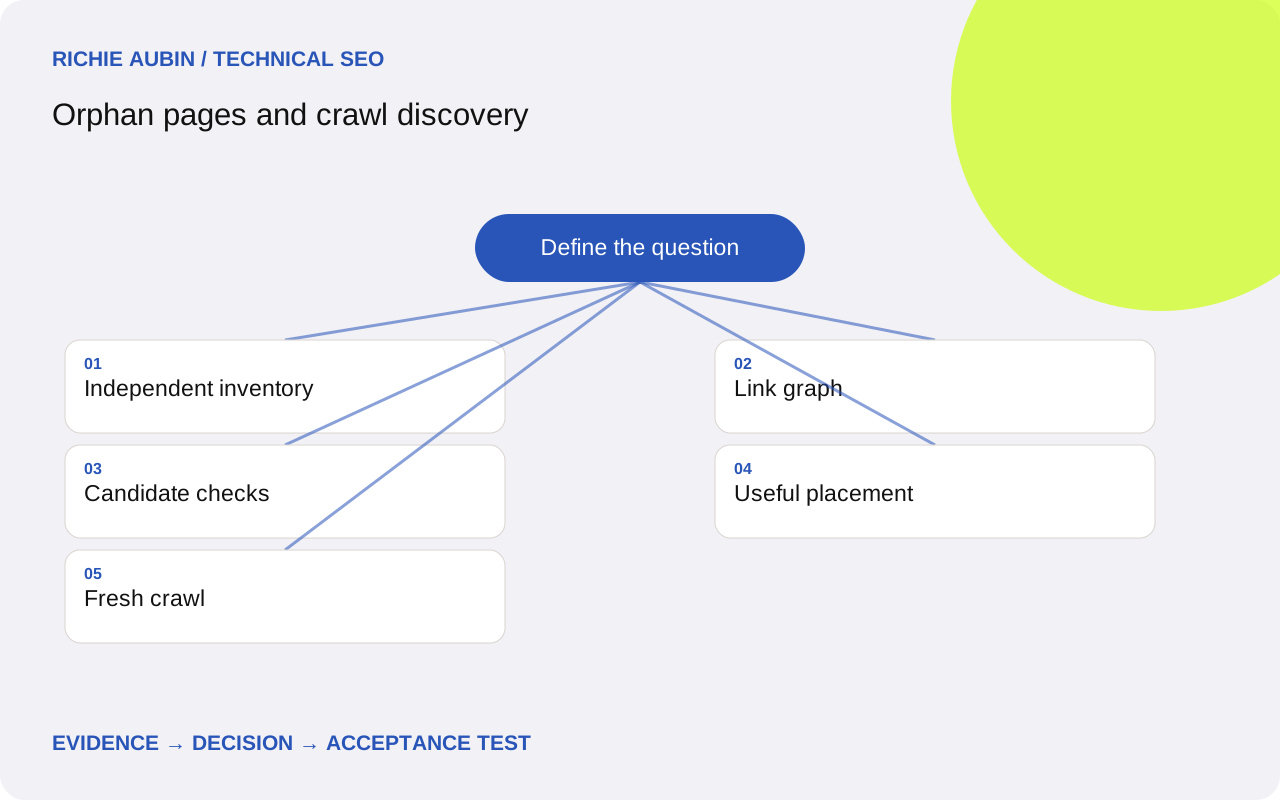
Define an orphan relative to a documented crawl
An internal crawl follows the links it can discover under its settings. If a page never appears, the crawl cannot tell you by itself whether the page exists. If the crawler imports a URL separately and finds no incoming link, that is stronger evidence of an orphan within the tested graph.
Document the crawl roots, included hosts, robots handling, JavaScript rendering, depth limits and URL exclusions. These settings define what an absent edge means. A link on a different subdomain, behind authentication or inside a component the crawler did not render may fall outside the graph even though a visitor can reach the page.
Distinguish internal orphaning from lack of search discovery. A sitemap or external link can expose a URL without giving it a useful place in the site. A page can therefore be known to Google and still be poorly connected internally. Use crawling and indexing principles to avoid treating these different observations as one problem. The immediate task is to establish the missing relationship and its practical importance.
Compare link discovery with an independent URL inventory
Build an independent candidate set from published CMS records, sitemap entries, analytics landing URLs, relevant logs and known legacy routes. Each source has blind spots. Analytics excludes unvisited pages and depends on measurement consent; logs depend on retention; sitemaps reflect generator rules; CMS records may include unpublished content.
Preserve source membership and timestamps rather than flattening everything into an unexplained list. A product found only in old logs needs a different review from a currently published guide in the sitemap. Retain the raw URL alongside any normalised key so path case, parameters and redirects can be investigated.
Join that inventory to URLs reached through ordinary internal discovery. Candidates present independently but absent from link discovery warrant inspection. URLs reached only because they were supplied as crawl seeds should not be mistaken for naturally connected pages. The orphan-page workflow at scale expands the reconciliation process, but even a small site benefits from a clearly documented distinction between imported URLs and URLs discovered through actual links.
Verify the missing link before recommending a fix
Inspect candidate URLs for status, final destination, canonical preference, indexing rules and useful content. A redirecting historical address may correctly have no direct internal links because the site already links to its replacement. A private account page may intentionally sit outside public navigation.
For a valuable current page, search the crawl's link data and inspect plausible parent pages. Compare raw HTML and rendered links when components are generated dynamically. Google generally extracts navigational links reliably from anchor elements with href attributes; a click handler on a generic element is not equivalent evidence of a crawlable link.
Test pagination and incremental loading. A category can appear to link every product in a browser session while exposing only the first set to a crawler. Use JavaScript internal-link diagnosis when the graph changes after rendering. Keep evidence of the parent component and the missing destination, not just the orphan URL. The repair often belongs in a listing or publishing workflow rather than on the isolated page itself.
Identify why the page became disconnected
Competing explanations often include a removed hub link, incorrect publication taxonomy, incomplete pagination, a navigation render failure or an intentional retirement. Compare affected and unaffected records from the same content type to find the boundary. A shared category flag or release date can be more informative than page age.
Review whether the page has a natural parent and useful contextual neighbours. Some resources are deliberately distributed through campaigns or direct customer communication. That does not automatically make them suitable for public search, nor does it automatically justify deletion. Record the owner's intended audience and discovery method.
Check whether the problem is concentrated in a template or spread across editorial decisions. If every newly published manual lacks a category link, fix the publication rule. If a handful of articles lost their references after a rewrite, an editorial repair may suffice. Avoid assigning the same remedy to every candidate. The important question is why the intended relationship is missing and whether restoring it serves visitors as well as crawlers.
Choose connection, consolidation or retirement
Connect a current useful page from relevant hubs and related content where the link helps someone continue their task. Use descriptive anchor text that reflects the destination. A global footer list of hundreds of unrelated orphan URLs may create edges without providing a coherent browsing route.
Consolidate redundant material where another page genuinely replaces it, preserving unique useful details and relevant inbound journeys. Retire obsolete content only after checking support needs, external references and replacement options. Traffic alone is a weak criterion because a disconnected page may receive little traffic precisely because it is hard to discover.
Review the internal-linking audit alongside these decisions. A page with one fragile link from an obscure archive is technically connected but may still need a better location. Conversely, a niche support document does not need homepage prominence. Match placement to the user's task and the site's information hierarchy. Prioritisation should consider usefulness, publishing intent and the severity of the broken discovery route.
Illustrative example: manuals omitted by category filtering
Illustrative example: a manufacturer publishes installation manuals for current equipment. The sitemap includes the manuals, but an internal crawl reaches only older manuals. One hypothesis is a JavaScript rendering failure. Another is that the category query excludes records using a new document-type value.
A rendered inspection confirms the listing contains ordinary links, but none for the new type. Comparing CMS records with the listing query reveals the taxonomy mismatch. The manuals themselves return useful public pages and carry the intended canonical preference. Their absence from navigation is the first confirmed defect.
The proposed change updates the category query to include the new document type and adds regression examples for both old and new manuals. The product detail pages should also link to the appropriate installation resource, giving visitors a direct route from equipment to instructions.
Acceptance requires the selected manuals to be reachable through the public category and relevant products. It does not require them to receive a particular number of links or promise that sitemap-known pages will enter the index immediately after the navigation fix.
Test the repaired graph and its publishing rules
Specify the parent pages expected to link each affected content class and the conditions governing inclusion. Require valid anchor destinations, useful anchor text and successful target responses. Test current records, newly published records, archived records and pagination boundaries. A hard-coded link can fix today's example while leaving the next publication orphaned.
Run a fresh crawl from the documented roots without importing the candidate URLs as seeds. Confirm that the repaired pages are reached through the expected paths. If rendering is necessary, compare the rendered graph with a source-only graph to understand the dependency rather than hiding it.
Rollback risks include exposing unpublished records, overloading a category with irrelevant documents or generating huge numbers of links through an incorrect join. Preserve the query and taxonomy configuration. Define a narrow reversal that restores the previous listing while retaining any safe editorial links added separately. Retest product-to-manual associations after rollback because a correct destination is as important as the presence of a link. Keep the publication rule owned by the team maintaining the listing.
Monitor graph coverage without chasing a perfect count
Track the proportion of intended public pages reached through normal links and investigate new exceptions. Segment by content type and publication cohort so changes in a large archive do not obscure a failure affecting current products. Preserve crawl settings across comparisons or clearly annotate changes in scope.
False positives are common. Redirect aliases, historical parameter URLs, analytics artefacts and pages outside the crawl's hostname scope can all appear as candidates. Validate them before reporting a business risk. A crawler configured not to render JavaScript cannot prove that rendered links are absent.
Use sitemap reconciliation as an independent publishing check, not a substitute for a connected structure. Monitor whether future records enter the graph automatically. A falling orphan count is useful only if valuable pages gained appropriate routes and obsolete pages received deliberate treatment. The lasting objective is a publishing process that gives each useful resource a sensible home, with evidence precise enough to distinguish a genuine missing link from a limitation of the audit.
Frequently asked questions
Can an orphan page already be indexed?
Yes. Google may discover it through a sitemap, external reference or an earlier link that no longer exists. Internal orphaning describes its current place in the tested site graph. Check index information separately and focus on whether visitors and crawlers have useful durable routes to important content.
Does one internal link mean the problem is solved?
It resolves the narrow absence of an edge if the link is valid and discoverable, but placement still matters. A fragile archive link may not provide a sensible route for readers. Check the relevant hub, product or related article and ensure future publications receive equivalent treatment.
Should I add every orphan to the sitemap?
Only if the page belongs in the intended searchable inventory. A sitemap can support discovery but cannot decide whether obsolete, private or duplicate material should remain public. Review the page’s purpose first, then align the sitemap and internal architecture with that decision.
Why do different crawlers report different orphan counts?
They may use different roots, imported URL sources, rendering settings, robots rules or normalisation. Compare those assumptions before comparing totals. Preserve the raw candidate URLs and source membership so genuine missing links can be distinguished from differences in scope and data collection.