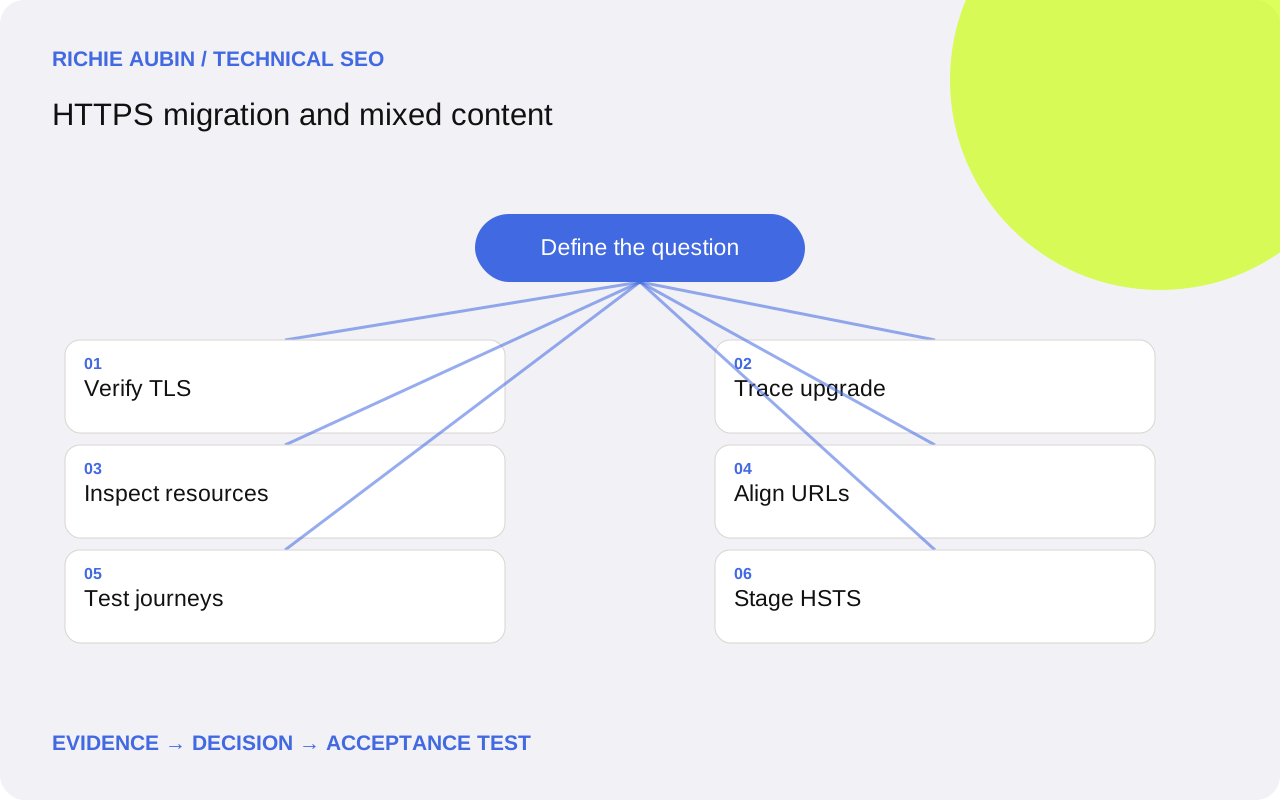
Separate transport, routing and resource failures
Three systems can fail independently. TLS establishes the secure connection and checks the certificate. Routing decides what happens to the old HTTP address. Resource loading determines whether the secure page can fetch scripts, styles, media and data. A working redirect says nothing about whether a blocked script has removed the booking form.
Classify the visible symptom before changing settings. A certificate warning occurs before an ordinary page response. An endless redirect suggests conflicting protocol decisions. A page that loads but lacks styling or functionality needs a network and console investigation. An HTTP URL in a search report can reflect older processing rather than a live transport fault.
Keep these categories separate in incident records. Otherwise a single “HTTPS issue” ticket can move between teams without anyone owning the failing layer. Include the exact URL, browser, timestamp and whether the failure happens on a fresh visit or only after an earlier session.
Establish reliable TLS on every required hostname
Inventory the public names that must serve content or redirects, including www, bare-domain, static assets and old subdomains. Confirm certificate coverage, chain presentation, renewal ownership and monitoring with infrastructure specialists. An old HTTPS address needs a valid connection before it can send visitors to a new location.
Test the public delivery path, not only the origin server. CDN configuration and hostname routing can differ from the application environment. Check relevant network locations where the service uses regional delivery, and ensure renewal does not depend on an employee remembering a manual task.
A certificate test is necessary but incomplete. It does not confirm that a form action is secure, that a legacy API supports HTTPS or that the page's canonical uses the preferred scheme. Keep transport acceptance alongside separate content and application checks. For a simultaneous hostname change, include the additional ownership work in the domain migration guide.
Make HTTP requests converge on the intended HTTPS page
Map old HTTP pages to their HTTPS equivalents and combine host or path changes deliberately. Where possible, send a request directly to its final public URL rather than upgrading protocol, changing hostname and renaming paths in separate hops. Preserve query values that affect the page or a legitimate application journey.
Test a matrix of host and scheme variants against the same destination. If HTTPS redirects back to HTTP, or repeatedly to itself, inspect proxy and application assumptions about the original scheme. The chain and loop workflow explains how to capture the full sequence instead of reporting only the last error.
Include non-GET routes in a separate functional review. Form submissions, uploads and callbacks can depend on method and body handling. Do not assume a sitewide rule intended for article visits is automatically safe for every endpoint. Agree permanent routing behaviour with the developer responsible for those flows.
Trace mixed content to the initiating reference
Mixed content occurs when a securely loaded page requests resources over an insecure protocol. Browsers may upgrade some requests and block others. That means a visually complete page is not proof that the references are correct, while a missing resource may result from a failed upgrade rather than a missing file.
Use browser network tools and the console to identify the requested URL, initiating document or script, resource type and observed outcome. Inspect template HTML, CSS URLs, responsive image candidates, embedded frames, API requests and third-party widgets. Search generated output as well as CMS content; an obsolete base URL may be assembled at runtime.
The evidence checklist should include affected page families, insecure reference locations, whether the secure resource exists and who controls it. Fix the originating reference to a working secure endpoint where possible. If a supplier cannot serve a required resource securely, replacing or removing that dependency may be necessary. A simple scheme substitution is not a fix if the HTTPS endpoint fails.
Align canonical references and search discovery
Update internal navigation, contextual links, sitemap entries and canonical references to the intended HTTPS URLs. Check language alternates and document references too. Do not let a secure page advertise HTTP as preferred through an old template setting. The canonical guide covers diagnosing disagreements among URL signals.
Submit a sitemap containing the new preferred public URLs and inspect representative destinations. A protocol-only migration does not use Google's Change of Address tool. Verify the appropriate Search Console coverage so you can observe the transition, but do not confuse property setup with implementing the move.
Check public response headers for inherited restrictions and test an invented address. Application fallbacks can return a successful secure shell for a missing page, concealing errors that existed before the protocol move. HTTPS is a delivery property; it does not make thin, empty or unavailable content indexable, and it cannot guarantee search inclusion.
Illustrative example: a secure page loses its enquiry form
Illustrative example: a service page loads over HTTPS and its main images appear, but the enquiry form remains blank. One explanation is mixed content, another is a restrictive content policy, and a third is a vendor script error. The page's secure address does not distinguish them.
Inspect the network request initiated by the form module. If it requests an HTTP script and the console identifies mixed-content blocking, confirm whether the same vendor endpoint works over HTTPS. If it does, update the vendor configuration and retest in a clean session. If the endpoint loads but the form still fails, inspect subsequent requests and application errors instead of declaring the transport change complete.
Acceptance follows the entire journey: the form appears, validates, submits securely and reaches the confirmation state under expected consent conditions. The example describes a plausible diagnostic process, not a measured incident or an assurance that every missing form has the same cause.
Introduce HSTS as a separate operational decision
HSTS tells browsers to use HTTPS for future requests to the host. It can also apply to subdomains when configured that way. Treat it as a security policy with infrastructure ownership, not an SEO checkbox. Establish reliable HTTPS coverage and renewal before extending the commitment.
Inventory dependent subdomains before using includeSubDomains. A legacy service on a subdomain may be outside the website team's release plan but still affected by the policy. Preloading has additional requirements and persistence implications; assess it separately with the security and infrastructure owners rather than adding it to an untested first deployment.
Rollback planning must recognise browser memory. Removing a header does not immediately erase a previously stored policy in every client. Reverting the site to HTTP can therefore leave users unable to connect. Prefer restoring secure service and repairing the failing resource or route over treating an HTTP downgrade as a routine recovery option.
Require evidence from browsers and public responses
Developer acceptance should require valid public TLS for required hosts, approved HTTP-to-HTTPS routes, consistent preferred URLs and working critical resources. No mixed-content fault may prevent essential text, navigation or transactions. Require successful browser journeys for forms, downloads and embedded services, alongside automated response and reference checks.
Document test limits. A static crawl may miss a resource loaded after consent or interaction. A returning browser may mask server routing through HSTS. A successful secure endpoint may still be rejected by a separate cross-origin or content-security policy. Test competing explanations instead of labelling every blocked request as mixed content.
Keep a versioned release and focused recovery plan for templates, vendor settings and edge rules. Revert the narrow faulty change where safe while preserving the secure connection. Monitor certificate renewal and recurring insecure references after launch. The migration checklist helps keep these continuing responsibilities visible beyond the protocol switch.
Frequently asked questions
Is an ordinary link to an HTTP page mixed content?
An ordinary navigation link differs from embedding an insecure resource inside the secure page. Review both, but classify them correctly. Prefer secure destinations where available and check downloads separately. A blanket search for HTTP strings needs context because not every match triggers a mixed-content request.
Why do some HTTP images still appear on an HTTPS page?
The browser may have upgraded eligible requests to HTTPS. Inspect the network evidence and original reference rather than assuming the old URL is harmless. Correct the source reference to a tested secure resource so behaviour does not depend on automatic upgrading or particular browser conditions.
Will redirecting the HTTP asset fix a blocked script?
Do not rely on that. A browser can block an insecure request before the server has an opportunity to return its redirect. Reference the working HTTPS resource directly, then test the script and its subsequent dependencies in the affected page state.
Should we use Change of Address for HTTPS?
No. Google distinguishes a protocol change from a qualifying domain or subdomain move for that tool. Implement the secure URLs and redirects, update references and monitor the relevant properties. An administrative submission is not required to make a protocol-only move function.
Can we reverse HTTPS if a vendor integration breaks?
Repair or replace the integration where possible. An HTTP downgrade can conflict with stored browser policy and expose additional operational problems. Plan recovery before introducing HSTS, especially subdomain coverage or preloading, and keep secure delivery available while addressing the specific failure.